Two million wildebeest, the Ngorongoro Crater's dense wildlife bowl, and river crossings that define what a safari can be — timed precisely, by people who track the herds year-round.
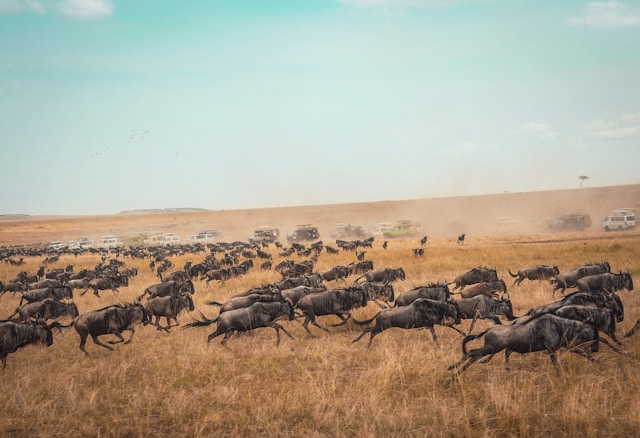
The Great Migration isn't a single event — it's a year-round movement across nearly 30,000 square kilometers. Our Tanzania-based team monitors herd positions weekly through the season, so your camp placement and game-drive routes are built around where the action actually is, not where it was last year.
Every Tanzania itinerary can be seamlessly extended with a Zanzibar beach finale, a Kenya Maasai Mara crossover, or combined into our Grand East Africa journey.
We operate exclusively across Uganda, Kenya, Tanzania, Zanzibar and the Seychelles — deep, focused local expertise rather than a continent-wide generalist operation.
East Africa & Indian Ocean Islands — Paramount Gorilla Expeditions's area of specialization
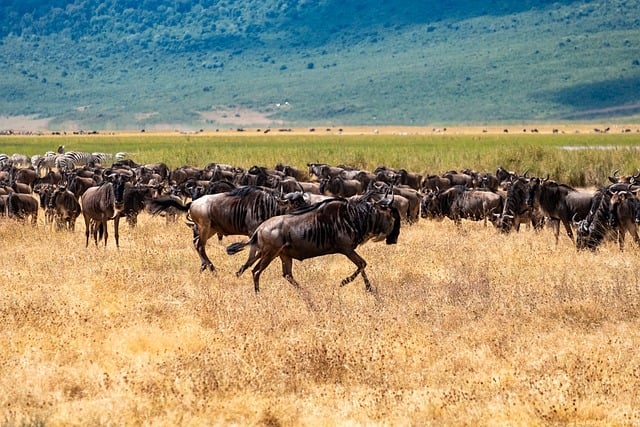
1.5 million wildebeest moving in a single, unbroken circuit across endless plains.
Tanzania's oldest and most famous national park, and the stage for the Great Migration's most dramatic chapters — from the short-grass calving plains in the south to the Mara River crossings in the north.
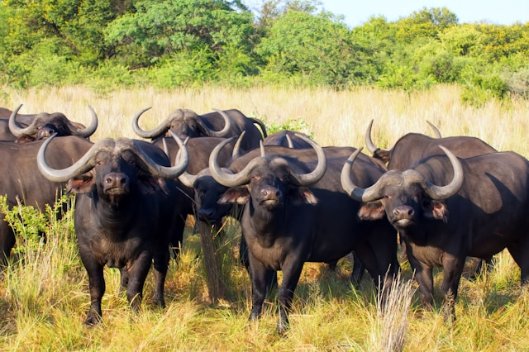
One of the densest concentrations of wildlife on Earth, inside a single volcanic caldera.
Technically a multi-use conservation area rather than a national park — Maasai communities graze livestock here alongside the wildlife — the Ngorongoro Crater floor holds an estimated 25,000 large animals within just 260 km², including a resident black rhino population.
Ancient baobabs and Tanzania's largest elephant herds outside the Serengeti ecosystem.
Often skipped by first-time visitors rushing to the Serengeti, Tarangire rewards a full day or two with some of the highest elephant densities in Africa and a landscape defined by centuries-old baobab trees along the Tarangire River.
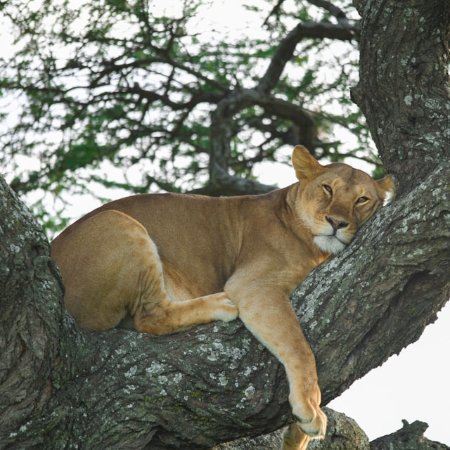
Tree-climbing lions, flamingo-lined shallows and groundwater forest, all in a compact half-day park.
Wedged beneath the Rift Valley escarpment, Lake Manyara packs groundwater forest, acacia woodland, and an alkaline lake shoreline into a small, easily combined park — best known for its lions' unusual habit of resting in tree branches.
Africa's largest protected wilderness — boat safaris on the Rufiji River, wild dog, and near-zero crowds.
Formerly part of the Selous Game Reserve and renamed Nyerere National Park in 2019, this southern-circuit wilderness is roughly the size of Switzerland and one of the continent's best remaining strongholds for African wild dog, alongside boat- and walking-safari options rarely available up north.
A living guide our local specialists update every season — use it to choose your travel window park by park.
Raised platform suites overlooking a floodlit watering hole in the heart of the Serengeti.
Chandeliered suites perched directly on the caldera edge, with private butlers throughout.
A working 1929 coffee farm on the crater's outer slopes — Tanzania's oldest guesthouse.
Best positioned for the January–March calving season, when predator action peaks.
Seronera Valley for resident big cats and river-crossing approach routes.
Positioned for the dramatic June–September Mara River crossings.
“Book Paramount Gorilla Expedition, you won't regret it.”
“Kenny is an outstanding guide, absolutely lovely, lots of knowledge about the country, the people who live here.”
A short flight connects the northern Serengeti circuit to Zanzibar in under two hours — see our combined itinerary for the seamless route.
View Combined ItineraryJanuary to March for the calving season in the southern Serengeti, and June to July for the dramatic Grumeti and Mara river crossings in the north.
Yes — a short domestic flight connects the northern Serengeti circuit to Zanzibar in under two hours, making a combined safari-and-beach itinerary seamless.
We recommend a minimum of 6–7 days to properly cover Ngorongoro Crater and both central and northern Serengeti, with flexibility to chase crossing activity.
In-depth, regularly updated guides to Tanzania's parks, circuits and planning essentials:
Many guests add gorillas in Rwanda or Uganda, or the Maasai Mara, to the Serengeti. Start with our multi-country guide, or choose a ready-made route:

.jpg)

.jpg)
.jpg)
.jpg)