
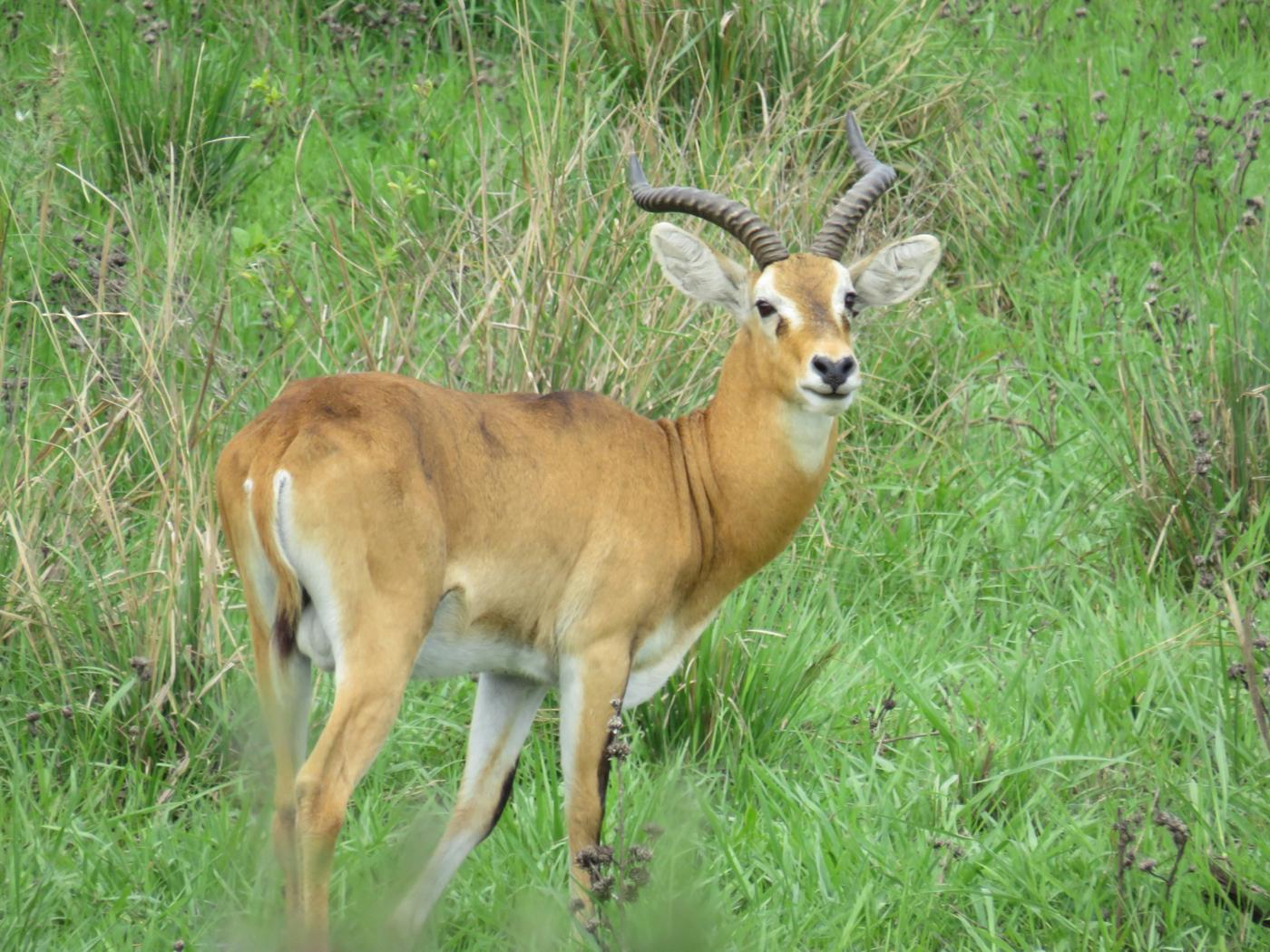
The little five animals are the elephant shrew, the buffalo weaver, the leopard tortoise, the antlion and the rhinoceros beetle. Each is named after a member of the Big Five, and together they give you a reason to look down, stop the vehicle and slow your safari to walking pace. The list is a travel nickname, not a scientific group, and it is used across Africa. This guide covers what each animal really is, which species you can find in Kenya, Tanzania, Uganda and Rwanda, how guides locate them, how to photograph them, and where the popular facts about them are wrong. People also search for it as Africa's little five, little 5 animals, small five safari, the little five facts for kids and little five vs big five.
Quick answer
What are the little five animals? They are the elephant shrew (now usually called a sengi), the buffalo weaver, the leopard tortoise, the antlion and the rhinoceros beetle. Each takes its name from a Big Five animal: the sengi's long nose recalls an elephant's trunk, the leopard tortoise's shell is spotted like a leopard, the antlion's larva ambushes prey like a lion, the beetle's horn recalls a rhino's, and the buffalo weaver is a bird tied to buffalo country. The list is informal. In East Africa the buffalo weaver and leopard tortoise are the easiest to find, the antlion and beetle take patient looking, and the sengi is the hardest.
The little five at a glance
| Elephant shrew (sengi) | Buffalo weaver | Leopard tortoise | Antlion | Rhinoceros beetle | |
|---|---|---|---|---|---|
| Named after | Elephant | Buffalo | Leopard | Lion | Rhino |
| What it is | Small mammal, order Macroscelidea | Bird, family Ploceidae | Reptile, one species | Insect, family Myrmeleontidae (the larva is the "lion") | Insect, subfamily Dynastinae |
| Scientific name in East Africa | Several, for example Galegeeska rufescens, Rhynchocyon petersi | Dinemellia dinemelli, Bubalornis niger | Stigmochelys pardalis | Many species; large African genus Palpares | Oryctes boas is the widely recorded one |
| Size | Most species 10 to 30 cm; the largest about 700 g | White-headed 17 to 19 cm, 57 to 85 g | Shell about 40 cm, about 13 kg | Pit about 5 cm deep, 7.5 cm wide | Oryctes boas typically 30 to 40 mm |
| IUCN status | Least Concern to Endangered, by species | Least Concern | Least Concern (2015 assessment) | Not tracked species by species | Not tracked species by species |
| Where in East Africa | Dry bush (rufous sengi), coastal and mountain forests (giant sengis) | Dry savanna of Kenya and Tanzania, and the dry north of Uganda | Savanna and bush across the region | Dry sheltered sand | Wherever there is rotting wood and compost |
| Lifespan | About 2.5 to 4 years in the wild | Not well documented | Many decades; matures at 12 to 15 years | Larva months to several years; adult about 25 days | Not well documented |
| Chance of a sighting | Low | High in the right habitat | Fair to good | Fair if you know where to look | Fair, mostly after dark |
Chapter 01 — What are the little five animals?
What are the little five animals? They are five small creatures that safari guides and lodges promote as a companion to the Big Five: the elephant shrew, buffalo weaver, leopard tortoise, antlion and rhinoceros beetle. Each shares a name with one of the five large animals, and between them they cover a mammal, a bird, a reptile and two insects.
The idea is simple. A Big Five checklist rewards speed, because you drive fast between sightings of large animals. A Little Five checklist rewards slowness. You walk, you stop at a sandy bank, you scan a thorn tree for a nest, and you wait. That is why it works so well on a walking safari, from a camp, or on a family trip where children get bored between lion sightings.
Not every list agrees. Some lodges swap the beetle for a dung beetle or mention a different weaver or tortoise, and some add an "extra" animal. The five used here are the ones most commonly listed, and the page follows the species you can actually meet in East Africa. For the large animals they are named after, see our guide to where to see the Big Five, the Big Five against the Big Nine and Kenya's Big Five safari.
Chapter 02 — Where did the term "Little Five" come from?
Who invented the Little Five? Nobody has documented it. The term followed the commercial success of the Big Five in southern African safari marketing, and the usual account says conservationists promoted it to draw attention to smaller animals. No person, lodge, year or place has been attached to that account, and tourism sites repeat it from one another.
This is worth saying plainly because many pages state an origin as fact. What can be said safely is this. The Big Five is the older idea. It began with big-game hunters and names the five animals that were hardest to hunt on foot: lion, leopard, elephant, African buffalo and rhinoceros. Accounts differ on whether "hardest to hunt" or "most dangerous" is the better description, and none of them names the person who coined it. The Little Five is a later, informal echo of it, and the five animals are chosen by tourism, not by any scientific or conservation authority.
That is not a reason to dismiss the list. A nickname that makes people look at an antlion pit or a weaver colony is doing useful work. It only means you should not read any single Little Five list as official.
Chapter 03 — Little Five vs Big Five
How are the Little Five different from the Big Five? The Big Five are large mammals that are hard to hunt or dangerous on foot. The Little Five are small animals named after them, from four different animal groups, chosen for charm, not danger. You find the Big Five by driving. You find the Little Five by walking and looking closely.
| Big Five animal | Little Five counterpart | Why the name fits |
|---|---|---|
| Elephant | Elephant shrew (sengi) | Long, mobile snout like a tiny trunk; the sengi is also, genetically, closer to elephants than to shrews |
| Buffalo | Buffalo weaver | The white-headed species follows buffalo and feeds on the insects they disturb |
| Leopard | Leopard tortoise | Bold black blotches on yellow, like a leopard's rosettes, on young animals |
| Lion | Antlion | The larva waits at the bottom of a pit and seizes its prey, an ambush hunter |
| Rhinoceros | Rhinoceros beetle | A male's curved horn on the head or thorax |
The comparison is a memory aid, not biology. A leopard tortoise is not related to a leopard, and the sengi's link to elephants is a real evolutionary one that the nickname only accidentally hints at. If you want the large cats themselves, our planned guides to leopards in East Africa and the Ugly Five cover them next to this one.
Chapter 04 — The elephant shrew (sengi)
What is an elephant shrew? An elephant shrew, now more often called a sengi, is a small insect-eating mammal of Africa with a long flexible snout, long legs and fast, hopping movement. Despite the name it is not a shrew. It belongs to Afrotheria, the group that also holds elephants, tenrecs and golden moles, and it is placed in its own order, Macroscelidea.
The name "sengi" comes from Bantu languages and was proposed as the standard English name by the zoologist Jonathan Kingdon in 1997. "Elephant shrew" is the traditional name and it is still the one on most Little Five lists. Researchers placed the group in Afrotheria in 1998, which is why a sengi's nearest relatives are not shrews at all.
Which sengis live in East Africa? There is no single "Little Five" sengi. East Africa has several, and which one you meet depends on the habitat:
| Species | Where | Habitat | IUCN Red List |
|---|---|---|---|
| Rufous sengi, Galegeeska rufescens | Kenya, Tanzania and Uganda, also Ethiopia, Somalia and South Sudan | Dry savanna and dry shrubland | Least Concern (2015) |
| Black-and-rufous sengi, Rhynchocyon petersi | Kenya and Tanzania | Lowland and montane forest, including the Eastern Arc Mountains | Least Concern (2016) |
| Golden-rumped sengi, Rhynchocyon chrysopygus | Kenya only, in and around Arabuko-Sokoke on the north coast | Coastal forest | Endangered (2015) |
| Four-toed sengi, Petrodromus tetradactylus | Kenya and Tanzania, and across central and southern Africa | Forest, woodland and thicket | Least Concern (2015) |
| Grey-faced sengi, Rhynchocyon udzungwensis | Tanzania only, in the Udzungwa Mountains | Montane forest | Vulnerable (2015) |
The grey-faced sengi is the one that shows how much was left to find. Camera traps photographed it in 2005, and the species was formally described in 2008. It is the largest of all sengis, averaging around 700 g, and it lives in about 300 km² of forest in the Udzungwa Mountains, which is a small range for a mammal that size.
What does a sengi do all day? It feeds, mostly on insects, spiders, centipedes, millipedes and earthworms, and some species also take seeds, fruit and young leaves. Most species are active in daylight. Many keep a network of cleared pathways through the leaf litter, which they patrol for food and use as escape routes. Many live in monogamous pairs and defend a territory marked with scent glands. Sengis are quick, with speeds near 29 km/h recorded for the group, and they live about two and a half to four years in the wild.
Can you see one on safari? Rarely, and almost always as a flash. Sengis are wary, well camouflaged and quick to bolt at a noise. The realistic chances are the rufous sengi in dry bush, seen as a small, sandy-brown animal bounding along a trail with its nose twitching, and the giant sengis of coastal and mountain forests for travellers who go to those places on purpose. If you want to spend a morning looking, choose stony or sandy ground with low bush, stay quiet and let your guide find the trail. Treat any sengi as a bonus, not a target. On the usual Kenya and Tanzania savanna circuit it is the one of the five most likely to stay a checklist gap, and that is part of its appeal.
Chapter 05 — The buffalo weaver
What is a buffalo weaver? A buffalo weaver is a stocky, noisy bird of dry savanna, in the weaver family Ploceidae, that builds huge untidy nests of thorny sticks in colonies. Three species carry the name: the white-headed (Dinemellia dinemelli), the red-billed (Bubalornis niger) and the white-billed (Bubalornis albirostris).
The name is explained by the white-headed species' habit of feeding around African buffalo and taking the insects they disturb. It is the Little Five bird because of that link, and because the nests are as hard to miss as the animal.
Which buffalo weavers live in East Africa?
- White-headed buffalo weaver (Dinemellia dinemelli): Kenya, Tanzania and Uganda, plus Ethiopia, Somalia and Sudan. A white head and underparts on a brown back, with a red rump and a heavy bill. It is 17 to 19 cm long and weighs 57 to 85 g. It lives in savanna, shrubland and acacia thickets.
- Red-billed buffalo weaver (Bubalornis niger): eastern and southern Africa, in dry savanna and sparse woodland, often near people and livestock. A black bird with a red bill, 21 to 25 cm long, males averaging 82 g.
- White-billed buffalo weaver (Bubalornis albirostris): a species of much of Africa south of the Sahara, in open country, scrub and cultivation.
All three are Least Concern on the IUCN Red List (BirdLife assessments, 2016 and 2018).
What are the nests like? The nests are the reason this bird makes the list. A white-headed nest is an oval mass of pushed-together, not woven, material about 570 mm wide, with a short entrance tube pointing downward, built 2 to 4 metres above the ground. Thorny branches form the outside and soft material lines the inside, and one large tree can hold several nests. Red-billed weavers build the largest: an enormous heap of thorny twigs divided into lodges, each with several chambers, and each chamber holds a smaller nest of grass, leaves and roots, usually built by the female. Raptors build above them: white-backed vultures and bateleurs often nest on top of red-billed colonies, and African pygmy-falcons use the white-headed nests.
How do they breed? White-headed weavers are monogamous. They breed with the rains, and a female lays three to five eggs and incubates them for 11 to 14 days while both parents feed the chicks. Red-billed weavers are different. A male controls between one and eight nest chambers shared with up to three females, and the dominant male controls the most. Males have a small, phallus-like structure, about 1.5 cm long, which is unusual in birds and larger in males that live in colonies than in solitary ones. Females lay two to four eggs and incubate them for about 14 days. Young birds leave the nest at 20 to 23 days.
What do they eat? Insects first: beetles, butterflies, crickets, locusts, grasshoppers, caterpillars, weevils, ants and spiders, plus seeds and fruit. They forage mostly on the ground, white-headed birds in small groups of three to six, often alongside starlings.
How do you find them? Look for the nest, not the bird. In dry acacia country a bulky mass of sticks in a thorn tree is almost always a weaver colony, and the birds are loud around it. Early morning and the hour before dusk are best, when they are feeding on the ground and the nests are lit from the side. Because breeding follows the rains, nest activity is busiest after the rains begin. If you are a birder, our East Africa birding guide places them among the dry-country species worth stopping for.
Chapter 06 — The leopard tortoise
What is a leopard tortoise? The leopard tortoise (Stigmochelys pardalis) is a large, high-domed land tortoise of the African savanna, named for the black spots and blotches on the shell of young animals. It is the only species in its genus and occurs from South Sudan and Somalia across East Africa to South Africa and Namibia. It is the Little Five counterpart of the leopard.
How big is it and how long does it live? A typical adult has a shell about 40 cm long and weighs about 13 kg. Adults in the far north and far south of the range are larger, with typical weights up to 20 kg, and an exceptional animal can reach 70 cm and 40 kg. Maturity comes at around 12 to 15 years. Many pages state a lifespan of 80 to 100 years, but that figure rests on a single zoo source, and no study of wild tortoises backs it, so "many decades" is the safe description.
What does the shell tell you? Young animals and young adults are yellow with bold black blotches, spots, dashes or stripes. Mature adults fade to plain brown or grey. The tortoise's head and legs are yellow, tan or brown. Counting rings on the shell scutes is a popular way to "age" a tortoise, but growth rings are not a reliable clock, and our guides do not rely on them.
What does it eat, and how does it breed? It is a grazer. Grasses, forbs, thistles and succulents make up most of its diet, plus fruit and berries when it finds them, and it sometimes gnaws bone or eats ash or hyena droppings for the calcium. Seeds pass through undigested, so it spreads plants as it walks. A female digs a nest hole and lays 5 to 30 eggs per clutch, and she may lay up to five to seven clutches in a season. Incubation takes 8 to 15 months depending on temperature. Eggs and hatchlings are taken by rock monitors, puff adders, jackals and crows. Adults have few predators, though lions and hyenas have occasionally taken them. Males fight over females by ramming and butting, and they grunt while mating.
Is it threatened? It is Least Concern on the IUCN Red List (2015 assessment), and it is described as widespread and common through most of its range. The threats listed are agricultural burning, harvesting for food and, most of all, the pet trade. It has been in CITES Appendix II since 1975, and most tortoises exported from Kenya and Tanzania come from captive breeding. Never take one from the wild and never buy one as a souvenir.
Where do you see one? Leopard tortoises live in grassland, thorn scrub and brushland from sea level to about 2,900 metres, and they are diurnal, so you meet them on tracks and open ground in daylight. They are slow, so a tortoise on a track is a good reason for a vehicle to stop. The surest way to see one is on foot or on a slow drive, and you will almost always see more of them on a walking safari than from a vehicle moving between sightings. Treat any tortoise with respect: do not pick it up or move it, give it room, and never put it in the vehicle.
Chapter 07 — The antlion
What is an antlion? An antlion is an insect of the family Myrmeleontidae, in the order Neuroptera, whose larva ambushes ants and other small prey. The family holds about 2,000 species worldwide. The larva is the "lion". The adult looks like a lacewing, with two pairs of long, narrow, veined, translucent wings, a slender body and clubbed antennae.
Why "doodlebug"? In North America the larvae are called doodlebugs because their wandering spiral tracks across sand look like doodles. The meaning of "antlion" itself is uncertain, but ants form much of the diet and "lion" is usually read as destroyer or hunter. The name goes back to classical antiquity.
How does the pit trap work? Only three tribes of antlions build pits: Myrmeleontini, Myrmecaelurini and Nesoleontini. The larva marks a circular groove in dry, loose sand, walks backward while using its abdomen as a plough, places sand on its head and flicks it out with a front leg. It works in a spiral from the rim to the centre, and the pit deepens until its walls sit at the steepest slope the sand can hold, called the critical angle of repose. A typical pit is about 5 cm deep and 7.5 cm across at the rim. The larva settles at the bottom with only its jaws showing.
When an ant slips in, the larva throws sand at it and undermines the walls so the sand slides and carries the prey down. It seizes the ant with hollow jaws, injects venom and digestive enzymes and sucks out the body fluids. It flicks the dry husk out of the pit afterwards. Larvae sense ground vibrations through hair tufts on the thorax, and a larva that is disturbed may play dead for a few minutes up to an hour.
Two facts that surprise people. First, the larva has no anus. Waste is stored and released as a single mass at the end of the pupal stage. Second, many antlion species do not build pits at all. Their larvae hide under leaves, debris or wood, in cracks or in tree holes, and wait there. If you see no pit in a likely spot, that is not proof there is no antlion.
How long do they live? The larval stage can last several years in some conditions and shorter when food is plentiful, and larvae can survive many months without feeding. A larva spins a cocoon of sand and silk and pupates for about a month. The adult emerges, flies feebly at dusk or night and lives about 25 days, sometimes up to 45. Some adults eat pollen and nectar and others take small insects. Among African antlions, the genus Palpares contains some of the largest.
Where do you look? Look in dry, loose sand that rain cannot reach: the base of a large tree, a sandy bank, the dust under a rock overhang, the ground under raised camp buildings, a quiet path edge. Low, slanting light shows the cone shapes best. Kneel and look closely, and approach slowly because the larva responds to vibration. A grain of sand tipped gently down the slope is enough to make a larva react. Never dig one up and never block a pit.
Chapter 08 — The rhinoceros beetle
What is a rhinoceros beetle? A rhinoceros beetle is a large, glossy, dark beetle of the subfamily Dynastinae in which the male carries a horn on the head, thorax or both. The Little Five lists give it no single species. In East Africa the widely recorded species is the African rhinoceros beetle, Oryctes boas.
What does Oryctes boas look like and where is it found? Oryctes boas is typically 30 to 40 mm long, and in a sample of 711 specimens ranged from 27 to 46 mm. Males have a long horn that curves back at the tip, and females have a very short one. It occurs across sub-Saharan Africa and is most often recorded from Tanzania to eastern South Africa, and in Madagascar. Specimens have been recorded in Kenya, Rwanda, Uganda, Tanzania, Burundi and Ethiopia, and in Zanzibar it is a coconut-palm pest.
How does it live? The larvae grow in compost heaps and other rotting plant material, and the immature stages take about 18 weeks in total in this species. Adults feed on palm fronds and other plant material, bore into palm crowns, and are mainly active at night, spending the day under logs or vegetation. When disturbed some species make a hissing squeak by rubbing the abdomen against the wing cases. In the subfamily as a whole, the males use their horns to fight other males in the mating season and for digging.
Do they really lift 850 times their weight? That claim appears on many safari sites. It is attributed to "some species" with no study named, and we cannot point to a measurement that supports it. A large beetle is strong for its size, as most beetles are, but the specific figure is a popular claim, not a reliable fact.
Is it a dung beetle? No, and the two are often confused. Giant dung beetles such as Heliocopris can reach 3 to 5 cm and a few species about 7 cm, and the males of some have horns, but they belong to a different subfamily (Scarabaeinae) and lay eggs in a tunnel under dung. Rhinoceros beetles are in Dynastinae and breed in rotting wood and compost.
Where do you find one? After dark, around camp lights and compost heaps, and under logs by day. A camp that is on the edge of a forest or has a compost heap is a better place than open plain. Ask your guide and the camp staff, who often know where the beetles turn up. Photograph them where you find them and put them back where they were.
Chapter 09 — Why the little five matter
Why look for the Little Five at all? Because they make a safari fuller. On a Big Five drive the animals are large and the gaps between sightings are long. The Little Five fill those gaps, change the pace and teach you to read the ground, the trees and the sand. They also let you understand how a savanna works: insects feed the birds, antlions and sengis take their share of the ants and other insects, a tortoise carries seeds, and a weaver colony gives raptors a place to nest.
They also suit families. A child who cannot sit through a long lion sighting will spend twenty minutes at an antlion pit. Our guides to the best age for a family safari, family-friendly safari camps and Kenya family safaris cover which ages and camps suit that pace.
And they suit walking. Many of the best places to find the Little Five are places where you can leave the vehicle. Our guide to night drives and walking safaris explains where that is allowed in East Africa, and the rules that go with it.
Chapter 10 — Where to see the little five in East Africa
Where can you see the little five in East Africa? Mostly in the dry savanna parks of Kenya and northern Tanzania, with the best odds in places where you can walk or drive slowly. Buffalo weavers and leopard tortoises are possible in most dry-country parks. Sengis are rare everywhere, and Kenya's wider wildlife picture is in our Kenya wildlife and biodiversity guide. The table gives honest odds for each country, based on habitat and range. Chances are the guide's judgement and a good guide will improve them.
| Country | Park or area | Best of the five here | Chance | Best months | Park guide |
|---|---|---|---|---|---|
| Kenya | Samburu and the dry north | White-headed buffalo weaver, leopard tortoise, rufous sengi; walks and night drives at lodges with conservancy access | Good for weavers and tortoise; low for sengi | June to October; weaver nests are busiest after rain | Samburu guide |
| Kenya | Laikipia conservancies | Weavers, tortoise, antlion pits and beetles on guided walks | Good, because walking is allowed | Dry months for walking | Laikipia guide |
| Kenya | Tsavo | Weavers, tortoise, antlion in sandy ground; walking is not standard inside the parks, so look from the vehicle and around camp | Fair | Dry months | Tsavo guide |
| Kenya | Arabuko-Sokoke Forest, north coast | Golden-rumped sengi (Endangered) | Low; needs a specialist guide | Dry months | Kenya destination page |
| Tanzania | Tarangire | Weavers, tortoise, antlion pits under trees; walking and night drives are usually possible at stays outside the park boundary | Good for weavers; fair for the rest | June to October | Tarangire guide |
| Tanzania | Udzungwa Mountains | Grey-faced sengi, other forest sengis | Very low; specialist trip | Dry months | Tanzania national parks guide |
| Uganda | Lake Mburo | Tortoise, weavers, beetle after dark, antlion on walks | Fair; walking and night drives are offered | June to August; December to February | Lake Mburo guide |
| Rwanda | Akagera savanna and the forest parks | Rhinoceros beetles are recorded in Rwanda; tortoises and savanna insects in Akagera | Low to fair | Dry months | Rwanda national parks compared |
For when to travel, our guides to the best time to visit Kenya and the best time to visit Tanzania set the dry and wet seasons, and the table's "best months" are the dry months in each. Lake Mburo is in the south-west of Uganda and has two dry seasons, which is why two ranges appear.
Where you sleep matters as much as the park. A camp with a compost heap, sandy banks and old trees in its grounds gives you the beetle, the antlion and the weavers without leaving the property. Conservancies such as the ones in Laikipia allow walking, and our Samburu and Laikipia wilderness safari is built around that slower pace, and our Tanzania family safari through Tarangire, Serengeti and Ngorongoro suits families who want to look closely. For first-timers who want the Little Five as an add-on, our first-time safari planning guide shows where to start.
Chapter 11 — How guides find small animals
How do guides find the Little Five? They look for signs. A guide scans for the round, cone-shaped pits of an antlion on dry, shaded sand, for the heap of sticks in a thorn tree that marks a weaver colony, for the trail a sengi has cleared through leaf litter, and for the slow, domed shape of a tortoise on an open track. They also know where each is likely, which is the real skill.
A few habits help you do the same.
- Slow down. Most of these animals are found at walking pace. If your driver is moving at speed between big animals, ask to stop for a nest or a pit.
- Read the ground. Dry sand under overhangs, trails through leaf litter and the bases of big trees are the places that hold antlions, sengis and beetles.
- Look up at thorn trees. Weaver nests are visible from a long way off and tell you where the birds will be at dawn.
- Visit at the edges of the day. Sengis and weavers feed in cool hours, tortoises are on tracks after cool nights, and beetles come out after dark.
- Ask the camp. Staff know where the antlion pits are in the grounds and which tree holds the weaver colony.
The Little Five also work well on a night drive. Many guides will stop for a beetle or a night insect, and the night-drive rules in our guide to night drives and walking safaris apply.
Chapter 12 — Photographing the little five
How do you photograph small animals on safari? Get low, get close and be patient. Most of the Little Five are best shot at their own eye level, with a lens that can focus close, and with enough light to use a fast shutter speed.
- Buffalo weavers: shoot the nest and the birds at dawn or late afternoon when the light comes from the side. A medium telephoto lens (200 to 400 mm) works for the nest, and a faster shutter speed keeps birds sharp when they cross the tree.
- Leopard tortoise: lie down or kneel and shoot at the tortoise's eye level, not down at the shell. The low angle, with grass in the foreground, makes a better picture than the usual top-down view.
- Antlion pit: use a macro lens or a close-focus lens, and kneel before you start, because the larva reacts to vibration. Late afternoon light shows the cone clearly.
- Rhinoceros beetle: use a macro lens with a flash or a light held to one side, and shoot at night when the beetle is active. Keep the beetle on the surface it was on.
- Sengi: use a fast shutter speed (1/1000 second or faster) and continuous focus, and keep still. The first sighting is usually brief, so be ready before you need to be.
Our safari packing list covers the gear that makes this easier, such as a lens with close focus or a small tripod.
Chapter 13 — Conservation and responsible viewing
Are the Little Five endangered? Not as a group. The buffalo weavers and leopard tortoise are Least Concern. But some sengis are not: the golden-rumped sengi is Endangered, restricted to the coastal forest around Arabuko-Sokoke in Kenya, and the grey-faced sengi is Vulnerable and found only in the Udzungwa Mountains of Tanzania. Both depend on forest, and forest loss and fragmentation are the main pressure. Where the animals are rare, your park fees and a decision to visit forest reserves carry real weight.
How to behave around the Little Five.
- Never pick up a wild tortoise, move it or take it. Collecting for the pet trade is one of the few real threats to the species.
- Do not dig up antlion larvae, block pits or tip prey into them to watch.
- Stay on tracks and paths, and do not chase a sengi for a picture.
- Do not climb into or disturb weaver colonies. Raptors and other birds use them.
- Leave beetles where you found them, and keep lights off animals for no longer than a photograph needs.
- On a walking safari, follow your guide's instructions every time.
For the wider principles, see our guide to responsible and sustainable safari travel. The IUCN Red List at iucnredlist.org gives the current status of each species named here, and the tortoise's trade status is set by CITES.
Chapter 14 — Little Five myths and mistakes
What do people get wrong about the Little Five?
- "The Little Five is an official list." It is not. It is a tourism nickname with no authority behind it, and lists vary from lodge to lodge.
- "An elephant shrew is a shrew or a rodent." It is neither. It belongs to Afrotheria, and its nearest relatives are not shrews.
- "There is one elephant shrew." East Africa has several species of sengi, from a dry-country rufous sengi to the Endangered golden-rumped sengi and the forest giants.
- "Leopard tortoises live 100 years." The figure is repeated from one zoo source. Maturity comes at 12 to 15 years and the true wild lifespan is not well measured.
- "You can read a tortoise's age from its shell rings." You cannot. The rings are not a reliable clock.
- "Rhinoceros beetles lift 850 times their weight." The figure has no study we can point to, and it is repeated without a source.
- "All antlions dig pits." Only three tribes do. Many species ambush from hiding places and leave no pit.
- "You will see all five in a day." You will not, in most places. A sengi is the one most likely to stay a checklist gap, so go for the whole pattern of small things, not a tick list.
- "Buffalo weavers weave." Their nests are pushed together from thorny sticks, not woven, and the red-billed species adds woven grass nests inside.
Chapter 15 — The Little Five for kids
What are the little five animals for kids? They are five small animals named after the Big Five: the elephant shrew, buffalo weaver, leopard tortoise, antlion and rhinoceros beetle. Kids can look for them on a walking safari, tick them off a list and learn why each has the name it does.
A good game for families is a Little Five scorecard. Give a point for each animal found, a bonus for a nest or a pit, and ten bonus points for a sengi. The scorecard turns waiting into the game, which is exactly what children need on a long safari day.
Our verdict
The Little Five is a nickname, but it is a useful one. It pushes you out of the vehicle and into a slower, closer way of watching animals, and that habit pays off on every other sighting. If you take only one tip from this guide, make it this: ask your guide to stop for something small on every drive, and spend ten minutes on it. Weaver colonies and leopard tortoises will give you easy wins, an antlion pit or a beetle will take patience, and a sengi will take luck. If you want a safari with walking, small animals and room to slow down, tell us your dates and who is travelling, and we will build the route around it.
Plan your safari with us. Tell us the month you can travel, how many days you have and who is coming, and we will reply within 24 hours with a route and a written quotation.
Request a free quotation- Where to see the Big Five in Kenya, Tanzania and Uganda
- Big Five vs Big Nine
- Night drives and walking safaris
- The Ugly Five: Africa's most misunderstood animals
- Leopards in East Africa
- Best age for a family safari