
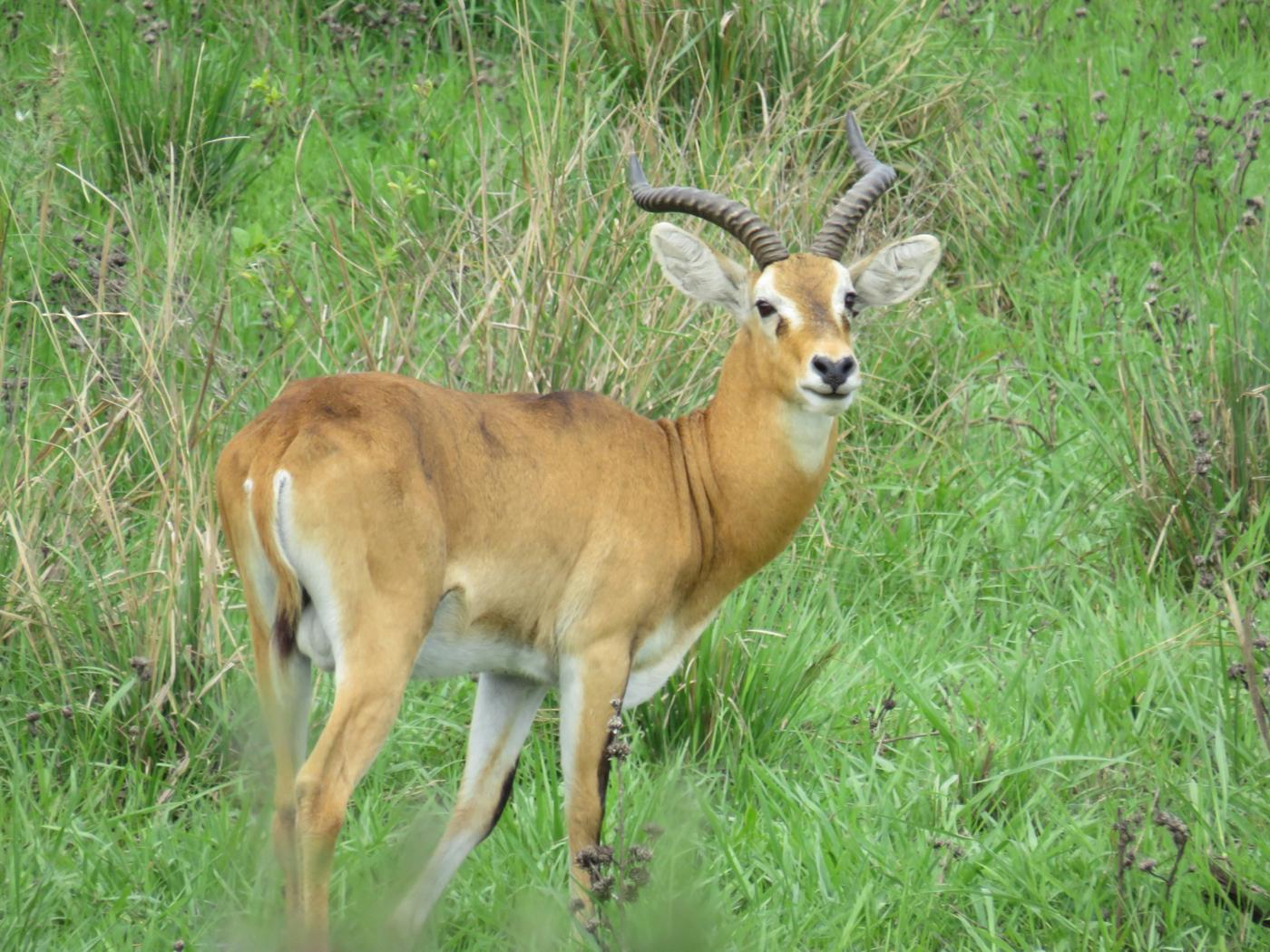
Akagera National Park is Rwanda's only savannah park and its only place to see all of the Big Five: a mosaic of lakes, papyrus swamp, open plains and forested hills in the east of the country, along the border with Tanzania. Lions came back in 2015, black rhinos in 2017, and the park is now managed by Rwanda's national parks authority together with a conservation charity. This guide explains what Akagera National Park offers, what each Big Five animal really costs you in time, what the 2025 park fees are, how a game drive, boat trip and night drive work, where to stay, when to go and how to fit Akagera with gorillas and Kigali. People also search for the same park as Akagera National Park Rwanda, Akagera safari, Akagera game drive, Akagera big five, Lake Ihema boat trip, Akagera day trip from Kigali and Akagera park fees.
Quick answer
Is Akagera National Park worth visiting? Yes, for anyone who wants a classic savannah safari in a small, calm park without the crowds of the Mara or the Serengeti. Akagera covers about 1,122 square kilometres, holds lions, elephants, buffalo, giraffe, zebra, hippos and black and white rhinos, and has nearly 500 bird species. It is about two and a half to three hours by road from Kigali, so it works as a long day trip, but one or two nights give you far better game viewing.
Akagera National Park at a glance
| Detail | |
|---|---|
| Where | Eastern Rwanda, on the border with Tanzania, along the Kagera River |
| Size | About 1,122 km²; about 2,500 km² before the 1990s reduction |
| Established | 1934 as a national park |
| Management | Akagera Management Company, a partnership between the Rwanda Development Board and African Parks, signed in late 2010 |
| Big Five | Lion (reintroduced 2015), leopard, elephant, buffalo, black and white rhino (black from 2017, white from 2021) |
| Landscape | Lakes and papyrus swamp covering about a third of the park, open plains, acacia woodland and hills |
| Birds | Nearly 500 species recorded |
| From Kigali | About two and a half to three hours by road to the south entrance |
| Entry fee (2025 list) | USD 100 per international adult per day, USD 50 for a child aged 6 to 12 |
| Best months | June to September and January to February |
| Typical stay | A long day trip, or one to two nights |
Chapter 01 — What is Akagera National Park?
Akagera National Park is a protected area in the east of Rwanda, named after the Akagera, or Kagera, River that runs along its eastern edge and feeds Lake Ihema and the smaller lakes of the park. It covers about 1,122 square kilometres, and the lakes, swamps and papyrus belts make up roughly a third of that area. African Parks describes it as the largest protected wetland in Central Africa. The rest is rolling savannah, acacia woodland and ridges of hills, which is what gives the park its mix of scenery.
For a visitor this means variety in a small space. In one morning you can watch buffalo on a grassy plain, hippos in a lake and birds in the papyrus, and in the afternoon climb a ridge for a view across the water into Tanzania. Compared with the volcano forests of the north-west, Akagera feels like another country. Our Rwanda national parks comparison puts it beside Volcanoes and Nyungwe, and our Rwanda destination page shows how the three fit into one trip.
Chapter 02 — How Akagera came back: a short history
Akagera was gazetted as a national park in 1934, and for decades it was Rwanda's savannah wildlife refuge. In 1975, 26 young elephants were moved into the park from the Bugesera area, where they were in conflict with farmers; every elephant in Akagera today descends from that group. Masai giraffes were brought from Kenya in 1986, and their descendants still live in the park.
Everything changed in the 1990s. After the 1994 Genocide against the Tutsi, the park was reduced in 1997 to make room for returning refugees and settlement, and it is now about 1,122 square kilometres against roughly 2,500 square kilometres before. Lions were hunted out of the park by the early 2000s, and the rhinos were lost to poaching. Poaching and the loss of habitat had emptied much of the wildlife.
The turning point came in late 2010, when the Rwanda Development Board and the conservation charity African Parks signed a management partnership and set up the Akagera Management Company. Rangers and fencing along the park's boundary reduced poaching, and the park began to bring back the species it had lost. African Parks reports no recorded loss of elephant, rhino or lion to poaching since 2010. In 2025 the park became financially self-sustaining, meaning that tourism and other income now cover its running costs. That is the story to keep in mind while you drive through: this is a restored park, and what you see is the result of fifteen years of careful work.
Chapter 03 — The Big Five in Akagera, and your honest odds
Akagera is the only Rwandan park with all of the Big Five, and the dates matter, because the figures that circulate online are often wrong. Lions returned in 2015, when seven were brought in, and two more males followed in 2017. Eastern black rhinos came back in 2017, when 18 were brought from Europe and South Africa, followed by five more from European zoos in 2019. In 2021, 30 southern white rhinos were brought from South Africa, and in June 2025 another 70 arrived, flown from Durban to Kigali. The Big Five were therefore complete in 2017, not in 2015 and not in 2021.
Current numbers, from the park's 2026 figures: at least 150 elephants, at least 70 lions, at least 60 leopards and at least 3,300 buffalo, up from about 882 buffalo in 2010. In total the park has introduced 100 white rhinos and 23 black rhinos, and calves of both species were born in the second quarter of 2026. A park survey in 2025 identified 106 individual elephants, about three-quarters of the herd, which shows how closely the animals are monitored.
The table sets out what we tell guests to expect. These are planning judgements, not guarantees, and no park can promise a sighting.
| Animal | Where the population stands | Our planning view |
|---|---|---|
| Buffalo | At least 3,300 | Very good; large herds are seen on most game drives |
| Elephant | At least 150 | Good; usually seen within a day or two |
| Lion | At least 70, reintroduced 2015 and 2017 | Fair; many are tracked, but the park is bush and thicket as well as plain, so allow two game drives |
| Leopard | At least 60 | Low; leopards are secretive, and a night drive improves the odds |
| White rhino | 100 introduced since 2021 | Fair to good in the areas where they were released; ask your guide for the current area |
| Black rhino | 23 introduced since 2017 | Low; black rhinos favour dense thicket and are shy |
If seeing a rhino is the main aim, read our guide to rhino tracking in East Africa, which compares Akagera with the other places in the region. For a ranking of the odds across the whole region, see where to see the Big Five, and for the difference between the Big Five and the wider list, Big Five vs Big Nine.
Chapter 04 — The two halves of the park: the lakes and the plains
Most visitors split the park into two areas, and it helps to plan around them. The southern section is where the main lakes sit, with the largest, Lake Ihema, the boat landing, the southern campsites and the hills and ridges that overlook the water. This is the area for hippos, crocodiles, waterbirds and lake views, and it is the part of Akagera that day visitors usually see.
The northern section is more open, with the Magashi conservancy, the northern campsites and Lake Rwanyakazinga, and it is the quieter half. It is further from Kigali and takes longer to reach, which is why many travellers who want to see the whole park stay one night in the north and one in the south. The two halves are connected by a road that runs through the park, and a full crossing takes a good part of a day.
Chapter 05 — Game drives: self-drive or with a guide
Most visitors do the park by game drive, and there are three ways to do it. You can drive yourself in your own or a hired vehicle, you can take a guide in your own vehicle, or you can book a park vehicle with a driver and guide.
The 2025 price list from African Parks sets these out. A foreign-registered vehicle pays USD 40 to enter. A guide for a self-drive costs USD 25 for a half day or USD 40 for a full day; a guide who is collected before 9 am and returned within five hours counts as a half day, and a guide taken through to the north gate counts as a full day. A park vehicle with a driver and guide, which holds up to seven people, costs USD 200 for a half day of up to five hours and USD 350 for a full day. Half-day game drives run from 6.30 am to 11.30 am or from 12 noon to 5 pm, and full days from 6.30 am to 5 pm.
Self-driving is easy on the main tracks, and it suits confident drivers with a 4x4, but a guide finds animals much faster, because rangers and guides share the positions of lions and rhinos by radio. We recommend a guide for your first day. Our self-drive safari guide explains the rules, the vehicles and the costs for East Africa as a whole.
Chapter 06 — The Lake Ihema boat trip
The boat trip on Lake Ihema is one of the best things to do in Akagera, and it is a different experience from a game drive. You travel by boat across the lake for about an hour, past hippo pods, crocodiles on the banks and, in the papyrus, a rich variety of birds. The lake is also one of the places where the shoebill has been seen, though sightings are uncommon and nobody should plan around one.
Scheduled boat trips run at 7.30 am, 9 am, 3 pm and 4.30 pm, and the last is the sunset trip. The 2025 price list gives USD 35 per adult and USD 20 per child aged 6 to 12 for the morning and daytime trips, and USD 45 and USD 30 for the sunset trip. A scheduled boat takes up to 29 people. A private boat costs USD 200 for up to 11 people or USD 360 for up to 18, per hour. The morning trips usually give the best bird photography, and the late trip gives the best light.
Chapter 07 — Night drives
A night drive is the best way to look for leopards and the nocturnal animals that you will otherwise miss, such as genets, civets, bushbabies and, with luck, a porcupine or an aardvark. Night drives are run by the park's management company in the south of the park and at Karenge Bush Camp. They start at 5.30 pm and finish at about 8 pm to 8.30 pm.
The 2025 price is USD 40 per adult and USD 25 per child aged 6 to 12 for about two and a half hours, in a vehicle that carries between two and twelve people. Wear warm clothing, because the evenings are cool, and keep your voices low. Our guide to night drives and walking safaris explains how night viewing works and what to expect.
Chapter 08 — Other activities: behind the scenes, walks, fishing and community visits
Akagera offers more than drives and boats, and a longer stay lets you try several. The 2025 price list includes:
- Behind-the-scenes tour: about one and a half hours with the park's staff, USD 25 per adult and USD 15 per child, with a minimum of four people, or USD 180 for a group of eight or more.
- Walk the Line: a walk of about 7 km along the park's boundary fence, taking about two hours, for USD 30 per adult and USD 20 per child, with a minimum of three people.
- Community cultural experience: a half-day visit, USD 30 per adult and USD 20 per child, with a minimum of three people.
- Fishing: USD 25 per adult per day, with your own equipment, and USD 15 for children.
The behind-the-scenes tour shows how the park manages animal tracking, anti-poaching and rhino monitoring, and it is the best way to understand what the fees pay for. The community visit connects you to the people who live around the park, and it supports the revenue-sharing programme that sends part of the park's income to local communities.
Chapter 09 — Wildlife beyond the Big Five, and birds
The Big Five are the headline, but much of the pleasure of Akagera lies in the other animals. Masai giraffes and plains zebras graze the open areas. Antelopes include impala, waterbuck, bushbuck, topi and eland, and the park is one of the few places in Rwanda where you can see roan antelope and oribi. Hippos fill the lakes, and crocodiles lie on the shores. The sitatunga, a swamp antelope, is rare and shy, and sightings are a bonus.
For birds, the park has nearly 500 recorded species, with waterbirds in the lakes and papyrus, raptors over the plains and woodland birds in the thickets. Herons, storks, ibises, eagles, kingfishers and the crowned crane are all part of the picture. Early morning is the best time, and a boat trip is the best place. If birds are your main interest, our birding safari guide shows how Akagera fits into a wider Rwanda and Uganda route.
Chapter 10 — Akagera National Park fees and prices
Park fees at Akagera are set in US dollars and Rwandan francs by African Parks and the park's management company. The table gives the entry fees from the 2025 price list, which is the latest we have published. The entry fee covers the person, not the vehicle or activities, and children under six do not pay. The fee is cut by half for the second and third nights and is free for any further nights up to a week.
| Visitor | 1 day or night | 2 nights | 3 nights |
|---|---|---|---|
| International adult | USD 100 | USD 150 | USD 200 |
| International child, 6 to 12 | USD 50 | USD 75 | USD 100 |
| Rwandan or East African citizen, adult | About USD 16 (RWF 15,000) | About USD 24 (RWF 22,500) | About USD 32 (RWF 30,000) |
| Pan-African visitor, adult | USD 50 | USD 75 | USD 100 |
Other fees: a foreign-registered vehicle USD 40, and a foreign-registered bus or overlander USD 100. Camping is USD 25 per adult and USD 15 per child per night, and USD 50 and USD 30 at the Mihindi campsite, which includes breakfast. A research or filming permit is charged separately. The park is cashless: payment is by mobile money, an online card payment, bank transfer, or Visa and Mastercard.
Cancellation is by writing only. Cancelling more than 30 days before arrival costs 20 per cent of the total due, more than 7 days before costs 30 per cent, and less than 7 days before costs 50 per cent, and after the activity was due to start the full amount is due. The park's list may change for 2026 and 2027, so the fees in force on your dates are itemised on your written quote, together with the lodge, transfers and activities.
For the cost of a whole trip, see our Rwanda safari cost guide and our Rwanda safari packages.
Chapter 11 — Getting to Akagera
Akagera is in the east of Rwanda, about 110 kilometres from Kigali. The drive from Kigali takes about two and a half to three hours to the south entrance in normal conditions, longer in the rains or after a late start, and the road is tarmac for most of the way and then a good track into the park. From Kigali International Airport the transfer is only a little longer than from the city centre. Our Kigali travel guide explains the city, the airport and the other roads out of it.
Travellers arriving by road from Uganda can cross the border at Kagitumba, near the north of the park, and enter the north without going through Kigali, and we explain the border crossing in our Uganda to Rwanda border guide. If you are coming from the Volcanoes region, plan a full travel day, and consider an overnight in Kigali to break the journey.
Chapter 12 — Where to stay in and near Akagera
Accommodation inside the park runs from basic campsites to a luxury camp. We name only the places that are currently listed as operating, and your written quote gives the rates and availability.
- Budget: campsites. The park has basic campsites, including Mihindi and Mutumba in the north, with grills and washrooms, and Mihindi has a café. Camping is cheap but you need your own equipment or the park's hire tents. Verdict: good value for self-drivers who like to be close to the animals.
- Mid-range: Ruzizi Tented Lodge. Nine solar-powered tents in the woodland on the shore of Lake Ihema, with meals included. Verdict: the easiest comfortable base for the lake, the boat trips and the southern game drives.
- Mid-range: Karenge Bush Camp. A small camp of seven canvas tents on the Kilala plains, reopened in May 2025, with night drives available from the camp. Verdict: a more remote and wilder feel than the lodges at the lake.
- Luxury: Magashi Camp. Opened in 2019 in the Magashi conservancy in the north and run by Wilderness, and the park's first luxury camp. Verdict: the most exclusive stay, best for two nights and for travellers who want to see the quieter north.
- Near the south entrance. Rhino Lodge overlooks Lake Ihema near the southern entrance, and Akagera Game Lodge can prepare lunch for non-guests if you call ahead.
If you would like a single base, choose the lake in the south. If you have three nights or more, split them between the south and the north.
Chapter 13 — Best time to visit Akagera
The park's dry seasons, from June to September and from January to February, are the best months for game viewing. Animals gather near the water, the grass is shorter, the roads are firm, and the lake boat trips are at their clearest. The wet seasons, March to May and November to December, are greener and quieter, with lower prices at some lodges, but the tracks are slower and some roads become difficult.
Birdwatchers can enjoy the park all year, and the wet season brings migrant birds and fresh green scenery. For a first visit, choose a dry month. Our Rwanda national parks comparison gives the season for each of the three parks.
Chapter 14 — Day trip or overnight?
A day trip from Kigali is possible, and some visitors do it, but it is a long day. You leave Kigali before dawn, spend about eight hours in the park, and return after dark, with about five to six hours on the road. A day trip lets you do one game drive and one boat trip, and little more.
One night is a much better plan. You arrive for a late-morning drive, take a boat trip at sunset or a night drive, and spend a second morning in the park before you leave. Two nights give you a full day without a rush, and let you try the night drive, the boat and a longer game drive. Our guide to how many days for a safari helps you set the right length for your whole trip.
Chapter 15 — Akagera and the gorillas: how to combine them
Akagera and gorilla trekking make a natural pair, because one is open savannah and the other is mountain forest. The usual order is gorillas in Volcanoes National Park first, a night in Kigali, and then Akagera for two nights to rest your legs, or the reverse. Our Volcanoes National Park guide explains the trekking, and our gorilla trekking in Rwanda page lists the permit steps.
If you have a longer trip, add Nyungwe National Park for chimpanzees and canopy walks, which we cover in our Nyungwe guide, and the shore of Lake Kivu, which we cover in our Lake Kivu guide. The order matters for the road: Akagera is east of Kigali, and the other three are west and north-west.
Chapter 16 — Sample itineraries with Akagera
These plans give an idea of how Akagera fits into a Rwanda trip, and we adjust each to your dates.
Three days: Kigali and Akagera. Day 1: arrive in Kigali and visit the city. Day 2: drive to Akagera, take an afternoon game drive and a sunset boat trip. Day 3: morning game drive, then return to Kigali.
Five days: gorillas and savannah. Days 1 to 2: Kigali to Volcanoes for gorilla trekking. Day 3: return to Kigali. Days 4 to 5: Akagera for a night drive, a boat trip and two game drives, then return to Kigali.
Seven days: Rwanda's three parks. Combine Volcanoes for gorillas, Nyungwe for chimpanzees and Akagera for the Big Five, with Kigali as the hub. See our 7-day complete Rwanda primates tour and our 3-day Rwanda gorilla express for ready-made options, and our 5-day Rwanda gorilla and golden monkey tour.
Chapter 17 — Akagera compared with Queen Elizabeth and the Maasai Mara
Akagera is often compared with the bigger East African parks, and the comparison is useful if you are choosing between them.
| Akagera | Queen Elizabeth (Uganda) | Maasai Mara (Kenya) | |
|---|---|---|---|
| Size | About 1,122 km² | Larger, with the Kazinga Channel and Kyambura Gorge | Larger, with the migration |
| Big Five | All five | Four of the five; no rhino | All five, though rhino are few |
| Crowds | Very quiet | Quiet | Busy in peak season |
| Boat trip | Lake Ihema | Kazinga Channel | None of note |
| Strength | Calm, restored, easy from Kigali | Tree-climbing lions and chimpanzee tracking nearby | The Great Migration |
Choose Akagera if you are already in Rwanda for gorillas and want a short savannah stay. Choose Queen Elizabeth if you are combining Uganda and Rwanda, and the Mara if the Great Migration is your priority. Our guides to Queen Elizabeth National Park and the Maasai Mara cover them in detail, and our Uganda vs Rwanda comparison helps you choose between the two countries.
Chapter 18 — How your visit supports conservation and communities
Akagera's revenue is a big part of how the park runs, and your fees are put to work. In 2025 about 51,769 paying visitors came to the park, up from 15,259 in 2010, and in 2024 about 45 per cent of visitors were Rwandan. Tourism earned about 97 per cent of the park's income in 2024. Ten per cent of the park's income goes to Rwanda's revenue-sharing programme, which funds projects in the communities around the park.
The park also runs eco-clubs that reach more than 2,300 students in 76 programmes a year, and a fish farm at Gishanda, opened in October 2022, that provides protein and income to local people. Rangers number nearly 100, and the six anti-poaching campaigns run in 2025 show how seriously the work is taken. A visit that includes a behind-the-scenes tour or a community experience adds directly to this. Our responsible and sustainable safari guide explains what to look for in any park.
Chapter 19 — Tips from our guides
- Spend at least one night. The best light and the best animals are at dawn and dusk.
- Take a guide on day one. Rangers share positions, and a guide finds lions and rhinos faster.
- Book the sunset boat trip. It gives the best light, and it is a calm end to a day.
- Add a night drive if you want a chance at a leopard.
- Carry a light jacket. Evenings in the park are cool, and early boat trips are windy.
- Pack binoculars. The bird life is excellent, and the animals can be at a distance.
- Bring cash for tips and small purchases, and a card for the park, which is cashless.
- Keep to the tracks and to the rules, because fines for breaking them are USD 150.
- Check the roads in the rains. The tracks can be slow from March to May and in November and December.
- Do not plan around one animal. A good safari is made of many small sightings.
- Check the date of the park's price list, because fees change from year to year.
- Ask us to plan it. We confirm the lodge, transfers, guide and fees on your written quote.
Chapter 20 — Myths about Akagera
- "Akagera has had the Big Five for decades." It has not. Lions returned in 2015 and black rhinos in 2017, after the animals were lost in the 1990s and 2000s.
- "Akagera is a small version of the Serengeti." It is a different kind of park, with lakes, hills and a quiet feel, and it does not have a mass migration.
- "You cannot do Akagera in a day." You can, but it is a long day, and one night is a much better plan.
- "You must self-drive." You do not. A park vehicle with a driver and a guide is available.
- "Rhinos are easy to see." They are not. Black rhinos in particular are shy and favour thicket.
- "There is nowhere to stay." There are campsites, tented lodges and a luxury camp.
Our verdict
Akagera National Park is the best place in Rwanda to see the Big Five and the best place to spend two relaxed days between gorillas and the city. It is a restored park, and you can feel that in the way the animals are monitored and the way the staff talk about the work. Go in a dry month, stay at least one night, take a guide for your first drive, add a boat trip and a night drive, and do not expect a rhino on demand. Tell us your dates and who is travelling, and we will plan the route and confirm the lodge, guide and fees on your written quote.
Plan your safari with us. Tell us the month you can travel, how many days you have and who is coming, and we will reply within 24 hours with a route and a written quotation.
Request a free quotation