
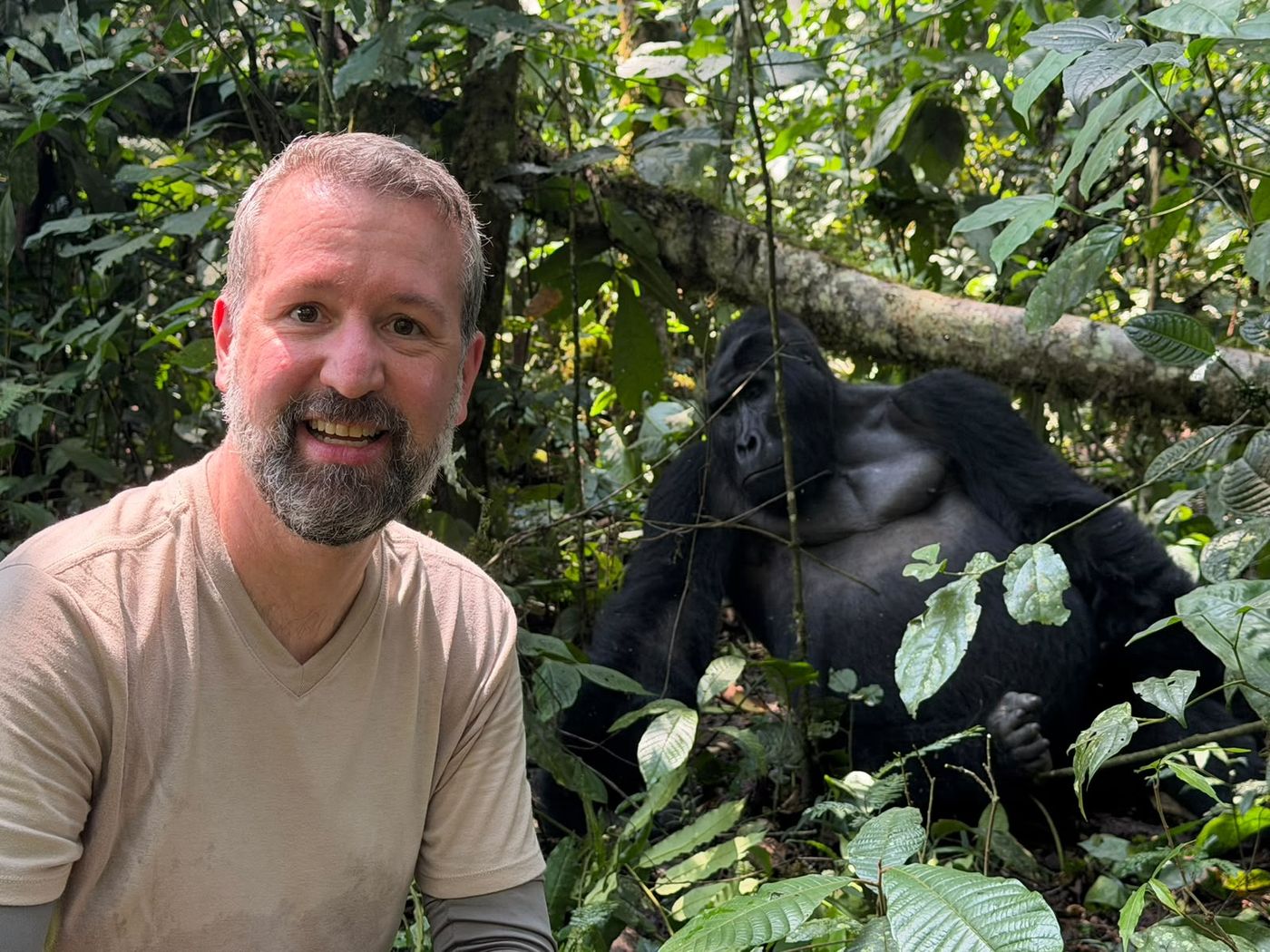
An East Africa safari that crosses four countries gives you four different kinds of wildlife encounters: mountain gorillas in the forests of Uganda and Rwanda, big cats and river crossings in Kenya and Tanzania, and a beach at the end if you want one. This guide walks through what you will actually see in each country, how the seasons change the odds, and how the pieces fit together as one trip.
Quick Answer: What You Will See on an East Africa Safari
On a multi-country East Africa safari you can expect mountain gorillas in Bwindi (Uganda) and Volcanoes National Park (Rwanda), chimpanzees and Nile scenery in Uganda, lions, leopards, cheetahs and elephants in Kenya's Masai Mara, and the Serengeti plains and Ngorongoro Crater in Tanzania. The Great Migration herds move between the Serengeti and the Mara through the year, so what you see depends on when you travel. Zanzibar or the Seychelles can close the trip with a beach.
Gorilla permits cost $800 per trek in high season and $600 in low season. Sightings are never guaranteed, and neither are permits or river crossings. We plan around the calendar, not the other way round.
At a Glance: What You See in Each Country
| Country | Main experiences | What drives the experience |
|---|---|---|
| Uganda | Mountain gorillas in Bwindi, chimpanzees, the Nile | Forest trekking, permit-led planning |
| Rwanda | Mountain gorillas and golden monkeys in Volcanoes National Park | Volcano-slope forest, short transfers |
| Kenya | Masai Mara big cats, river crossings, elephants | Open savanna game drives, migration season |
| Tanzania | Serengeti, Ngorongoro Crater, migration herds | Vast plains, caldera wildlife density |
| Zanzibar or Seychelles | Beaches, warm water, rest | Optional finish after the safari |
Uganda: Gorillas, Chimpanzees and the Nile
Most multi-country routes begin in Uganda, and for good reason. The forests here hold some of the most remarkable primate encounters in Africa, and the country's compact geography makes it practical to combine several of them.
Mountain gorillas in Bwindi
Bwindi Impenetrable National Park is the main stage. Treks begin at the trailhead of the sector your permit is assigned to, and the walk to a habituated gorilla family can take anywhere from under an hour to most of a day, depending on where the family fed and slept the night before. The terrain is steep, humid and dense. That is the point: you are inside the forest, not watching it from a vehicle.
Once you reach the family, you spend a fixed, limited time with the group. Expect to see adults feeding, juveniles playing and, with luck, a silverback keeping watch. We say "with luck" deliberately. Gorillas are wild animals, and no operator can guarantee a sighting.
Gorilla permits cost $800 per trek in high season and $600 in low season. Our Uganda-based team handles the permits, lodges and transfers, so you are not trying to secure a permit date and a lodge room separately.
Chimpanzees and the Nile
Chimpanzee tracking is a very different experience from gorilla trekking. The animals are noisier, faster and more spread out, and the best moments often arrive as sudden bursts of calling and movement in the canopy. It pairs well with a gorilla trek because the effort is lower and the rhythm is different.
The Nile adds a change of pace. Uganda's stretch of the river offers boat-based viewing and a sense of the country beyond the forest, which makes a useful break between two trekking days.
Local expert tip: Book your Bwindi trek early in the trip, not at the end. If a weather delay or logistics hiccup shifts your schedule, you want slack after the gorilla day, not before it.
Rwanda: Gorillas and Golden Monkeys in Volcanoes National Park
Rwanda sits directly south of Uganda, and a gorilla trek here feels distinct from Bwindi. Volcanoes National Park covers the slopes of a volcanic chain, with bamboo and montane forest instead of Bwindi's dense, tangled understory.
You will find mountain gorillas here as well, in habituated families that you reach on foot with a guide and trackers. The park also hosts golden monkeys, a smaller and more playful primate that makes a lighter second forest outing alongside a gorilla day.
Rwanda is a sensible choice if you want to compare two gorilla destinations in one trip, or if your route runs from Uganda toward Kenya or Tanzania and you want to add a country without a long detour. Permit costs are quoted by itinerary, season and party size, so we confirm them in your written quotation rather than guess at a figure here.
Kenya: Big Cats, River Crossings and Elephants in the Masai Mara
After the forests, Kenya opens up. The Masai Mara is open savanna, and the viewing style changes completely: you move from walking to game drives, and from close, quiet encounters to wide-angle scenes.
Big cats
The Mara is known for its lion prides, and leopards and cheetahs are part of the picture too. Cheetahs tend to use the open plains and termite mounds as lookouts, while leopards favor riverine trees and rocky outcrops. Early morning and late afternoon drives are the productive windows, when the cats are most active and the light is best for watching them.
Elephants and general game
Elephant herds, giraffes, zebra, buffalo and a long list of antelope fill out the days. As a planning rule, your best sightings will come from patient, unhurried drives, not from covering the most ground.
River crossings
When the Great Migration herds are in the Mara, river crossings are the headline event. Thousands of wildebeest gather at the water's edge, hesitate, then plunge in. It is dramatic, and it is also unpredictable. Herds can wait for hours or days, and they sometimes turn back. We never promise a river crossing, and we would be wary of any operator that does.
Migration camps in this part of East Africa run roughly $450 to $1,800+ per person per night, depending on the camp, the season and your party size. Your written quotation shows the exact figures for your dates.
For a deeper look at how the herds move through the year, see our guide to the best time to see the Great Migration.
Tanzania: The Serengeti, Ngorongoro Crater and the Migration
Tanzania is the largest piece of the circuit, and it rewards time. The Serengeti's plains stretch to the horizon, and the herds that cross into the Mara in Kenya spend much of the year moving within the Serengeti itself.
The Serengeti
The Serengeti feels different from the Mara: larger, more varied and often quieter. Depending on the month, the herds may be calving on the southern plains, moving through the central and western corridors, or heading north toward the Kenya border. Big cats are present all year, so even outside peak migration movement the game drives stay productive.
Ngorongoro Crater
Ngorongoro is a collapsed volcanic caldera, and the crater floor packs a remarkable range of wildlife into a confined space. It is not a national park in the conventional sense but a conservation area with its own rules and fees, which is worth knowing when you plan costs. A single day on the crater floor can deliver lions, elephants, buffalo, hippos and a wide variety of grazers. It is also one of the more reliable places to see large animals on a short schedule.
If you can only give Tanzania a few days, a short safari works well. Our 3-day Tanzania safari starts from about $1,045 per person, with the final price depending on season, party size and lodge tier.
Local expert tip: If your trip is short, choose between the Serengeti and Ngorongoro rather than rushing to cover both. A well-paced day in one place beats two hurried ones.
Optional Beach Finish: Zanzibar or the Seychelles
After several days of early starts, a beach finish makes practical sense. Zanzibar is the easier option from Tanzania, with a Swahili coast atmosphere, historic Stone Town and warm, shallow water. The Seychelles is farther and more secluded, a good fit if you want a honeymoon-style ending.
Neither is essential, and plenty of travelers skip the beach entirely. If you are weighing the options, read our guide to the islands of East Africa or our piece on a Seychelles safari honeymoon.
How Seasons Affect What You See
Season shapes almost every part of this trip, but not equally.
- Gorillas (Uganda and Rwanda): Trekking runs year-round. The drier months generally make trails easier underfoot, while the wetter months mean muddier paths. Permit pricing follows the same split: $800 per trek in high season, $600 in low season.
- Big cats (Kenya and Tanzania): Sightings are possible in every month. The dry season thins the vegetation and draws animals to water, which can make spotting easier.
- The Great Migration: This is the most season-dependent element. The herds are in the Serengeti for much of the year and in the Mara for a shorter window. River crossings are tied to that window and to unpredictable herd behavior.
- Beaches: Zanzibar and the Seychelles each have their own wetter and drier periods, so check them against your travel dates.
For a month-by-month breakdown, see our guide to the best time for a safari in Africa.
A Sample 14-Day Route (Example Only)
This shows how a trip could be shaped, not a fixed itinerary. Real routes are built around your dates, interests, permit availability and budget.
- Days 1 to 4: Uganda. Arrive, transfer toward Bwindi, trek to a gorilla family, and add a chimpanzee or Nile day if time allows.
- Days 5 to 6: Rwanda. Cross to Volcanoes National Park for a second gorilla trek or a golden monkey outing.
- Days 7 to 9: Kenya. Fly to the Masai Mara for big cat drives and, in migration season, a chance at river crossings.
- Days 10 to 12: Tanzania. Move to the Serengeti, then the Ngorongoro Crater.
- Days 13 to 14: Beach finish. Fly to Zanzibar to rest before heading home.
For a longer trip, our 21-day itinerary covering Uganda, Kenya, Tanzania and Zanzibar is priced at $16,900 per person. As with every trip, the final figure depends on season, party size and lodge tier.
How It Fits Together as One Itinerary
The logic of the route is simple: start in the forest, move to the plains, end on the coast. Gorilla trekking asks for fitness and patience, so doing it first means you do it while fresh. Savanna safaris are more relaxed, and the beach is a natural recovery.
The hard part is coordination. Permits are date-specific, lodges fill early in peak months, and cross-border flights need to line up with game drives. That is where a private, tailor-made trip earns its value. Our Uganda-based team handles permits, lodges and logistics, and guides you on the ground, so the pieces connect without you managing them.
If you are still deciding between Kenya and Tanzania for the savanna portion, our comparison of Kenya vs Tanzania safari sets out the trade-offs.
Design My Safari
Every trip we build is private and tailor-made. Tell us your interests, dates and budget, and our local team will shape a route around them, with permits, lodges and logistics handled for you. Prices are per person and quoted by itinerary, season, party size and lodge tier.
Design My Safari: message us on WhatsApp at +256 744 269 228, or learn more at paramountgorilla.com.