
The northern Serengeti migration is the Tanzanian half of the river story: the weeks when the herds fill the remote country around Kogatende, Lamai and Lobo and line up along the Mara River. Many travellers know the Kenyan side of the river by name and only discover the northern Serengeti when they start comparing camps. This guide places each area on the map, gives the months the herds are usually here, explains how to fly in and where to sleep, and says who should choose a different side. It forms part of our Great Migration safari guide.
Facts checked 12 October 2026. Fees, schedules and herd positions change, so we confirm them again when we quote.
Where are Kogatende, Lamai and Lobo in the northern Serengeti?
Kogatende, the Lamai Wedge and Lobo are three parts of the north of Serengeti National Park, and the Mara River runs along the top of Kogatende and the Lamai Wedge. Together they make up the country that most safari planners mean by the northern Serengeti.
- Kogatende. The area's main reference point, a ranger post lying just south of the Mara River. Tanzanian crossing areas are usually described by number, counted from here.
- The Lamai Wedge (Lamai Triangle). Isolated country bounded by the river and the Kenyan frontier. "Crossing Point Number Four", inside the wedge, has a name for being productive.
- Bologonja and Wogakuria. Quieter hills and tracks.
- Lobo. A part of the eastern side of the northern Serengeti on the route the herds use as they come up in late June and again as they stream south in November.
The Lamai Wedge lies against the Kenyan frontier, but there is no open tourist border crossing inside the ecosystem for game-drive transfers, so the wedge is reached from the Tanzanian side.
For the full list of crossing areas on both banks, including the Kenyan ones, read our guide to the Mara River crossing points. For the rest of the park, from the southern plains to Seronera, our Serengeti National Park guide covers the regions in turn.
When is the northern Serengeti migration? Kogatende Mara River crossings by month
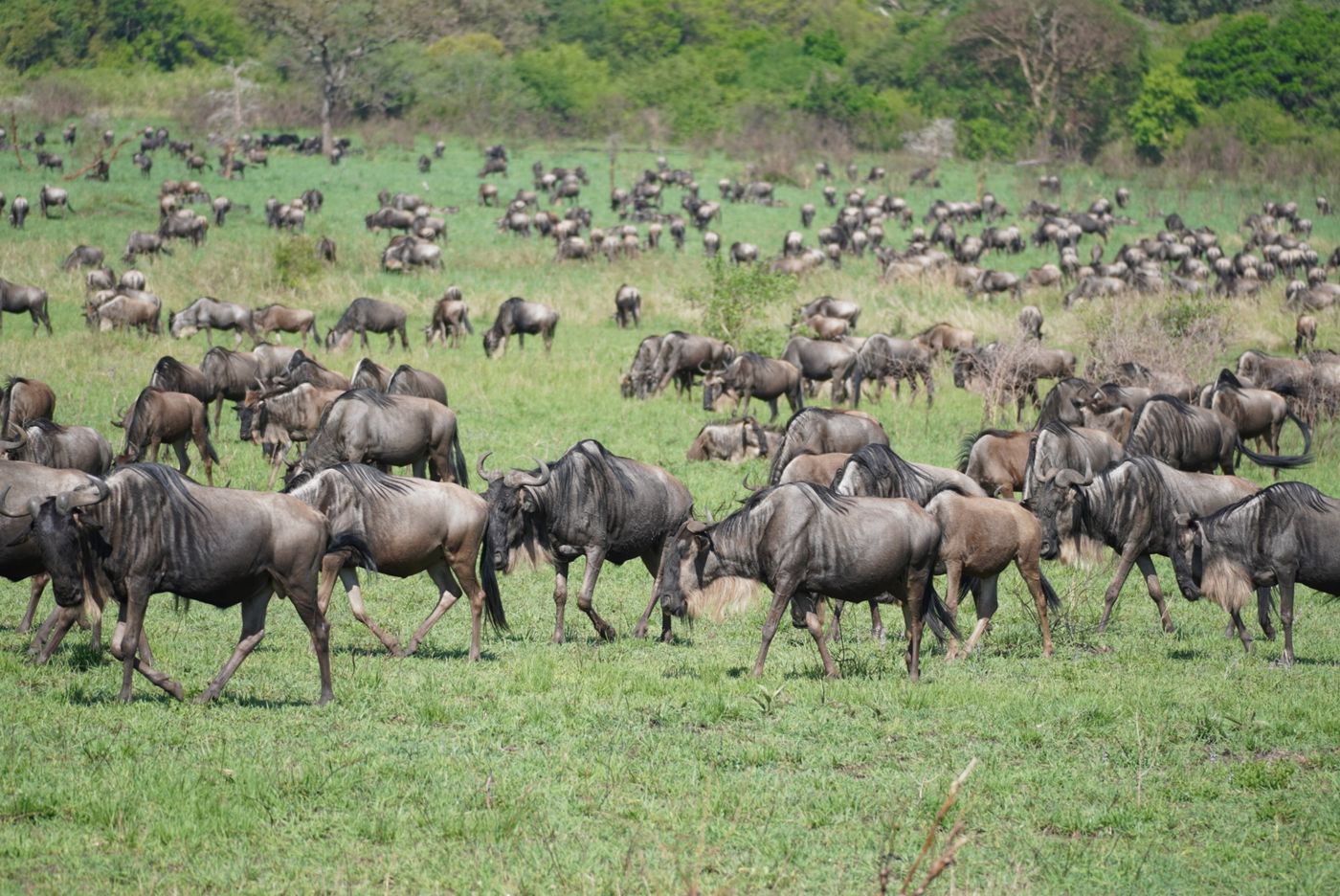
The herds are usually in the northern Serengeti from July to October, and they do not arrive in force before July. In a typical year, the first animals come up through Ikorongo and Lobo in late June, and the first Mara River crossings often come in July. Allow for the rains to push the whole schedule two to four weeks either way.
| Month | In the northern Serengeti |
|---|---|
| Late June | Part of the herd moves north through Ikorongo and Lobo. In an early year the first Mara crossings can come now, but late June is not the time to plan a river trip around. |
| July | Herds settle in the north, around Kogatende and Lamai. First crossings often come this month. The smaller Loita wildebeest population reaches the Mara around the same time. |
| August and September | Herds spread over the northern Serengeti and the Mara and cross the river many times, in both directions. Repeated crossings are likeliest from mid-August into mid-September. |
| October | Herds start drifting south. Crossings still occur, often southbound, and the animals are more scattered. Rates are lower than at peak. |
| November | Herds stream south on the eastern side. A few crossings remain possible early in the month. |
Month-by-month detail sits in our other guides. Read the Great Migration in July for the arrival, the August guide for the busiest weeks, the September guide for the quieter peak and the October guide for the southward drift.
Northern Serengeti vs Masai Mara: why choose the Tanzanian side of the Mara River
Choose the northern Serengeti if you want Kogatende Mara River crossings with fewer vehicles and a remote feel, and choose the Maasai Mara if you want the best-known Kenyan crossing scenes. Both banks see the same herds in the same weeks. The Serengeti hosts the herds for about nine months, whereas the Mara hosts them for roughly July to October.
Three differences matter in practice.
- Space. The Tanzanian crossing areas are generally quieter, so you share a crossing with fewer vehicles.
- Rules. Off-road driving, night drives and walks are not allowed in Serengeti National Park, just as they are not allowed in the main Maasai Mara reserve. If you want to leave the track, that is a reason to look at a conservancy on the Kenyan side.
- Getting there. The north is reached by light aircraft, so flights are part of the cost of the trip. We confirm every leg in your quote.
Our Serengeti vs Masai Mara migration guide settles the wider decision, including the calving season and the Grumeti. If you are weighing the Kenyan bank, read about where to sleep on the Kenyan side.
Where to stay for the northern Serengeti migration: northern Serengeti camps
Several northern Serengeti camps are tented and seasonal, so a camp can move to follow the herds. Mobile and seasonal camps move two or three times a year, whereas permanent lodges have pools and larger rooms. The question that matters most is the distance to the river. The gap between a 20-minute and a 90-minute drive is worth roughly two hours of viewing time every day.
| Style | Examples near Kogatende and Lamai | Typical peak price per person per night, sharing |
|---|---|---|
| Comfort | Seasonal tented camps near Kogatende | US$450 to US$750 |
| Premium | Lemala Kuria Hills, Olakira Camp | US$750 to US$1,300 |
| Luxury | Sayari Camp, Nomad Lamai Serengeti, Singita Mara River Tented Camp | US$1,300 to US$2,500+ |
The prices are indicative bands for peak season. Which camps are open, and where they stand, shifts each season, so the quote is where the camp, the rate and the room type are confirmed.
Seasonal camps can be placed to follow the herds, which suits travellers who put position first. Permanent lodges have pools and larger rooms. Whichever style you prefer, ask about the distance to the water before you ask about the pool.
Balloon flights over the Serengeti are weather-dependent and best booked early for peak months. Our hot air balloon safari cost guide explains the indicative price.
How to get to the northern Serengeti: flights to Kogatende and Lamai
We plan the northern Serengeti as a light-aircraft trip from Arusha or Kilimanjaro, and the flight to the Serengeti airstrips takes between one and two and a half hours. Kogatende and Lamai both have airstrips, and Seronera in the centre of the park is another.
- Luggage. Light aircraft usually allow about 15 kg per person including hand luggage, in a soft bag. Kenya and Tanzania have also banned plastic carrier bags, so pack in a soft bag without them.
- Cost. Internal light-aircraft legs often cost about US$250 to US$500 per person per leg. Internal flights are included in a package price where the itinerary lists them.
- Between Kenya and Tanzania. The Maasai Mara and Serengeti airstrips are not linked by a direct flight. A trip using both goes through Nairobi (Wilson) and Kilimanjaro or Arusha, so allow about half a day and an extra cost.
Our Tanzania Grand Migration Explorer is a 10-day itinerary from US$7,200 per person. It covers Ndutu and the southern Serengeti, central Serengeti and the northern Serengeti and Mara River, and it flies between Ndutu, Seronera and Kogatende. Its dates are built around either calving (late December to March) or the crossing weeks (late June to September). It suits travellers who want the Tanzanian side of the migration, timed for either the calving or the crossings.
How many nights do you need in the northern Serengeti?
Plan at least four nights for the northern Serengeti migration if you want a river crossing, and more if you can. A crossing is never guaranteed, and each extra night is another chance to catch a herd gathering at the bank. Fewer than four nights leave little margin for a herd that hesitates.
- Four nights. The shortest stay we recommend at the river.
- Five or more nights. Gives you room to wait out a hesitating herd and to mix river days with other game drives in the park.
- A split stay. On a longer trip, three nights in each of two places, such as Kogatende and a Mara conservancy, keeps your options open if the herds favour one bank.
If you want both banks, look at Mara to Serengeti: The Ultimate Migration Crossing Safari. It costs from US$7,600 per person for nine days, has four nights in Kenya and four in Tanzania, and fits July to October.
Booking matters as much as nights, because the camps closest to the river sell out first. For July to September, start at least 9 to 12 months out. The lead times for every month are in our booking-lead-time guide for migration safaris.
What you can and cannot do on a Lamai Wedge safari in the northern Serengeti
On a northern Serengeti migration safari you drive on the tracks with your guide, because off-road driving, night drives and walks are not allowed inside Serengeti National Park. Rules differ in private conservancies and reserves, such as the Mara conservancies in Kenya and the Grumeti reserve in the west, and we confirm what applies at each camp when we quote.
- Park fees. For a non-resident adult in 2026, the published tariff lists a Serengeti conservation fee of US$70 plus 18% VAT (about US$82.60) per 24 hours. Staying inside the park adds a concession fee of about US$60 plus VAT a night. Tariffs may change at short notice.
- What is included. Our quotes normally include accommodation, meals on safari, a private vehicle and specialist guide, park and conservation fees, airport transfers and internal flights where listed.
- What is not. International flights, visas, travel insurance with medical evacuation, balloon flights and tips. We explain the cover to buy when we quote.
Fees for 2027 are confirmed in your quote. Guide and camp-staff tips follow a rule of thumb that we explain before you travel.
Lobo Serengeti migration: the herds heading south in November
Lobo is where the northern story turns. By October the herds are drifting south, and in November they stream south along the eastern side of the park, through Lobo and eastern Serengeti, towards central Serengeti. The odd crossing is still possible early in the month, but the short rains have arrived by then.
November is low season. Lobo and the eastern side are quieter, the rates fall, and migratory birds arrive. The trade-off is plain: you give up the concentration of animals at the river for space and lower rates. If the river is your reason for coming, October is the safer month than November.
From central Serengeti, the herds continue towards the southern plains, where calving usually runs from late January to March. Our guide to how the Great Migration works follows the whole loop.
Who the northern Serengeti migration suits
The northern Serengeti migration suits travellers who value space, accept a flight in, and can give the river at least four nights. It is also a good match if you have visited Kenya before and want to see the other bank of the river.
- It suits you if you want the river without a crowd of vehicles, you can travel from July to October and you are happy with a tented camp.
- Choose the Maasai Mara instead if you want conservancy walks and night drives, a shorter flight from Nairobi, or the best-known Kenyan crossing scenes.
- Choose another month if your dates fall between December and March. The herds are then on the southern plains, and calving is the draw.
- Think again if you have fewer than four nights, or if a missed crossing would spoil the trip for you.
A Lamai Wedge safari suits patient travellers who want remote ground, and Kogatende Mara River crossings suit anyone who can give the river several days. The honest limit of this side is simple. The herds are not usually in the north before late June, and a quiet side does not make a crossing more likely. It makes each crossing quieter.
Next steps for your northern Serengeti migration
- Pick your weeks: July to October, with mid-August to mid-September the likeliest window for repeated crossings.
- Decide whether the north alone, or a split with a Mara conservancy, suits you.
- Allow at least four nights at the river and ask each camp how far it sits from the water.
- Send us your dates, party size and nationality, and we will check entry rules and flights.
- Book early for July to September, when river camps sell out first.
Plan your northern Serengeti migration safari
Tell us when you can travel and who is coming, and we will build a private itinerary around Kogatende and the Lamai Wedge, with flights and terms shown on the itinerary page.
Plan my tripKeep reading: related Great Migration guides
Mara River crossing points and timing
Where the herds cross, the likeliest weeks and how a crossing unfolds.
Where to stay in the Masai Mara for the migration
Camps and areas on the Kenyan side, by what you want to see.
Great Migration month by month
Twelve months compared, with a page for each one.
How to plan a migration safari itinerary
How many nights, which areas and in what order.
Western Corridor and Grumeti
The Grumeti River and the western herds, and who it suits.
Southern and central Serengeti
Ndutu, the southern plains and Seronera across the year.
For the whole picture, see our Great Migration safari guide. If you are ready to price a trip, Tanzania Grand Migration Explorer starts from US$7,200 per person.