
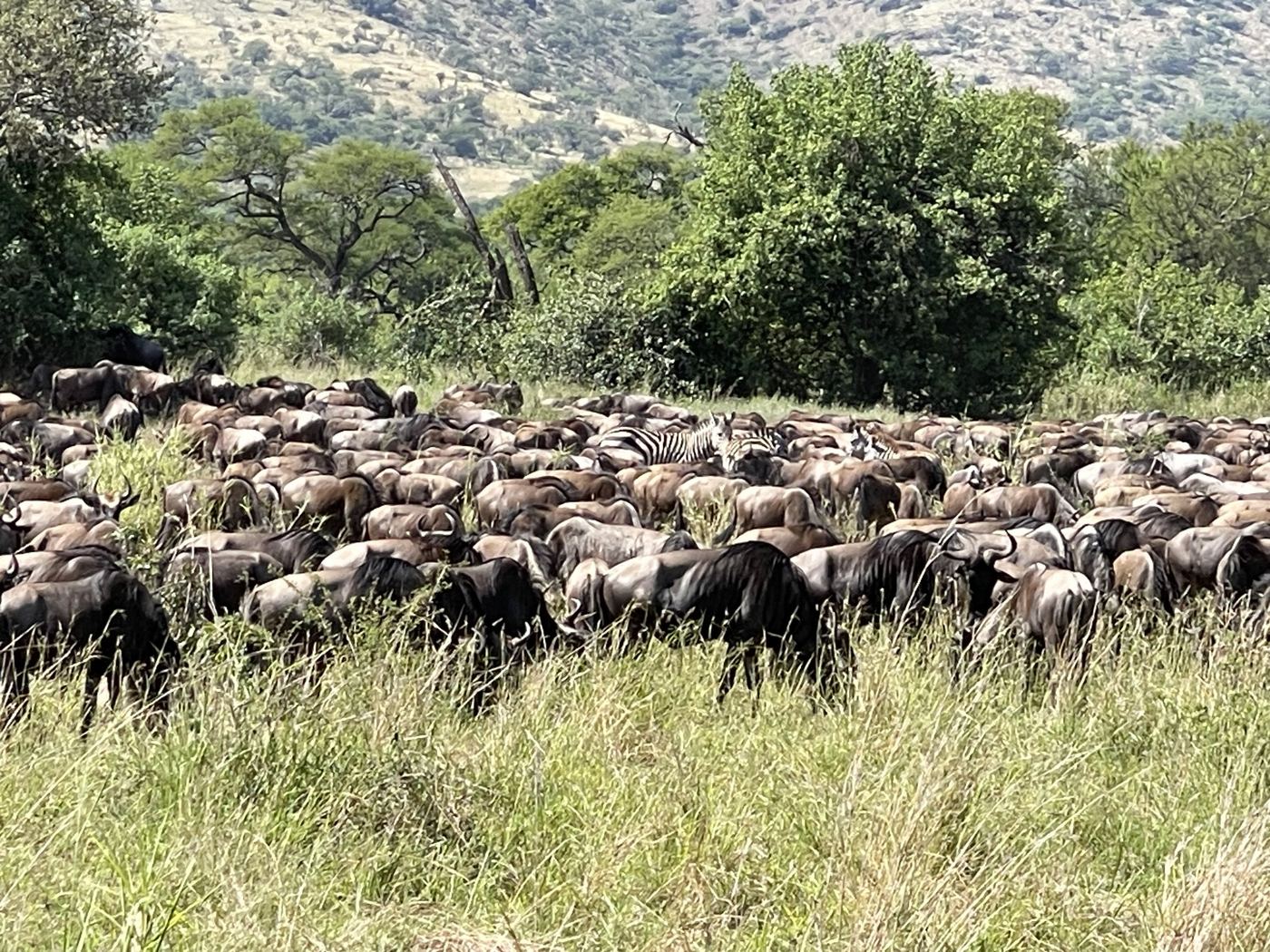
Migration or mountain gorilla safari: if you can only do one, which should it be? They are the two most famous wildlife experiences in East Africa, and they could hardly be more different. One is a moving landscape of well over a million wildebeest watched from a vehicle across several days. The other is a quiet hour on foot with a single family of mountain gorillas. This guide helps you choose between them, by what you want to feel, the month you can travel, your budget, your age and fitness, who is coming and how many days you have. If you would rather do both, there is a short pointer near the end.
The short answer
- Choose the Great Migration if you want scale and movement: 1.3 to 1.5 million wildebeest, zebra, predators and rivers, watched over several days from a vehicle.
- Choose a mountain gorilla safari if you want one close, quiet meeting on foot with a family of gorillas, in a trip that can be as short as three to six days.
- Your month can decide it. July to September suits both. April is weak for both. The month table shows where one clearly beats the other.
- Age and walking matter. The minimum age to trek is 15. A migration safari has no such limit and needs very little walking.
- Budget favours gorillas in Uganda, usually. Our ready-made gorilla trip starts below our ready-made river-crossing trip, because the migration needs more nights. The cost section has the numbers.
Facts checked 16 October 2026. Fees, schedules and herd positions change, so we confirm them again when we quote.
Great Migration or gorilla trek: the two experiences side by side
Most comparisons stop at "plains versus forest". The practical differences are larger than that, and they are what separate a good decision from a regret. This table puts the two next to each other on the points that usually decide it.
| Question | Great Migration safari | Mountain gorilla safari |
|---|---|---|
| What you actually do | Game drives in a vehicle, based at one or two camps close to the herds. Short walks at most. | A ranger-led walk into the forest, one hour with a habituated gorilla family on foot, then the walk back out. |
| Time with the animals | Days of watching across at least four nights, with the herds' position deciding how much of each day is spent driving. | One hour, which starts once the trackers have found the family. The walk to reach them runs from under an hour to most of a day. |
| How predictable it is | The herds are in the Serengeti about nine months a year, but a river crossing cannot be promised for any day, and timing can slip by two to four weeks either way. | Trackers find a family each day, so the hour itself is far more predictable than a crossing. The length of the walk and the weather are not. |
| Physical effort | Low. Long days and early starts in a vehicle. | Moderate to demanding. Steep, uneven, often muddy forest paths at altitude. A porter can be hired and walking sticks are usually available. |
| Minimum age | None set by the experience, which is why family trips are built around it. | 15 years. |
| Closeness and crowds | Open plains that are sometimes busy. Vehicles gather at the Kenyan crossing points, most of all in August. | No more than eight visitors per gorilla family per day, with rules on distance and noise. |
| Best months | July to October for Mara River crossings, late May to early July for the Grumeti, and calving season peaking in February. April is the month most likely to disappoint. | The drier months are easier underfoot, roughly June to September and December to February. Treks also run in the wet months. |
| Shortest sensible trip | About six days, because we recommend at least four nights in the main migration area. | Three to six days, depending on the country and how you reach the forest. |
| Where the cost sits | Spread across the nights: camp rates, daily park fees and flights. | Concentrated in one fixed fee, the permit, plus the lodge and transfers. |
| Photography | Open light and long distances, with dust and movement. Long lenses help. | Dim forest light, no flash allowed and one hour to work in. |
| Book ahead | 9 to 12 months for July to September. | Permits are limited per day and tied to a person and a date, so the permit date comes first. |
Two of those rows deserve a second look. The first is predictability. People assume the gorillas are the risky one because they are wild and hidden, and the migration is the safe one because it involves a million animals. In practice it is the other way round for the headline moment. A gorilla hour is arranged by trackers who found the family that morning, while a river crossing is a decision the herd makes. Our guide on whether the Great Migration is worth it explains how to plan so that one missed crossing does not cost you the trip.
The second is where the cost sits, which the budget section picks up below.
Scale or closeness: which one are you really asking for?
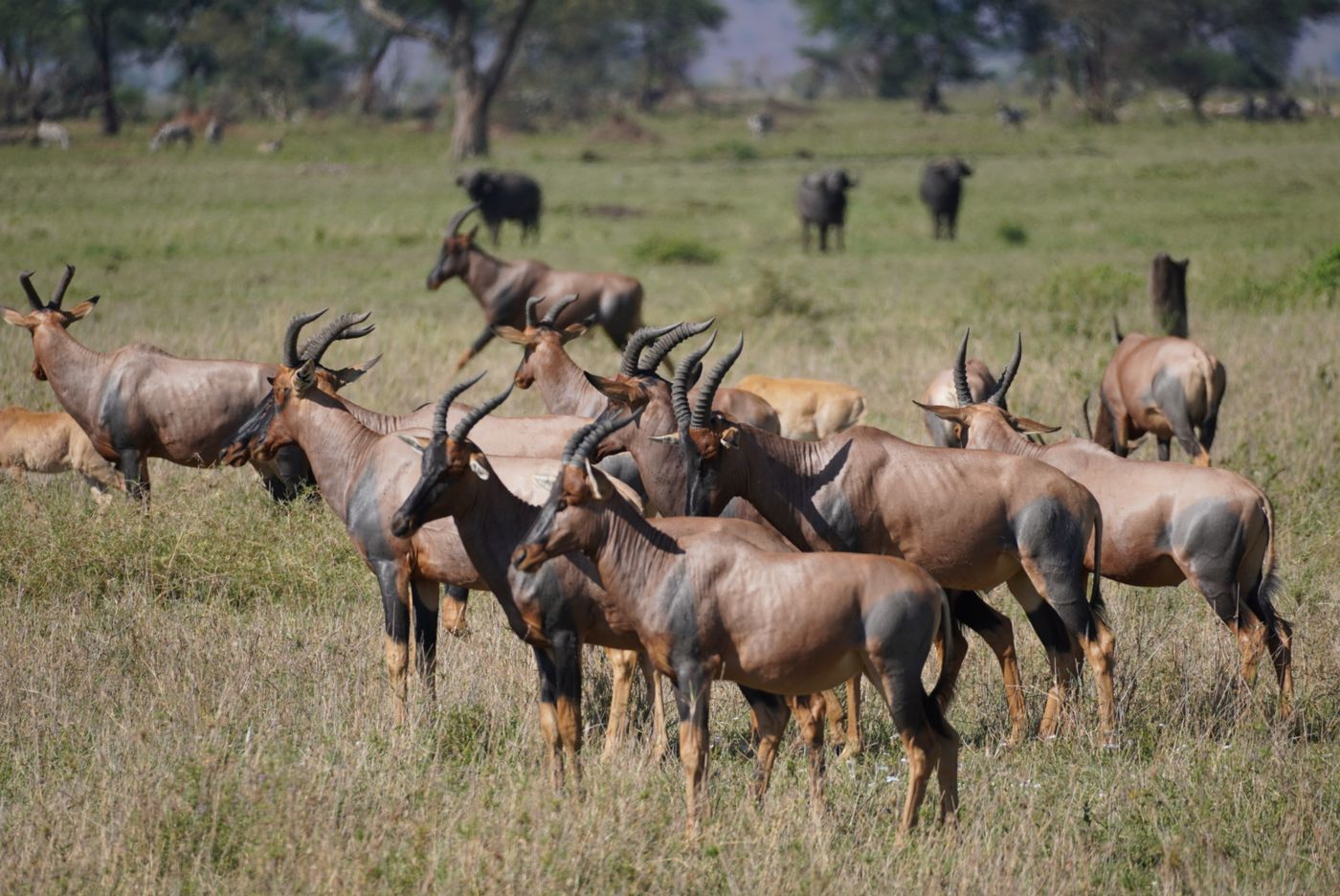
Strip away the logistics and the choice is about what kind of wonder you want. The migration gives you scale. The herds hold about 1.3 to 1.5 million wildebeest, with about 200,000 zebra and hundreds of thousands of gazelle moving in a loop of 800 to 1,000 kilometres. The effect is of a landscape that is alive and moving, and of a story with chapters: calving, the long walk north, the river, the predators that follow. You watch it from a distance, and you watch it for days.
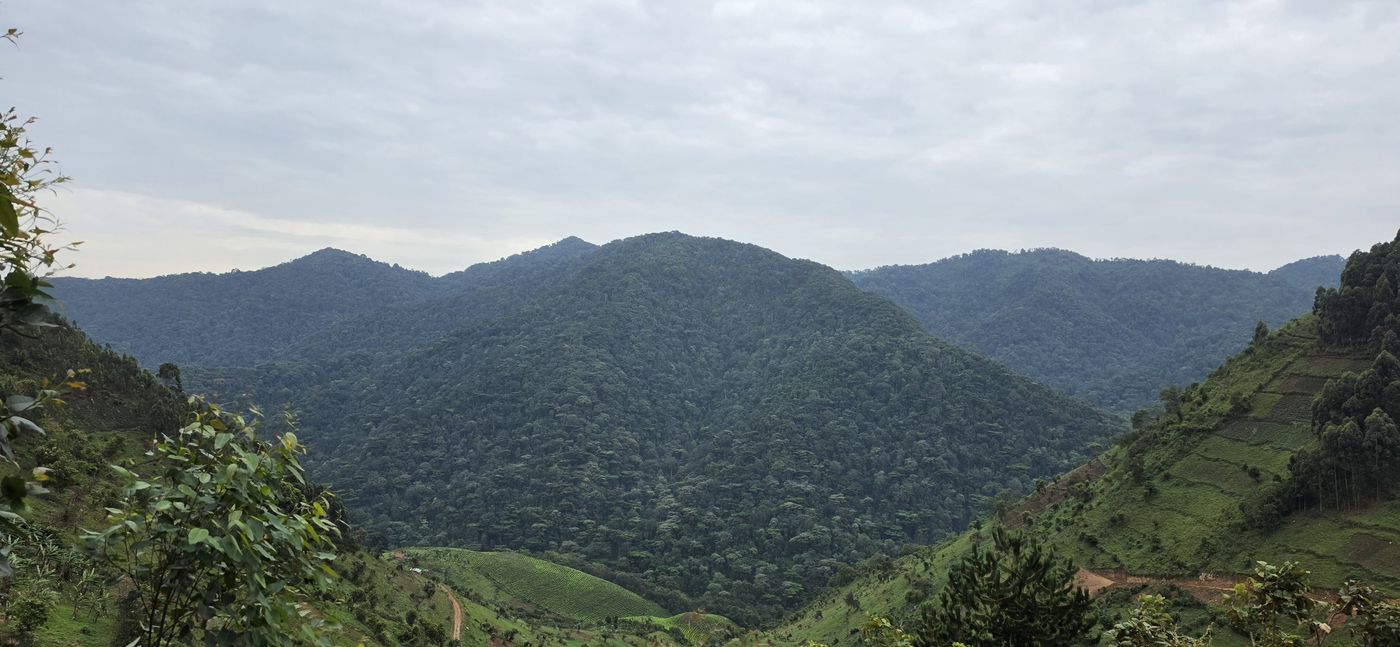
Gorilla trekking, which some countries call gorilla tracking, gives you closeness. The last full counts, the Virunga massif in 2015 and Bwindi in 2018, put the total at 1,063, and the species is listed as Endangered. A new count of the Bwindi population began in 2025. Your meeting is with one family, for one hour, on foot, a few metres from animals that are going about their day and are quite unbothered by you. People who have done it tend to describe the calm more than the thrill.
A quick way to test yourself is to ask which you would regret missing in ten years: the sight of a horizon full of animals, or the moment a gorilla looks back at you. If the answer is not obvious, the practical sections below will break the tie.
Another way in is to ask what you love most about wildlife:
- Big cats and hunting. The migration, because the predators follow the herds and the plains give them room to work.
- Primates and forest. The gorillas, and the forest itself is part of the day.
- Wide landscapes and long sunrise drives. The migration.
- Small groups and quiet. The gorillas, with no more than eight visitors to a family.
- A story that changes with the season. The migration, which moves through calving, the river and the long walk north.
- A walk with a purpose at the end of it. The gorillas.
Decide by your travel month: which one is better when
If your dates are fixed, the calendar often makes the decision for you. The table below gives a plain lean for each part of the year. Where both are strong, choose by taste. Where one is weak, choose the other.
| When | Great Migration | Mountain gorillas | Lean towards |
|---|---|---|---|
| December | Herds arriving on the southern plains, with Christmas and New Year priced as peak. | Start of the drier spell in the forest. | Either. Book early for the holiday weeks. |
| January to February | Calving season, peaking in February, with predators working the plains. | Drier forest, easier walking. | Either. A strong choice by taste for both. |
| March | Calving tails off and the rains approach. | Wetter, with muddier trails in both Uganda and Rwanda. | Migration, if you want to avoid muddy trails. |
| April to May | April is the month most likely to disappoint. Some camps close. | Wet season. Uganda has offered a lower permit price in April, May and November. | Gorillas, if you accept the mud and want the saving. |
| June | Shoulder month, with Grumeti River crossings from late May. | Dry season begins. | Either. Good value for both. |
| July to September | Mara River crossings. Peak rates, and camps sell out 9 to 12 months ahead. | The driest months, with the highest demand for permits. | Either, but book earliest. The migration costs most now. |
| October | Quieter camps, with smaller columns than most people expect. | Rains begin to return in Uganda. | Migration, if you want quieter plains. |
| November | Short rains and quieter camps, with lower rates. | Wetter. Lower permit pricing has applied in Uganda. | Gorillas, for the saving. Migration if you want quiet. |
Herds can run two to four weeks early or late with the rains, and permit pricing for later dates is confirmed when we quote. The Great Migration month by month and the best time to see gorillas in Uganda go deeper on each side.
Do not choose a month by the headline alone. A July trip built around a river crossing and a July trek both need to be booked a long way ahead. If your dates are flexible, the cheapest way to improve either experience is to move by two or three weeks, not to change the trip.
Decide by budget: which costs more?
Both are premium trips, so the useful question is where the money goes. A migration safari spends it across the nights: the camp rate, a daily park fee and often a light aircraft. A gorilla safari spends a large share in one fee, the permit, and the rest on a lodge and transfers.
| Cost | Great Migration safari | Mountain gorilla safari |
|---|---|---|
| The headline fee | Maasai Mara reserve ticket US$200 per adult per day from 1 July 2026. Serengeti conservation fee US$70 + VAT per 24 hours. | Permit US$800 per person in Uganda and US$1,500 in Rwanda for 2026, for a foreign non-resident. |
| Nightly rate | About US$350 per person per night in the green season to US$2,500 and more at luxury camps in the peak weeks. | Varies by lodge and sector. Quoted in your itinerary. |
| Flights between camps | US$250 to 500 per leg by light aircraft. | By road, or by light aircraft to the forest if you want to avoid the long drive. |
| A ready-made trip from | Kenya Migration Explorer, 8 days, from US$6,100 per person. | Classic Gorilla Trekking Safari, 6 days, from US$3,800 per person. |
| What pushes the price up | Peak weeks, camps close to the herds and light aircraft between regions. | Choosing Rwanda over Uganda, a flight to the forest and a luxury lodge. |
The comparison is fairer than a single price makes it look. The gorilla permit is a large number for one hour, but the migration needs more nights to be worth doing, and those nights carry the rate, the daily fee and often a flight. That is why our six-day gorilla trip costs less than our eight-day river-crossing trip, even though both are premium. If cost decides it for you, the gorillas in Uganda are usually the lower-cost choice, and the migration is usually the more expensive one in peak weeks. The detailed numbers for each sit in our Great Migration safari cost guide and our gorilla permit cost comparison.
The migration has one real way to save: the green season and shoulder months. Rates drop, and our green season safari value guide shows what the lower price buys. The gorilla permit has no such flexibility beyond the low-season pricing Uganda has offered, so the saving there is mostly in the choice of country and lodge.
Decide by who is travelling
The table below gives our usual lean for the people we plan trips for most often. It is a starting point, not a rule, and the notes explain why.
| If you are | Lean towards | Why |
|---|---|---|
| Planning a first safari ever | Migration, usually | It is the full safari: big landscapes, big cats and several days of watching. Choose gorillas first if primates are the dream and the plains are secondary. |
| Travelling with children under 15 | Migration | Gorilla trekking has a minimum age of 15. Our Kenya & Tanzania Family Migration Safari runs 11 days from US$8,300 per person. |
| Travelling with teenagers of 15 or over | Either | Both are open to them. The trek asks for steady fitness, so match it to your least fit traveller. |
| On a honeymoon or a couples' trip | Gorillas, for quiet | A forest hour is intimate and calm. The migration works for couples too, especially in conservancies that limit vehicles. |
| A photographer | Migration, for variety | Action, light and many days to work in. Gorillas are rewarding but demanding: dim light, no flash and one hour. |
| Less comfortable on rough ground | Migration | It is vehicle-based. A trek can be steep and muddy, though a porter and walking sticks help. Read how fit you need to be before deciding. |
| A repeat safari-goer | Gorillas | If you have already watched a plains safari, a primate trek is a different kind of experience, not a repeat of one you know. |
| Short on time, with under a week | Gorillas | A trek fits into a three to six day trip. A migration safari needs at least four nights in the region to be worth the money. |
| Watching the budget | Gorillas in Uganda | The permit is the lower of the two main options, and the trip needs fewer nights. See the cost table above. |
Decide by how many days you have
Time is the quiet factor in this decision, and it often cuts through the rest.
Three to five days: gorillas
A gorilla trek fits comfortably into a short trip, and a few days in Rwanda or Uganda is enough to do it properly. A migration safari squeezed into this length has to choose one region and skip the rest, and we advise against it unless you are flying in directly to the river.
Six to eight days: either
This is where both work, with different shapes. For the migration, one region with four nights at the river is the right plan, and our 6 day Masai Mara migration fly-in safari is built exactly that way. For gorillas, our classic gorilla trekking safari is the simplest six-day version.
Nine days or more: you have room to do both
With about a week and a half, the question stops being which and starts being how. That is a different decision, and our guide on combining gorillas and the Great Migration sets out the routes. If you are not sure whether to pay for two experiences or choose one and give it more time, the next section helps.
What can go wrong with each, honestly
Neither is risk-free. Knowing the usual disappointments in advance is the best way to avoid them.
With the migration
- Expecting a river crossing on a fixed day. Crossings cannot be promised, so plan for several nights.
- Sleeping far from the herds. A camp 20 minutes from the action instead of 90 gives roughly two extra viewing hours a day.
- Arriving in the wrong weeks. April is the month most likely to disappoint.
- Joining the crowd at a Kenyan crossing point in August without expecting it.
With the gorillas
- Underestimating the walk. It can run from under an hour to most of a day.
- Booking flights before the permit date. Permits are tied to a person and a date.
- Arriving with a cough or cold. Rangers can refuse anyone who is unwell, to protect the gorillas.
- Expecting more than an hour. The hour is the limit, and it is timed by the rangers.
The migration's risks are about timing and positioning, and you manage them with the right region, the right month and a camp near the herds. The gorilla risks are about preparation, and you manage them with fitness, an early permit and a calm approach to a walk you cannot measure in advance. Our guides on the migration's most common disappointments and what happens on a trek day cover each in detail.
A six-question method to choose
If you are still undecided, answer these six questions and keep a tally of which side each answer favours. Most people have a clear winner by the fourth.
- Which would you regret missing? A horizon of animals favours the migration. A face looking back at you favours the gorillas.
- When can you travel? Check the month table. If one side is weak in your weeks, the other wins.
- How comfortable are you on steep, muddy ground for several hours? If not very, the migration. If yes, the choice is still open.
- Who is coming? Anyone under 15 means the migration. Otherwise the choice is still open.
- How many days do you have? Under a week favours gorillas. About a week or more means either works.
- How do you feel about leaving the main event to chance? A crossing cannot be promised, and a trek's length cannot be known in advance. If either uncertainty would spoil the trip for you, choose the one whose uncertainty you can live with.
If the tally is tied, the tie-breaker we use is simple: choose the experience you could not easily have anywhere else. For most people that is the gorillas, because mountain gorillas live in just two forest areas, the Virunga volcanoes and Bwindi, and permits are limited each day, while the plains can be seen again on another trip. But if the scale of the herds is the thing you have wanted since childhood, ignore the tally. It is your trip.
If your answer is "both"
Many travellers reach the end of this decision and decide that they want both. That is a reasonable answer, and it is a different question. The two fit into one trip with enough days, and into two trips if you would rather give each its own space. Our guide to combining gorillas and the Great Migration covers the routes and the minimum nights, and our guide on whether to put the gorillas first or last covers the order. If you are planning them as two separate trips over a few years, one sensible order is the more demanding one first: do the trek while the walk is no worry, and keep the migration for a later, family-friendly trip.
Next steps: choosing between a migration safari and a gorilla safari
- Write down your dates, your group and the number of days. The month table and the days section will often settle it on their own.
- Decide what matters most. Use the six questions above and keep the tally honest.
- Tell us your answers. We will say which experience fits and why, and we will not sell you the other one if it does not.
- Then fix the date that cannot move. For gorillas that is the permit, and for the migration it is the river camp.
Not sure which to choose? Ask us.
Tell us your travel weeks, who is coming and how many days you have. We will give you a straight answer on migration or gorillas, including the option we would steer you away from.