
Serengeti or Mara in 2027
Serengeti vs Masai Mara migration comes down to timing: the herds are in Tanzania about nine months of a typical year and in Kenya roughly July to October, so your travel month decides the side.
The Serengeti vs Masai Mara migration question is settled mostly by the calendar, not by taste. The wildebeest herds are in Tanzania about nine months of a typical year and in Kenya only roughly July to October, so the side you pick decides whether you meet calving, river crossings or neither. This page gives you the rule, a month-by-month table and the trade-offs in crowds, cost and travel time. It also says when to do both, and when to walk away from one side.
Facts checked 12 October 2026. Fees, schedules and herd positions change, so we confirm them again when we quote.
The rule of thumb for the Serengeti vs Masai Mara migration
Choose the Serengeti from November to June, and in any month when you want calving or the Grumeti River. Choose the Masai Mara for a short July-to-October trip from Nairobi. Choose both for nine to twelve days in July, August or September. Everything else on this page adjusts a decision the calendar has largely made already.
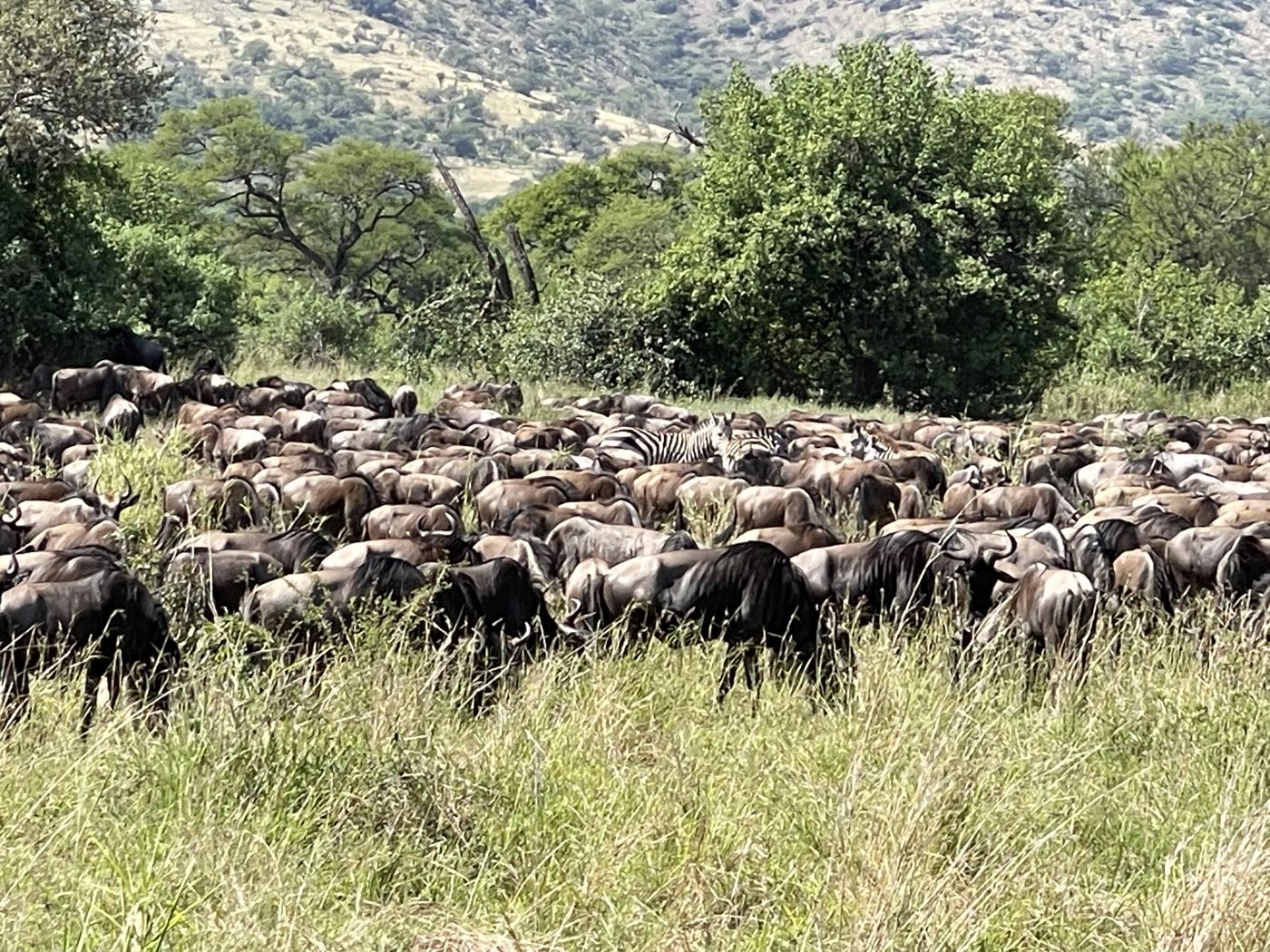
The Serengeti and the Maasai Mara are one ecosystem shared by Tanzania and Kenya. The herds walk a clockwise loop of about 800 to 1,000 km through it, following rain and fresh short grass. Serengeti National Park covers about 14,763 km², while the Maasai Mara National Reserve covers about 1,510 km² plus the surrounding conservancies. Most of the loop is therefore in Tanzania, and Kenya hosts the herds for a few months at the top of the circuit.
If you want the whole picture of the loop first, read our Great Migration safari guide, then how the Great Migration works for the reasons behind the movement. Here we only need one idea from them: the herds go where the grass is, and the grass follows the rain.
Serengeti or Masai Mara migration: which side by month
The Serengeti is the right side in eight months of the year, the Masai Mara is a real option in July, August and September, and October is the hand-over. The table gives our pick for a typical year. Each month has its own guide, linked in the first column.
| Month | Pick | Why |
|---|---|---|
| Great Migration in January | Serengeti | The herds are on the short-grass southern plains around Ndutu. Calving can begin at the end of December or in January. Kenya has no Serengeti herds. |
| Great Migration in February | Serengeti | Calving usually peaks, with most calves born inside a window of two to three weeks. Cheetah and lion hunt in the open. |
| Great Migration in March | Serengeti | Calves are stronger and the herds gather in larger groups before they move. The long rains usually start late in the month. |
| Great Migration in April | Serengeti | The wettest month. The herds leave the southern plains for the north-west via Moru Kopjes and Seronera. Some camps close and the parks are quiet. |
| Great Migration in May | Serengeti | The rains ease and the rut begins. Herds in central Serengeti push west, with the first gatherings on the Grumeti River in late May. |
| Great Migration in June | Serengeti, Western Corridor | Grumeti crossings usually run from late May to early July. Part of the herd turns north late in the month, and the first Mara crossings come only in an early year. |
| Great Migration in July | Either side | Northern Serengeti fills and the first Mara River crossings often come in July. The Mara begins to fill as the smaller Loita herd arrives from the east. |
| Great Migration in August | Either side | Herds spread across the Mara and northern Serengeti and cross the Mara River in both directions. Peak season, with the most vehicles at Kenyan crossing points. |
| Great Migration in September | Either side | The likeliest crossing window runs from mid-August to mid-September. Often slightly fewer visitors than August, and short grass helps predator viewing. |
| Great Migration in October | Mara early, Serengeti late | The herds start drifting south and crossings still occur, often southbound. The first short rains can arrive late in the month. |
| Great Migration in November | Serengeti | Short rains. Herds stream south along the eastern side through Lobo towards central Serengeti, and a few crossings are still possible early in the month. |
| Great Migration in December | Serengeti | Herds are on or near the southern plains. Calving can start at the very end of the month, and Christmas is peak-priced and busy. |
Where to read the full migration calendar
For the full calendar with route maps for every month, use our month-by-month Great Migration guide. For the dates that decide when you must book, see how far ahead to book a migration safari.
How to break the tie in an "either side" month
In July, August and September, choose the Masai Mara when your time is short, your starting point is Nairobi and you want the shortest transfer. A flight from Nairobi Wilson to the Mara takes 45 to 60 minutes, and a Kenya-only trip needs no second country, no second visa and no second set of park fees.
Choose northern Serengeti when you want fewer vehicles at the river and can spend the extra flight time from Arusha or Kilimanjaro. The Tanzanian side is generally quieter, and our guide to the northern Serengeti migration explains Kogatende and the Lamai Wedge in detail.
Serengeti vs Masai Mara migration: the factors side by side
Serengeti vs Mara comes down to how long the herds stay, what they do there and how you travel in. This table puts the decision factors in one place so you can see which ones matter to you.
| Factor | Serengeti (Tanzania) | Masai Mara (Kenya) |
|---|---|---|
| Size | Serengeti National Park about 14,763 km², UNESCO World Heritage since 1981 | Maasai Mara National Reserve about 1,510 km², plus conservancies |
| Herds present | About nine months of a typical year | Roughly July to October |
| Calving | Southern plains and Ndutu, usually late January to March, peak February | None |
| River crossings | Mara River in the north, Grumeti River in the Western Corridor | Mara River only; no Grumeti |
| Crowds at crossings | Generally quieter; far fewer vehicles on the Grumeti | Central-Mara crossing points draw the most vehicles |
| Off-road, night drives, walks | Not allowed across most of the national park; allowed in parts of Ndutu and in private reserves such as Grumeti | Not allowed in the reserve; allowed in many conservancies |
| Getting there | Fly from Arusha or Kilimanjaro to Seronera, Ndutu, Kogatende or Lamai, 1 to 2.5 hours | Fly from Nairobi Wilson, 45 to 60 minutes, or drive 5 to 6 hours |
| Daily park charge (non-resident adult, 2026) | Conservation fee US$70 + 18% VAT (about US$82.60) per 24 hours, plus a concession fee of about US$60 + VAT per night inside the park | An adult reserve ticket of US$200 a day from 1 July 2026; the Mara Triangle sells its own cashless ticket |
| Entry paperwork | Tanzania eVisa | Kenya eTA before departure |
Park fees are from published 2026 tariffs and can change at short notice. Fees for 2027 are confirmed in your quote.
How to read the comparison table
Read the table by row, not by column. If calving is on your list, the Serengeti row settles it. If you have six nights and a Nairobi arrival, the getting-there row settles it. If you want to drive off the track after a leopard, the rules row points to a conservancy or a private reserve, not to either national park.
Serengeti or Mara for river crossings: can you see them on both sides?
Yes, the Mara River is crossed from both banks, and the Serengeti also has the Grumeti, so the answer to Serengeti or Mara for river crossings is that both sides can deliver them. The Mara River rises in Kenya's Mau Forest, flows south through the Maasai Mara, enters Tanzania's northern Serengeti and turns west to Lake Victoria. The herds cross it in both directions, many times a week in the busiest weeks, never on a fixed day and never on a schedule anyone can promise.
The likeliest window is mid-August to mid-September, and the odds on a given morning depend on rain, the position of the herd and how the herd behaves at the bank. A herd can gather, mill and retreat for days before it commits. Because of that, the useful question is not which side has crossings but how many mornings you can give the river. Plan at least four nights near the water on whichever bank you choose.
Our guide to Mara River crossing points names the Kenyan and Tanzanian crossing areas and explains how to watch from the right distance. The Grumeti is smaller and slower, with a quieter setting and very large Nile crocodiles. Read about the Grumeti River crossings if May or June is your window.
Kenya or Tanzania migration safari: what the border changes
Tanzania or Kenya for the migration is a choice about more than the herds: the border changes the park rules, the visa, the airports and the pace. Kenya gives you a short flight from Nairobi, a compact reserve and the Mara Triangle in the western part of the reserve. Tanzania gives you the southern plains, the calving grounds, the Western Corridor and the quieter crossing areas of the north.
That is all this page needs from the wider debate. Our Tanzania vs Kenya safari comparison covers the two countries as a whole, including the parks that have nothing to do with the herds.
Within the migration itself, the practical difference is the number of months. Booking Kenya only is a sound decision for July to October. Booking Tanzania only is sound for the other months and also works in July to October, which is why the northern Serengeti is the quieter alternative to the Kenyan crossings.
Mara vs Serengeti crowds and driving rules
On Mara vs Serengeti crowds, the Mara draws the most vehicles at its central crossing points in peak weeks, and the Tanzanian side is generally quieter. That does not make either side a poor choice. It means the quality of the sighting depends on where your camp sits, which crossing area your guide chooses and how far you are from the river.
Crowds on the Kenyan side
The central reserve holds the famous Kenyan crossings at Lookout and Paradise, so it attracts the most vehicles. The Mara Triangle, in the reserve's west, is run by a non-profit, the Mara Conservancy. It sells its own cashless ticket and enforces strict vehicle rules, with strong ranger patrols and well-kept roads. The Triangle is a different experience from the central reserve, not a lesser one. Our guide to where to stay in the Masai Mara for the migration compares the two.
Crowds on the Tanzanian side
Northern Serengeti around Kogatende and the Lamai Wedge is remote, and the Grumeti has far fewer vehicles at its banks. Reaching it takes a longer flight, which is the price of quiet.
Driving rules
Neither the Maasai Mara reserve nor most of Serengeti National Park permits off-road driving, night drives or walks. They are allowed in many Mara conservancies, in private reserves such as Grumeti and in parts of the Ndutu area. If these matter to you, read our guide to Mara conservancies for the Kenyan option.
At a crossing the etiquette is the same on both sides: stay back until the herd has committed, and keep the landing zones open. Blocking a bank can turn a whole herd back, so a guide who hangs back is doing you a favour.
Masai Mara vs Serengeti cost and travel time
On Masai Mara vs Serengeti cost, neither side is reliably lower in price. The Masai Mara is quicker to reach from Nairobi and carries one country's paperwork, while the Serengeti adds a nightly concession charge inside the park and longer flights. Which one costs less for you depends on your month, your camp class and how many flights your route needs.
As a guide to typical rates, accommodation per person per night, sharing, is indicatively US$350 to 550 per person per night in comfort camps in the green season and US$450 to 750 in peak season. Premium camps run about US$550 to 900 and US$750 to 1,300, and luxury camps about US$900 to 1,700 when the season is green, rising in peak from US$1,300 past US$2,500. Peak means July to September and Christmas, while June and October are shoulder months that are often lower, though each camp sets its own calendar. February is often priced as peak in the southern Serengeti. These bands are indicative and are confirmed in your quote.
Where the money goes on each side
- Masai Mara: a single daily reserve ticket (for adults US$200 a day from 1 July 2026, with children aged 9 to 17 at US$50 and under 9 free), a short flight from Nairobi Wilson and conservancy fees that are usually included in the camp rate.
- Serengeti: a conservation fee, a concession fee for each night inside the park, a separate Ngorongoro Conservation Area fee at Ndutu and longer internal flights from Arusha or Kilimanjaro.
- Both sides: a light-aircraft leg is often about US$250 to 500 per person, and a balloon flight is roughly US$550 to 750 each.
For totals by trip length and season, our Great Migration safari cost guide adds everything up.
Travel time to each side
The Mara is the quicker arrival from the international airport: a flight of 45 to 60 minutes, or a drive of five to six hours. The Serengeti airstrips of Seronera, Ndutu, Kogatende and Lamai are one to two and a half hours by air from Arusha or Kilimanjaro. Light aircraft typically limit you to about 15 kg a person, hand luggage included, in a soft bag.
Can you do both Mara and Serengeti on one trip?
Yes, and in July, August and September it is the strongest answer to Mara or Serengeti for the Great Migration, because it lets you watch the Mara River from both banks. Nine to twelve days is the realistic span. The catch is routing. There is no direct flight between the Maasai Mara airstrips and the Serengeti airstrips, and there is no open tourist border crossing inside the ecosystem serves game-drive transfers.
The route runs via Nairobi Wilson and Kilimanjaro or Arusha, then a light aircraft takes you to a Serengeti airstrip. Allow about half a day for the transfer, and remember that it adds cost. That is why the second side needs enough nights to justify the move, and why our two-side packages give each side four nights.
Two ways we build it
Our Mara to Serengeti: The Ultimate Migration Crossing Safari runs nine days, from US$7,600 per person, with four nights in Kenya and four in Tanzania so you see both banks of the Mara River. It suits travellers whose dates fall between July and October and who want the river as the centrepiece.
For a broader first migration trip, our Kenya & Tanzania Great Migration Grand Safari runs twelve days, from US$8,900 per person, with four nights each side of the border and the Ngorongoro Crater. It fits June to October and late December to March, so it also suits the calving season.
Both countries need their own entry paperwork, and a yellow fever certificate is worth carrying if you combine them. Tanzania may ask for one on arrival from, or after transit of more than 12 hours through, a country with yellow fever risk, and Kenya is on that list. Our combining Kenya and Tanzania guide explains the visa and health steps in order.
Our recommendation by type of traveller
Here is our recommendation on the Serengeti vs Masai Mara migration for five kinds of traveller.
First-timer
Choose by month. For July to October with a week to spare, the Masai Mara from Nairobi is the simplest first migration trip. For a first safari of one week in general, our Classic Serengeti & Ngorongoro Crater Safari runs seven days, from US$4,650 per person. It is best from June to October and late December to February, and it is built around resident big cats rather than the herds' position.
Photographer
Choose the Serengeti in the calving months, because the herds, predators and open plains give you action on short grass, and off-road driving is allowed in parts of the Ndutu area. In crossing season, choose the side where you can spend the most mornings at the river, and plan a shutter speed of 1/1600 s or faster. A beanbag works better than a tripod from a vehicle.
Couple
Choose a quieter setting. In July to September that means northern Serengeti, or the Mara Triangle for its strict vehicle rules, with a private vehicle. Our Gorillas, Migration & Zanzibar Honeymoon runs fourteen days, from US$11,800 per person, through Bwindi, the Maasai Mara and Zanzibar, privately throughout, in July to September.
Family
Choose the side with the shorter transfers, which from Nairobi is the Mara at 45 to 60 minutes by air, then add a second side only if the children can manage a longer trip. Minimum ages vary, and some camps set them at 6, 8 or 12, so ask before you choose a camp. Our Kenya & Tanzania Family Migration Safari runs eleven days, from US$8,300 per person, paced for families with a junior-ranger programme, in July and August and over the December school holidays.
Repeat visitor
Choose the side and season you have not seen. If you know the Mara in August, try the southern Serengeti for calving in February, or the Grumeti in June. If you know the Tanzanian plains, a conservancy stay with night drives and walks is a new way to see the Mara. Our southern Serengeti migration guide covers Ndutu, Kakesio and the calving zone.
Common mistakes when choosing a side
Most regrets about the Serengeti or Masai Mara migration choice come from one of the following errors.
- Choosing by airport, not by month. A short flight to the Mara is no use in February, when the herds are in Tanzania.
- Expecting herds in Kenya before July. The first Mara crossings can come late in June in an early year, but in a typical year the Mara fills in July.
- Planning a direct hop from the Mara to the Serengeti. There is no direct flight, so a two-side trip always routes through Nairobi and Kilimanjaro or Arusha.
- Treating a crossing as a booked event. No operator can promise a crossing, so give the river several mornings rather than one.
- Visiting the Serengeti in April and expecting a dry, busy park. April is the wettest month, some camps close and the herds are on the move north-west.
- Booking late for the peak. July to September and February sell out first, so plan nine to twelve months ahead at the least.
- Squeezing both sides into one week. You lose about half a day to routing and cannot give either river bank enough time.
Next steps for your Serengeti vs Masai Mara migration decision
- Pick your month using the table above, and note whether it says Serengeti, Mara or either side.
- Decide whether you have seven days (one side) or nine to twelve (both).
- Check the booking window for your dates: July to September and February need nine to twelve months at the least.
- Share your dates, group size and passport nationality. We will name the side, the camps and the flights, and show the fees in your quote.
Not sure which side suits your dates?
Tell us your month, how many days you have and who is travelling. We will recommend the Serengeti, the Masai Mara or both, and explain why in plain terms.
Plan my tripIf the Masai Mara vs Serengeti decision points to February, read our Serengeti calving season guide. If you want walks and night drives in Kenya, read about the conservancy option in the Mara.
Keep reading: related Great Migration guides
Mara River crossing points and timing
Where the herds cross, the likeliest weeks and how a crossing unfolds.
Great Migration month by month
Twelve months compared, with a page for each one.
How to plan a migration safari itinerary
How many nights, which areas and in what order.
For the whole picture, see our Great Migration safari guide. If you are ready to price a trip, Kenya & Tanzania Great Migration Grand Safari starts from US$8,900 per person.
Planning more than one country?
The migration can be combined with gorillas in the same trip. These pages show how.
- gorillas, the Mara and the Serengeti: gorillas, the Mara and the Serengeti.
- a ready ten day route: a ready ten day route.
- when each country is at its best: when each country is at its best.
- every route, visa rule and package in one place: every route, visa rule and package in one place.
Choose Serengeti vs Masai Mara for the migration
Park fees are set by Tanzania National Parks (TANAPA) and, for the crater, the Ngorongoro Conservation Area Authority. National park fees are set by the Kenya Wildlife Service, and Magical Kenya, the Kenya Tourism Board, publishes official visitor information. We confirm the current fees for your dates in every quote.