
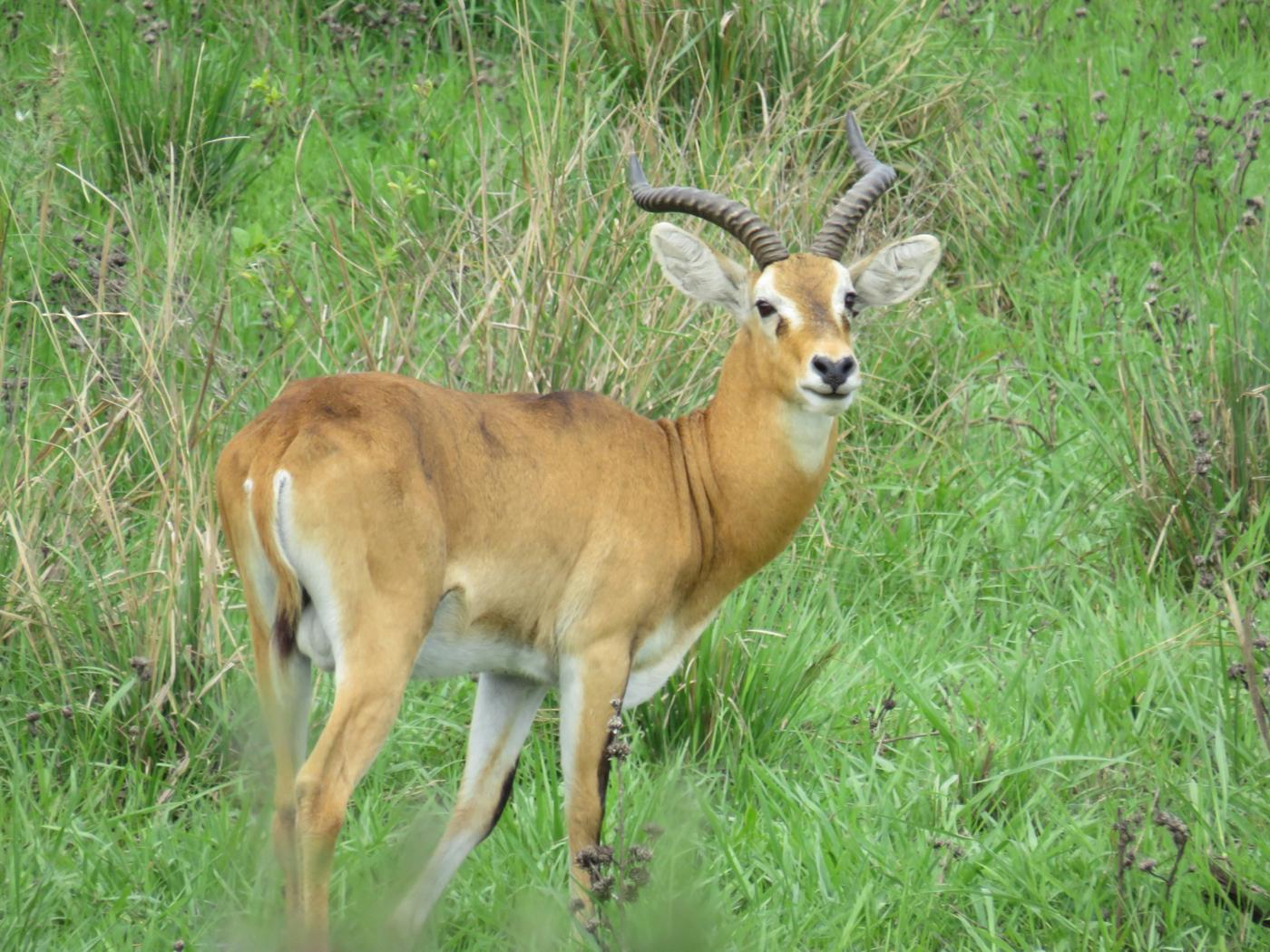
Semuliki National Park, on Uganda's far western border with the Democratic Republic of the Congo, is one of the strangest and most rewarding parks in the country: a low, hot, humid lowland forest that belongs more to the Congo Basin than to East Africa, with hot springs you can boil an egg in and a bird list that includes species you cannot see anywhere else in the region. People also search for it as Semliki National Park, Semuliki Forest, Sempaya Hot Springs Uganda, Semuliki birding or the park near Fort Portal and Bundibugyo. This guide answers the questions travellers actually ask: where it is, what makes it different, what the Sempaya hot springs are, which birds to look for, whether you can see a shoebill there, how to get there, when to go and how it fits with Kibale, the Rwenzori Mountains and Queen Elizabeth.
Quick answer
Semuliki National Park is a lowland tropical rainforest park of about 220 km² in Bundibugyo District, western Uganda, on the border with the Democratic Republic of the Congo. It lies at only 670 to 760 metres above sea level, one of the lowest national parks in Uganda, and it is the eastern edge of the great Congo Basin forest. It is best known for two things: the Sempaya hot springs, and a bird list of more than 435 species that includes dozens of Central African forest birds found nowhere else in East Africa.
Semuliki suits birdwatchers, forest walkers and travellers who want something very different from savannah game drives. Plan one night for the hot springs and a short birding walk, or two nights for serious birding. It is usually added to a western Uganda circuit through Fort Portal.
Semuliki National Park at a glance
| Fact | Detail |
|---|---|
| Location | Bundibugyo District, western Uganda, on the Democratic Republic of the Congo border |
| Park type | Lowland tropical rainforest, the eastern extension of the Congo Basin forest |
| Area | About 219 to 220 km² |
| Altitude | About 670 to 760 m above sea level |
| Status | Forest reserve from 1932; national park from October 1993 |
| Famous for | Sempaya hot springs, Congo-Basin birds, forest primates |
| Birds | More than 435 species according to the Uganda Wildlife Authority |
| Main walks | Sempaya hot springs and the Kirumia Trail (about 14 km), plus other guided forest walks |
| Nearest town | Fort Portal, about 60 km and about one hour from the Sempaya gate |
| From Kampala | About 290 to 296 km to Fort Portal, 4 to 5 hours, then about an hour on |
| Climate | Hot and humid; about 1,250 mm of rain a year; roughly 18 to 30 °C |
| Suggested stay | 1 night minimum, 2 nights for birders |
| Cost | Priced on the written quote; park fees are set by the Uganda Wildlife Authority |
Chapter 01 — Where is Semuliki National Park?
Where is Semuliki National Park? Semuliki National Park is in Bundibugyo District in the far west of Uganda, beside the border with the Democratic Republic of the Congo and on the western side of the Rwenzori Mountains. It sits in the Semliki Valley, part of the Albertine Rift, at the foot of the mountains and south of Lake Albert.
The park is reached by road from Fort Portal, the tourism hub of western Uganda, and the drive crosses the Rwenzori foothills before dropping into the valley. The change is dramatic: you leave the cool, green hills around Fort Portal and descend to flat, hot, dense forest where the air is heavy and the canopy closes overhead.
The spelling varies. The park itself uses Semuliki, while the river, the valley and the nearby wildlife reserve are usually written Semliki. They are the same place name, and you will see both spellings on signs and maps.
Chapter 02 — Why is Semuliki different from other Ugandan parks?
Semuliki is different because of where it is. Most of Uganda's forests, such as Kibale and Bwindi, are highland or mid-altitude forests. Semuliki is a low-lying forest of the Congo type. It is described as the easternmost extension of the Ituri Forest of the Congo Basin, so it holds plants and animals that have their main range in Central Africa and just reach Uganda here.
That is why birders speak about it so often. The Uganda Wildlife Authority says 35 Guinea-Congo biome species are found nowhere else in East Africa, and it also lists 23 Albertine Rift endemics. The mammals tell the same story, with forest species that are rare or absent elsewhere in the country.
The park has a long protected history. It was made a forest reserve in 1932 and became a national park in October 1993. It is smaller than Kibale or Queen Elizabeth, but it feels bigger because the forest is so continuous.
Chapter 03 — The Sempaya hot springs: what they are and how to visit
What are the Sempaya hot springs? The Sempaya hot springs are the best-known sight in Semuliki National Park. Two separate springs, named in the local tradition as female and male, bubble out of the ground on the edge of the forest, a short way from the park entrance. They are the reason many visitors come, even if they are not birders.
- Nyansimbi, the "female" spring. About a 15-minute walk from the gate. It is a smaller spring where the water erupts as a modest geyser that rises to about 2 metres. The Uganda Wildlife Authority describes visitors boiling eggs and bananas in the hot water here, which is a popular and memorable activity.
- Bintente, the "male" spring. About an hour's walk through the forest, ending at a large bubbling pool, about 12 metres across in the figure usually given. The walk is the main attraction, because it takes you into real lowland rainforest.
The springs are a good first walk in the park, and the combination of forest, steam and the smell of sulphur is unforgettable. We do not quote water temperatures, because they are not published in a form we can stand behind. The water is hot enough to cook, and the safety rule is simple: do not put your hands or feet in the water, and follow your ranger's directions at all times.
Take insect repellent, closed shoes and a light rain jacket. It is hot and humid, and the paths can be muddy.
Chapter 04 — Birding at Semuliki: the Central African specialities
How many birds are in Semuliki National Park? The Uganda Wildlife Authority's website gives more than 435 species, and its brochure gives 441. Both numbers say the same thing: this is among the richest bird lists in Uganda, and many of the birds are Central African species you will not see in Queen Elizabeth or Murchison.
These are the species the Uganda Wildlife Authority names as park highlights:
- Black dwarf hornbill
- Nkulengu rail
- Congo serpent eagle
- Gabon woodpecker
- Spot-breasted ibis
- Hartlaub's duck
- Chestnut-flanked goshawk
- Red-thighed sparrowhawk
- White-tailed hornbill
- Capuchin babbler
- Yellow-throated cuckoo
- Dwarf honeyguide
- Purple-breasted sunbird
Two more that birders look for here are Oberländer's ground thrush and Sassi's olive greenbul. Lowland forest birds are hard to see, because they live in the dark understorey and the canopy, so a good local guide is not a luxury here. He or she identifies birds by call first and by sight second.
A Semuliki trip works best with at least one early morning on the trail and a second walk in the afternoon. If you are also visiting the other bird-rich parks in the country, our East Africa birding safari guide sets the whole picture out.
Chapter 05 — Can you see a shoebill at Semuliki?
Can you see a shoebill at Semuliki National Park? Not in the park itself. The shoebill is a swamp bird, and Semuliki is a forest park. Shoebill boat trips in this part of Uganda start from Ntoroko on Lake Albert, near the neighbouring Toro-Semliki Wildlife Reserve, which is a different protected area with different habitats.
This is a very common mix-up, because the two places are close together and share a similar name. Toro-Semliki is a 542 km² reserve gazetted in 1926 according to the Uganda Wildlife Authority. It has savannah, woodland and lake shore, about 200 elephants and a bird list of about 440 species, and it is where the shoebill trips are based.
If a shoebill is high on your list, tell us at the start, and we will build the route around the right place. Semuliki gives you forest birds, and Toro-Semliki and Ntoroko give you open water and savannah, so the two make a good pair. For a wider look at where to see big mammals instead, our Queen Elizabeth National Park guide covers the classic game-viewing park nearby.
Chapter 06 — Mammals and primates in the forest
Semuliki is not a place for Big Five game drives. It is a place to walk slowly and watch. These are the mammals the Uganda Wildlife Authority and other published sources highlight:
- Forest buffalo. A smaller, redder buffalo than the savannah animal, found in the forest and clearings.
- Primates. Dent's mona monkey and the Central African red colobus, among others.
- Water chevrotain. A tiny, shy relative of the deer family that lives along streams.
- Duikers. Several species of small forest antelope; published counts differ, with up to nine duiker species mentioned.
Mammal counts in forest parks are rarely exact, and sources differ, so treat any total as an indication of variety. If chimpanzee tracking is what you want, that is the job of Kibale National Park, and we cover it in the Kibale chimpanzee trekking guide rather than repeat it here. You can read about the park itself on our Kibale destination page.
Chapter 07 — Other things to do around Semuliki
- Kirumia Trail. A longer walk of about 14 kilometres, as the Uganda Wildlife Authority spells it, through the heart of the forest for serious birders and walkers.
- Shorter guided forest walks. Your ranger-guide can build a short walk for an early morning when you have less time.
- The Batwa experience. A cultural experience with the Batwa people, who have long lived in these forests, offered as an activity from the park. We book it with respect for the community and ask guests to listen first.
- Toro-Semliki and Ntoroko. Game drives and boat trips on Lake Albert in the neighbouring reserve, as described in Chapter 05.
- The Rwenzori foothills. The road to the park passes the mountains. If you want to hike them, see our Rwenzori Mountains guide.
Chapter 08 — How to get to Semuliki National Park
How far is Semuliki from Kampala? Fort Portal is about 290 to 296 km from Kampala, which is a drive of 4 to 5 hours, and the Sempaya gate is about 60 km, or about an hour, beyond Fort Portal according to the Uganda Wildlife Authority. In practice, most travellers sleep in Fort Portal the night before and drive to the park in the morning.
| Route | Distance | Notes |
|---|---|---|
| Kampala to Fort Portal | About 290 to 296 km | 4 to 5 hours by tarmac road |
| Fort Portal to Sempaya gate | About 60 km | About one hour across the Rwenzori foothills |
| Fort Portal to Bundibugyo | About 83.6 km | The district town on the western side |
Your driver-guide meets you at Entebbe, takes the whole journey in a comfortable vehicle and plans stops so that you arrive at the park with daylight left. If time is short, we can build the trip around a flight and a shorter road transfer.
Chapter 09 — Where to stay for Semuliki National Park
There are three kinds of place to stay.
- Lodges and camps near the park gate. The most convenient choice, with early access to the trails and a forest setting.
- Lodges in the Toro-Semliki and Ntoroko area. Good for combining the forest with shoebill and savannah.
- Hotels and lodges in Fort Portal. The usual base for a day trip, but a long day.
Which one suits you depends on your route and your budget, so we choose it when we build your itinerary and name it on your written quotation. Other lodges in western Uganda, such as Mweya Safari Lodge, are listed in our recommended lodges and camps.
Chapter 10 — Best time to visit Semuliki National Park
Semuliki is hot and humid all year, with roughly 1,250 mm of rain and temperatures from about 18 to 30 °C. The rains fall mainly from March to May and from September to December.
- The months outside the main rains, roughly June to August and January to February: firmer trails, easier walking and more comfortable heat.
- Wetter months, March to May and September to December: muddy paths and heavier downpours, but the forest is at its greenest and quieter.
- Birders: the forest is rewarding in any month, because the resident birds are always there. Migrants add to the list at other times of year.
For a country-wide view, see our best time to visit Uganda guide. Because Semuliki is in the malaria zone, speak to a travel clinic well before you go, and read our malaria and vaccinations guide.
Chapter 11 — What does a Semuliki visit cost?
We do not publish one price for the park because costs depend on how long you stay and on charges set by the Uganda Wildlife Authority. These are the items that decide it:
| Cost item | What decides it |
|---|---|
| Park entry | Set by the Uganda Wildlife Authority and priced on your quote for your dates |
| Guided walks | Hot springs, birding trails and the Kirumia Trail are each guided and priced by activity |
| Accommodation | Lodge or camp near the park, or Fort Portal, and the number of nights |
| Transfers | Private vehicle from Kampala or Entebbe, and any drive to Ntoroko or Toro-Semliki |
| Cultural visit | The Batwa experience, if you choose it |
| Meals | Included at the lodge or arranged for a full-day walk |
Everything is itemised on your written quotation. For the cost of a whole trip, read our Uganda safari cost guide.
Chapter 12 — Semuliki compared with Kibale, Queen Elizabeth and Rwenzori
Is Semuliki worth visiting if you are already going to Kibale? Yes, if you are a birder or enjoy forest walks. Kibale gives you chimpanzee tracking and a richer primate list in a highland forest, and Semuliki gives you a different forest altogether, with Central African birds and the hot springs.
| Park | What it is best for |
|---|---|
| Semuliki | Congo-Basin birds, forest walks, the Sempaya hot springs |
| Kibale | Chimpanzee tracking and many primate species |
| Queen Elizabeth | Savannah game drives, tree-climbing lions and the Kazinga Channel |
| Rwenzori Mountains | High-altitude hiking and mountain scenery |
Semuliki is not the best first park for someone who wants big animals. It is the best second or third park for someone who wants variety. For the full list of national parks in the country, see our Uganda national parks guide.
Chapter 13 — How Semuliki fits into a Uganda itinerary
One night. Sleep in Fort Portal, walk to the Sempaya hot springs in the morning, do a short forest walk and move on. Enough to see the springs.
Two nights. The better choice for birders. A full day on the trails and a second morning with a guide for the specialities.
Three nights or more. Add Toro-Semliki and Ntoroko for the shoebill and savannah, and combine with the Rwenzori foothills.
Semuliki is an addition to a western Uganda circuit rather than a stand-alone trip. Our 14 Day Uganda Wildlife And Birding Safari and Uganda Birding And Gorilla Safari show how birding-focused routes are built, and your own route is planned from your dates and interests.
Chapter 14 — Safety, health and what to pack
- Health. Semuliki is hot, humid and in a malaria-risk area. See a doctor or travel clinic before you travel, and use insect repellent.
- Conditions. Travel advice for western Uganda is set by your own government and can change. We check current conditions with the Uganda Wildlife Authority before we build your route.
- Clothing. Lightweight long sleeves and trousers, a rain jacket, sturdy shoes that can get muddy and a hat.
- Hot springs. Follow your ranger's directions and keep away from the water's edge.
- Binoculars. Essential for forest birding.
For wider guidance, see our guide to whether East Africa is safe to visit and our safari packing list.
Chapter 15 — Mistakes to avoid and local tips
- Expecting savannah game. Semuliki is a forest park. Go for birds, trees and hot springs.
- Mixing it up with Toro-Semliki. The shoebill trips are based at Ntoroko, not in the national park.
- Doing it as a rushed day trip from Kampala. The park is a long drive beyond Fort Portal, so sleep nearer.
- Skipping the guide. Lowland forest birds are found by ear, and the guide is the whole experience.
- Dressing for the highlands. It is hot and humid here, so pack light layers and rain protection.
- Touching the springs. The water can scald.
- Ignoring malaria advice. Speak to a clinic before you go.
- Trusting a single source for bird and mammal totals. Counts differ, so use them as an indication.
- Leaving out the neighbours. Semuliki is more rewarding when combined with Fort Portal, Kibale or Toro-Semliki.
Our verdict
Semuliki National Park is the odd one out in Uganda's parks, and that is why it is worth a night or two. It is a different forest, a different bird list and a different kind of walk. It is not for everyone, but for a birder or a curious traveller it is one of the most distinctive places in the country.
If you would like Semuliki planned into a Uganda trip, with the right lodge, a guide who knows the forest birds and a written quotation, request a free quotation and we will reply within 24 hours.
Plan your safari with us. Tell us the month you can travel, how many days you have and who is coming, and we will reply within 24 hours with a route and a written quotation.
Request a free quotation