
The Great Migration in April: Where the Herds Are and What to Expect
Where the herds are in April, how wet the month really is, what it costs and who should choose March or May instead.
Read the guide →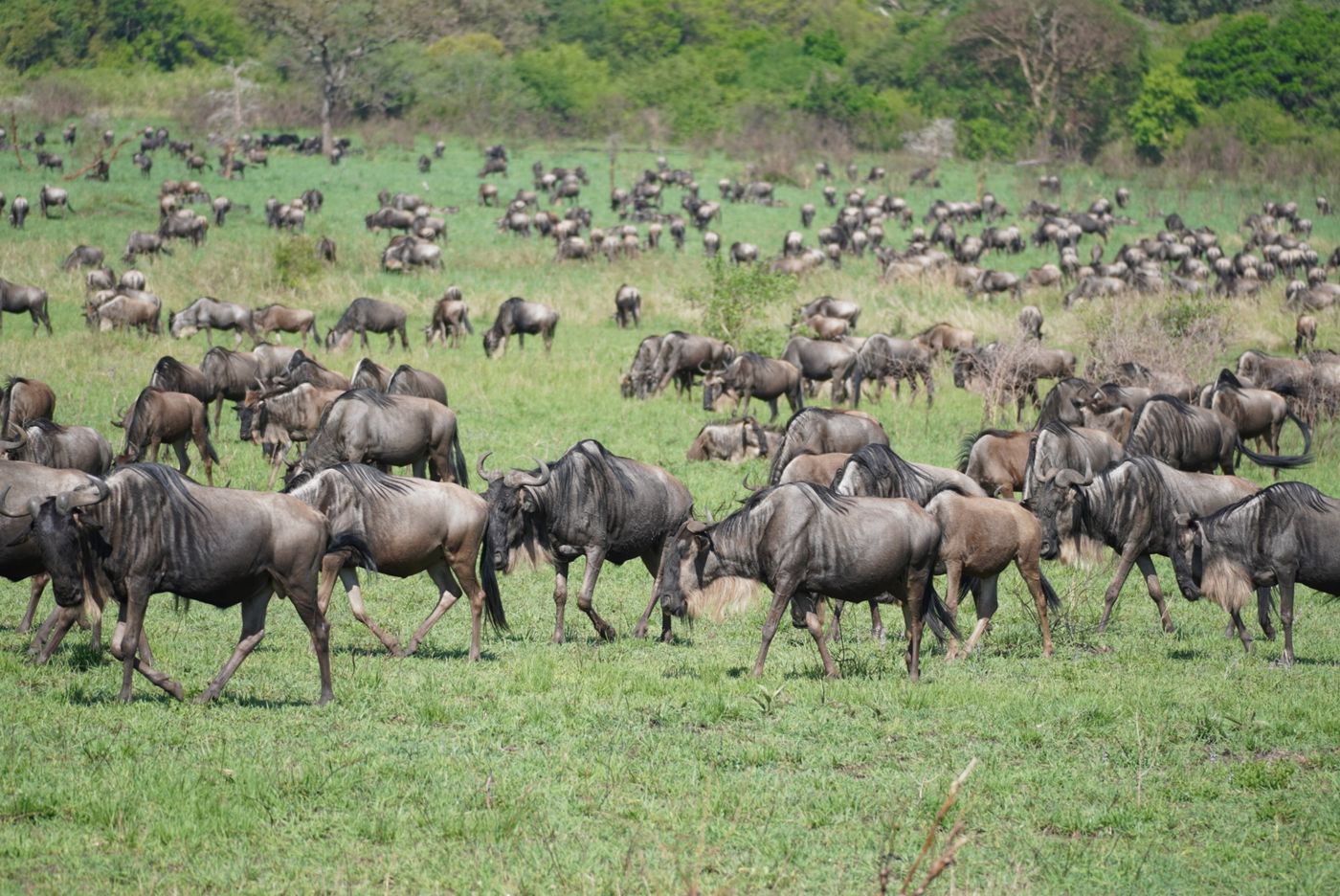
Where the herds are in June, why it is the month for Grumeti River crossings, and how to choose between a western and a northern base.
The Great Migration in June is a month with two possible homes, and choosing between them is the real planning problem. The herds are working through the Western Corridor and the Grumeti River, while part of the herd turns north through Ikorongo and Lobo. Travellers searching for the wildebeest migration in June usually want one answer, and the honest one is that the best base depends on the week and on the rains. This page tells you how to choose. Our Great Migration safari guide sets June in the full year.
Facts checked 12 October 2026. Fees, schedules and herd positions change, so we confirm them again when we quote.
In June the herds are in the west and starting to turn north. The first half of the month is the Western Corridor, around Kirawira and the Grumeti River. Later in the month, part of the herd moves north through Ikorongo and Lobo, towards the northern Serengeti. These are typical-year positions, and the rains can move the timing by two to four weeks either way.
The practical choice for the Serengeti in June is where to sleep. The table sets out the three options.
| Base | What it gives you | The risk |
|---|---|---|
| Western Corridor only | The prime Grumeti window, with far fewer vehicles than at the Mara River | If the herd moves on early, you are behind it |
| North only (Lobo, Kogatende) | You are in position for the northern herds if they turn north on time | Too early in the month, the herds may not have arrived |
| Split: west first, north second | Covers both outcomes and follows the herd's own route | An extra transfer |
A split stay suits a longer trip, usually with three nights in each of two places. On a shorter trip, choose one area and stay at least four nights. The extra cost of a split is shown in your quote.
June is when the Grumeti River crossings are most reliable. They usually run from late May to early July, and the Grumeti is a smaller, slower river than the Mara. In the dry season it shrinks to deep pools that hold very large Nile crocodiles, and crossings are less concentrated than at the Mara. Our guide to Grumeti River crossings and the Western Corridor covers the river in detail.
The rut also continues. It runs mainly through May and June, so males are still grunting and chasing. Lions and spotted hyena follow the herds, leopards use the riverine trees and crocodiles wait in the river.
Probably not. The herds have not yet reached the Masai Mara in June. Mara River crossings can come in late June in an early year, but they should not be expected, and they are far more likely in July. Kenya hosts the Serengeti herds from roughly July to October, so a June trip aimed at Kenya is a bet against the usual timing.
The reserve ticket reflects that shift: the published tariff had US$100 per adult per day until 30 June 2026 and US$200 per adult per day from 1 July 2026, and your quote confirms the fee for your dates. For the crossings themselves, start with the Great Migration in July, which is when the first Mara River crossings often come.
The dry season begins in June, skies clear and temperatures are pleasant, which defines the Great Migration June weather. For the general climate, see when Tanzania is at its best and when Kenya is at its best.
For a Great Migration June safari, the Western Corridor has far fewer vehicles than the Mara River. June is a shoulder month: rates are often lower than July to September, but each camp sets its own calendar, confirmed in your quote.
Typical per-person-per-night bands, sharing, are indicative and confirmed in your quote, which also states whether peak or lower rates apply to your dates. Comfort is about US$450 to US$750 at peak and about US$350 to US$550 in the green season. Premium is about US$750 to US$1,300 at peak, and Luxury about US$1,300 to US$2,500 and above. In the Serengeti a non-resident adult also pays US$70 plus 18% VAT, about US$82.60, as the daily conservation fee. Each of these is a 2026 figure that may change.
Book at least six to eight months ahead. June sits with October and January in that band, well short of the nine to twelve months that July to September needs. Peak crossing-point camps sell out first, so early booking matters more than perfect dates. Our booking-window guide for migration trips has the full table.
Where to stay in June starts with the Western Corridor. For examples by style, Kirawira Serena Camp is a Comfort option, &Beyond Grumeti Serengeti Tented Camp is Premium, and Singita Sasakwa and Singita Faru Faru are Luxury. The Singita camps are in a private reserve, so walks and night drives are possible there. In the national park they are not. Camp positions and availability can shift from one season to the next, and we confirm them when we quote.
For the north, the camps are mainly placed for July to October. If you want to follow the herd in late June, we confirm which northern camps are open on your dates when we quote.
The 10-day Tanzania Grand Migration Explorer starts from US$7,200 per person. It flies between Ndutu, Seronera and Kogatende and is timed for crossings from late June to September, so a late-June departure suits it. For the first half of June we can adapt the route.
The Kenya and Tanzania Great Migration Grand Safari runs 12 days from US$8,900 per person, with four nights each side of the border and a visit to the Ngorongoro Crater. Its best months are June to October and late December to March. Kenya hosts the herds roughly from July to October, so if the Mara matters most, a July departure fits better, and for June we can adapt the split. The two halves connect through Nairobi and Kilimanjaro or Arusha, because the airstrips on either side of the border have no direct link. That takes about half a day and adds cost.
June is a flexible month, and it suits flexible travellers. The Great Migration June safari is right for you if you:
Choose another month if:
For all twelve months together, use the Great Migration by month overview.
To plan the Great Migration in June, take these steps in this order.
Share your dates and we will tell you honestly whether June, May or July suits you best.
Plan my tripIf the river is your priority, read about the Mara River crossing points, then come back and compare dates.
Twelve months compared, with a page for each one.
Where the herds are in May, the weather and who should go.
Where the herds are in July, the weather and who should go.
Which side of the border suits your dates, budget and style.
For the whole picture, see our Great Migration safari guide. If you are ready to price a trip, Tanzania Grand Migration Explorer starts from US$7,200 per person.
Where the herds are in April, how wet the month really is, what it costs and who should choose March or May instead.
Read the guide →Where the herds are in August, how Mara River crossings work in both directions, how Kenya and Tanzania differ for crowds, and how many nights to allow.
Read the guide →In December most herds are back on or near the southern plains on fresh grass, with calving able to start at month end. Early December is quiet; Christmas is peak-priced.
Read the guide →February is the usual peak of calving in the southern Serengeti. See where the herds are, what you will see, the weather and price, and how early to book.
Read the guide →Where the herds are in January, what the early calving season looks like, the weather and price, and whether January or February suits your safari.
Read the guide →Where the herds are in July, when the first Mara River crossings usually come, what the month costs and how to choose between Kogatende, Lamai and the Mara.
Read the guide →In March the herds are still on the southern Serengeti plains, calves are stronger and the long rains start late. See the weather, price and how it compares with February.
Read the guide →Where the herds are in May, what the rut sounds like, how the rains ease, what it costs and whether May or June suits you better.
Read the guide →In November the short rains send the herds streaming south through Lobo towards central Serengeti, with low-season rates and arriving migratory birds.
Read the guide →Where the herds are in October: drifting south from the Mara and northern Serengeti, with crossings still possible but never guaranteed, quieter camps and the first short rains.
Read the guide →Where the herds are in September, how the crossings compare with August, why short grass helps predator viewing, and which base suits the month.
Read the guide →Tell us your dates and interests — a destination specialist replies within 24 hours.
Start Planning