
Migration Safari Planning 2027
To plan a Great Migration safari, decide what you want to see before you pick a camp or a date. The herds follow the same yearly loop, so the seven steps below work for 2027.
Knowing how to plan a Great Migration safari saves you from the most common mistake, which is choosing a camp or a date before deciding what you want to see. The herds cross two countries over the year, so the right trip depends on your goal, the weeks you can travel and the side you pick. This page settles that sequence in seven steps and finishes with four sample trips of 7, 8, 10 and 12 days.
Facts checked 12 October 2026. Fees, schedules and herd positions change, so we confirm them again when we quote.
How to plan a Great Migration safari: the seven steps
Each step narrows the next, so the order matters. Your goal sets the window, the window sets the side, and the side sets the flights. If you begin with a camp name instead, you can end up in the wrong area for your goal. For the background on why the herds move as they do, read our Great Migration safari guide.
| Step | The decision | The rule that settles it |
|---|---|---|
| 1. Goal | Calving, Grumeti, Mara River, or the herds in general | Pick the sight you would least like to miss |
| 2. Window | The weeks you travel | Cover the middle of the window, not its edge |
| 3. Side | Tanzania, Kenya or both | Match the side to the goal |
| 4. Days | Nights in the main area | At least four |
| 5. Camp | Area first, then camp | Ask how far the camp is from the action |
| 6. Travel | Flights and routing | No direct Mara to Serengeti flight |
| 7. Extras | Crater, balloon, beach, gorillas | Add them after the herd nights |
Nights (step 4) and travel legs (step 6) do the most to decide how much time you get with the herds, so we spend longer on both below.
Step 1: Choose what you most want to see
Start with the single sight you would least like to miss, because the herds do different things in different places. There are three main goals, and each points to a different part of the map.
- Calving and predators. Hundreds of thousands of calves are born on the short-grass southern plains, most within a few weeks, and lions, cheetahs and hyena clans work the open ground around them.
- River crossings. The Grumeti River in the Western Corridor and the Mara River in the north are where herds gather on a bank, mill, retreat and sometimes commit to the water.
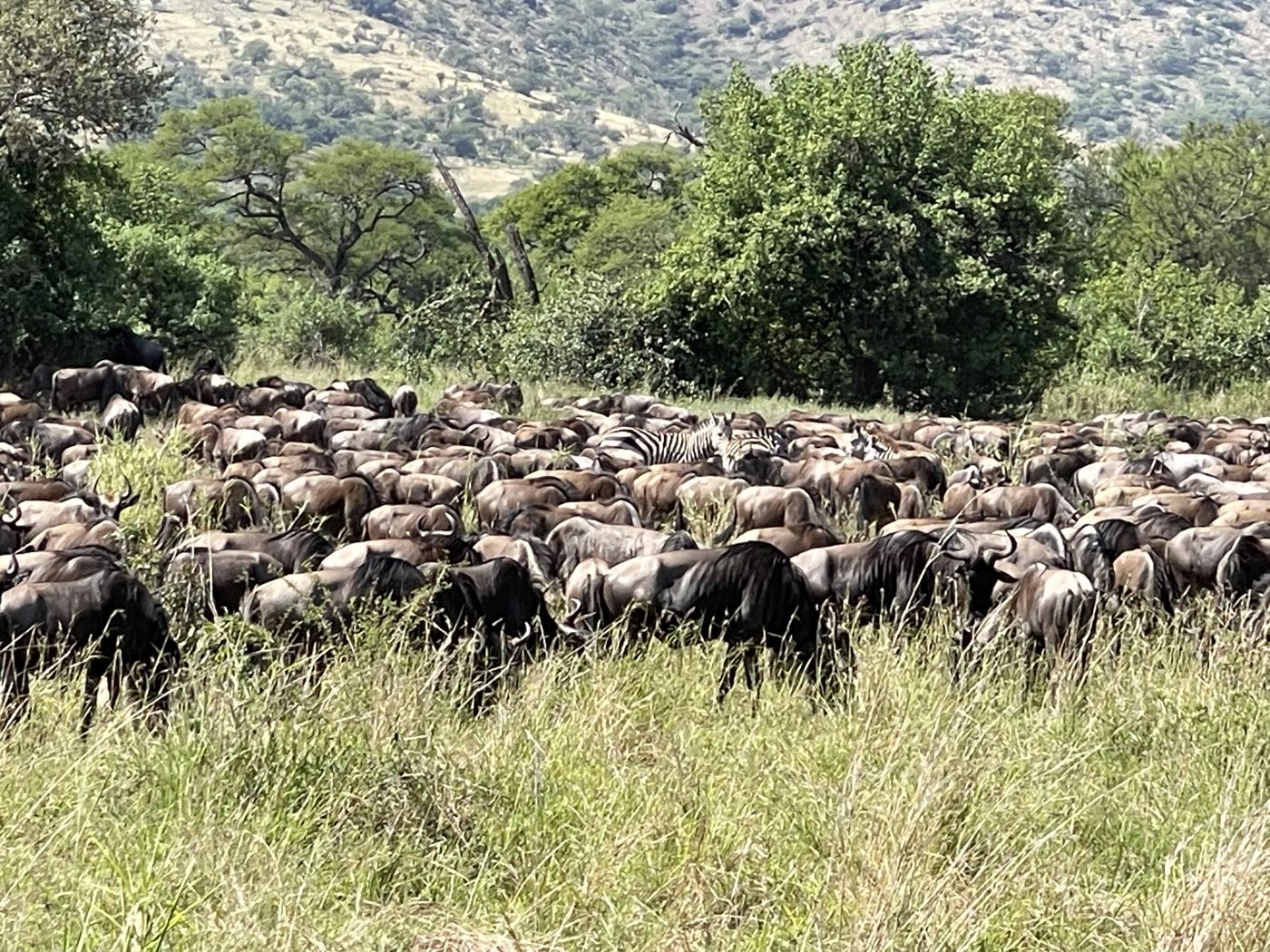
- The herds themselves. If you want to see the herds without waiting for one event, central Serengeti around Seronera suits you best in April and May and in November.
The detail on the first two goals sits in their own guides: the Serengeti calving season and Mara River crossing timing. Read one before you commit, because a goal that sounds simple often has a narrow window.
Step 2: Choose the window for your migration safari planning
Each goal has a typical window, and the herds can run two to four weeks early or late with the rains. The table gives the weeks to plan around in a typical year.
| Goal | Typical window | Where the herds are |
|---|---|---|
| Calving and predators | Late January to March, peak February; can start at the end of December | Ndutu, Kakesio, Lake Masek, Naabi Hill, Gol Kopjes |
| Grumeti River crossings | Late May to early July, June most reliable | Western Corridor around Kirawira and the Grumeti |
| Mara River crossings, Tanzania | July to October | Northern Serengeti around Kogatende and the Lamai Wedge |
| Mara River crossings, Kenya | July to October, likeliest mid-August to mid-September | Maasai Mara, central Mara and the Mara Triangle |
| Quieter weeks, lower rates | April to May and November | Central Serengeti around Seronera, then moving west or south |
Because the dates move, aim for the middle of a window and not its first or last week. Our guide to the Great Migration by month shows where the herds usually stand in every month.
Step 3: Choose the side, Tanzania, Kenya or both
Choose Tanzania if your goal is calving, the Grumeti or the longest season, and Kenya if your goal is the Mara River from its Kenyan bank in the peak weeks. The Serengeti holds the herds for roughly nine months of the year, while the Maasai Mara (also written Masai Mara) holds them for roughly July to October.
Calving happens only in the southern Serengeti and the Ndutu area, and Grumeti crossings are Tanzania only. Mara River crossings can happen on both banks. We compare the two sides in full in Serengeti or Masai Mara for the migration, so we keep this step short.
Both countries on one trip are possible from July to September, but the route runs through Nairobi and Kilimanjaro or Arusha, as step 6 explains. If that appeals, read combining Kenya and Tanzania before you decide.
Step 4: How many days for the Great Migration?
Allow at least four nights in the main area. Herds gather, mill and retreat at a river, sometimes for days, before they cross, and four nights gives the odds time to work.
- 7 days: one main area, four nights, with arrival and departure around it.
- 8 days: one side's river country, in our Kenya package across three areas.
- 10 days: two or three Serengeti areas, linked by light aircraft.
- 12 days: two countries, with four nights on each side of the border.
Each extra area adds a move, and going between the Mara and the Serengeti takes about half a day. Fewer, longer stays beat many short ones. If your days are limited, drop an area rather than shorten the main stay.
Step 5: Choose the area first and the camp second (migration camp positioning)
Pick the area where the herds will be in your weeks, then choose a camp inside it. The question that matters most is how far the camp is from the action. A camp 20 minutes from the river can give about two extra hours of viewing a day compared with one 90 minutes away. This is migration camp positioning, and it often matters more than room size.
Ask for the drive time to the crossing points or the calving zone, not the name of the park. Two camps in the same park can be a long way apart.
Mobile camp or permanent lodge
Mobile and seasonal camps move two or three times a year to follow the herds, so they can sit closer to the action. Permanent lodges have pools and larger rooms but do not move. Neither is better in every month, so ask which type each shortlisted camp is and where it will stand on your dates.
Where to look, area by area
Each area has its own guide.
- Southern and central Serengeti for calving and the Seronera area.
- Northern Serengeti around Kogatende for Mara River crossings on the Tanzanian side.
- Where to stay in the Masai Mara for the Kenyan side of the river.
- Mara conservancies for fewer vehicles and, in many, off-road driving.
- The Western Corridor for Grumeti crossings from late May.
As examples only, Lake Masek Tented Camp serves the Ndutu area from December to March, Olakira Camp serves northern Serengeti from July to October, and Governors' Camp stands beside Musiara Marsh in the central Mara. Availability and positions change every season and are confirmed in your quote.
Split stays
A split stay builds flexibility into the plan. On the Kenyan side, our Kenya Migration Explorer divides its nights between the Mara Triangle, the central Mara and Mara North Conservancy. Across the border, on a longer trip, a plan such as three nights at Kogatende and three in a Mara conservancy works, but it adds the Nairobi and Kilimanjaro routing described below. Build flexibility into the plan, not just the dates.
Step 6: Plan the travel legs
There is no direct flight between the Maasai Mara airstrips and the Serengeti airstrips. Going from one to the other means flying to Nairobi (Wilson), then to Kilimanjaro or Arusha, and on to a Serengeti airstrip. The detour takes about half a day and adds cost. There is also no open tourist border crossing inside the ecosystem for game-drive transfers, so do not plan to drive across the river country.
- Maasai Mara: fly from Nairobi Wilson to a Mara airstrip in about 45 to 60 minutes, or drive for five to six hours.
- Serengeti: fly from Arusha or Kilimanjaro to Seronera, Ndutu, Kogatende or Lamai in one to two and a half hours.
- Luggage: light aircraft usually allow about 15 kg per person including hand luggage, in a soft bag. Plastic carrier bags are banned in both countries.
Flying saves time, while driving the Mara road saves the aircraft fare. Our guide to fly-in or road safaris weighs the two.
Paperwork belongs in this step too. Tanzania uses an online eVisa and Kenya requires an eTA before departure. If you combine the two countries, carry a yellow fever certificate, and ask a travel clinic about malaria about six to eight weeks ahead.
Step 7: Add extras without breaking the herd time
Add extras last and place them after the herd nights, so that they never cut into the part of the trip you came for. Four extras come up most often.
- The Ngorongoro Crater. It pairs well with the Serengeti on the way in or out. Our Ngorongoro Crater guide covers timing and fees.
- A hot air balloon flight. It lasts about an hour in the air, followed by a bush breakfast, and it is weather dependent. Book early for peak months. The balloon flight price guide has the numbers.
- A beach. Our guide to adding Zanzibar explains the routing, and the Kenya Migration & Zanzibar Escape gives four nights of Mara River crossings, then four on Zanzibar's north coast, from US$5,450 per person for July to October.
- Gorillas. Our guide to whether to trek gorillas first or last covers the order, and the Gorillas, Migration & Zanzibar Honeymoon runs 14 days from US$11,800 per person for July to September.
Great Migration safari itinerary shapes: a Great Migration 7 day itinerary to 12 days
These four shapes show how the steps turn into a real Great Migration safari itinerary. Shapes 2 to 4 follow our own packages, and shape 1 is a planning outline that we adapt to your dates. Camps and times are confirmed in your quote.
| Trip | Days | Window | Main area |
|---|---|---|---|
| Calving outline | 7 | Late January to March | Ndutu and the southern plains |
| Kenya Migration Explorer | 8 | Late July to early October | Mara Triangle, central Mara, Mara North |
| Tanzania Grand Migration Explorer | 10 | Calving or crossings | Ndutu, Seronera, Kogatende |
| Kenya & Tanzania Grand Safari | 12 | Two windows | Mara, Serengeti, Ngorongoro |
A Great Migration 7 day itinerary for calving
A seven-day calving trip is possible if you accept one main area. Seven days leaves room for the journey in and out and four nights on the southern plains, covering Ndutu, Kakesio, Lake Masek and Naabi Hill. This leaves no room for a second area, so it suits a traveller who wants calving and the predators around it, and nothing else. Off-road driving is allowed in parts of the Ndutu area but not across most of Serengeti National Park.
If you want a first safari of seven days that is not built around the herds, our Classic Serengeti & Ngorongoro Crater Safari runs from US$4,650 per person. It covers Tarangire, central Serengeti and the crater, and it relies on resident big cats rather than the herds' position.
An eight-day Mara crossing trip
Our Kenya Migration Explorer: Maasai Mara River Crossings runs eight days from US$6,100 per person, in a private 4x4, for late July to early October. It moves between the Mara Triangle, the central Mara and Mara North Conservancy, so you meet several parts of the river. It suits travellers who want the Kenyan side only and do not want a second country. Crossings never fall on a fixed day, so several mornings at the river matter.
A Great Migration safari 10 days in the Serengeti
For a Great Migration safari of 10 days in Tanzania, the Tanzania Grand Migration Explorer runs from US$7,200 per person. It visits Ndutu and the southern Serengeti, central Serengeti and the northern Serengeti on the Mara River, flying between Ndutu, Seronera and Kogatende. It is timed either for calving (late December to March) or for crossings (late June to September), not both in the same departure. Choose the window first, and the camps follow the area.
A twelve-day two-country trip
The Kenya & Tanzania Great Migration Grand Safari runs 12 days from US$8,900 per person. It covers the Mara, the Serengeti and the Ngorongoro Crater, with four nights on each side of the border, and it suits a first migration trip that includes the crater. It fits June to October and late December to March. Be aware that the herds are in the Mara only from roughly July to October, so Kenyan nights in the December to March window will not be on the herds. Ask us how the route works for your dates.
What to tell a planner for your Great Migration safari
A planner needs eight facts to turn the seven steps into a route. Send as many as you have, and we ask for the rest.
- Goal: calving, crossings, or the herds in general.
- Dates, and how much they can move either way.
- The side you prefer, or that you are open.
- Who is travelling, including ages, since minimum ages at some camps run to 6, 8 or 12.
- The passport you travel on, since nationality decides visas.
- Camp style: comfort, premium or luxury.
- How you feel about light aircraft and about road days.
- Any extras you want: the crater, a balloon flight, a beach or gorillas.
Planning mistakes that cost herd time
- Booking fewer than four nights in the main area, then hoping the river cooperates.
- Choosing the camp before the area, and finding it sits far from the action.
- Assuming the Mara and the Serengeti connect by a direct flight.
- Putting the extras before the herd nights, so that one delay costs the main event.
- Planning for the first or last week of a window instead of the middle.
Private or shared vehicle matters at this stage as well. Our guide to private or group safari explains the difference.
Next steps: how to plan a Great Migration safari from here
- Write down your goal and the weeks you can travel, using the table in step 2.
- Read the area guide that matches your goal, from the list in step 5.
- Check what a Great Migration safari costs in your chosen month.
- Check lead times for migration camps, because peak camps sell out first.
- Send us your dates, group and nationality, and we will return a route and a quote.
Plan your Great Migration safari with a specialist
Tell us your goal, your weeks and your group. We reply with a route, the camp areas and a quote, and we say plainly if your month may not suit what you want to see.
Plan my tripNew to safari travel? Our first-time safari planning guide is the place to start, and our migration safari packages list every departure we run.
Keep reading: related Great Migration guides
Great Migration safari cost
What drives the price of a migration safari and what is included.
How far ahead to book a migration safari
How early to book for each month and why camps fill first.
Great Migration in February
Where the herds are in February, the weather and who should go.
Great Migration in January
Where the herds are in January, the weather and who should go.
Great Migration in March
Where the herds are in March, the weather and who should go.
Great Migration in October
Where the herds are in October, the weather and who should go.
How the Great Migration works
The yearly cycle, why the herds move and what drives the timing.
Is the Great Migration worth it
An honest look at crowds, expectations and who should choose another trip.
For the whole picture, see our Great Migration safari guide. If you are ready to price a trip, Tanzania Grand Migration Explorer starts from US$7,200 per person.
Planning more than one country?
The migration can be combined with gorillas in the same trip. These pages show how.
- gorillas, the Mara and the Serengeti: gorillas, the Mara and the Serengeti.
- a ready ten day route: a ready ten day route.
- when each country is at its best: when each country is at its best.
- every route, visa rule and package in one place: every route, visa rule and package in one place.
Plan your Great Migration safari with us
Park fees are set by Tanzania National Parks (TANAPA) and, for the crater, the Ngorongoro Conservation Area Authority. National park fees are set by the Kenya Wildlife Service, and Magical Kenya, the Kenya Tourism Board, publishes official visitor information. We confirm the current fees for your dates in every quote.