Rwanda and Kenya Safari Route Guide: Kigali, One Gorilla Trek and the Mara
A planner's guide to a Rwanda and Kenya safari: start in Kigali, trek once, fly to Nairobi, then the Mara. Flights, how to split your days and the entry rules for both countries.
October 11, 2026Published
19 minRead time
Paramount Gorilla Expeditions Team East AfricaAuthor
A Rwanda and Kenya safari pairs one mountain gorilla trek near Kigali with several days of big-cat country in the Mara, and it is simpler than a three-country trip: two entry systems, one international flight between them and one bush flight. This guide covers the Kigali to Nairobi leg, the Nairobi to Mara leg, how to split the days, the entry rules for exactly these two countries, who the route suits and its plain trade-offs, with facts checked 11 October 2026.
Written by Paramount Gorilla Expeditions Team East Africa. Facts last checked 11 October 2026.
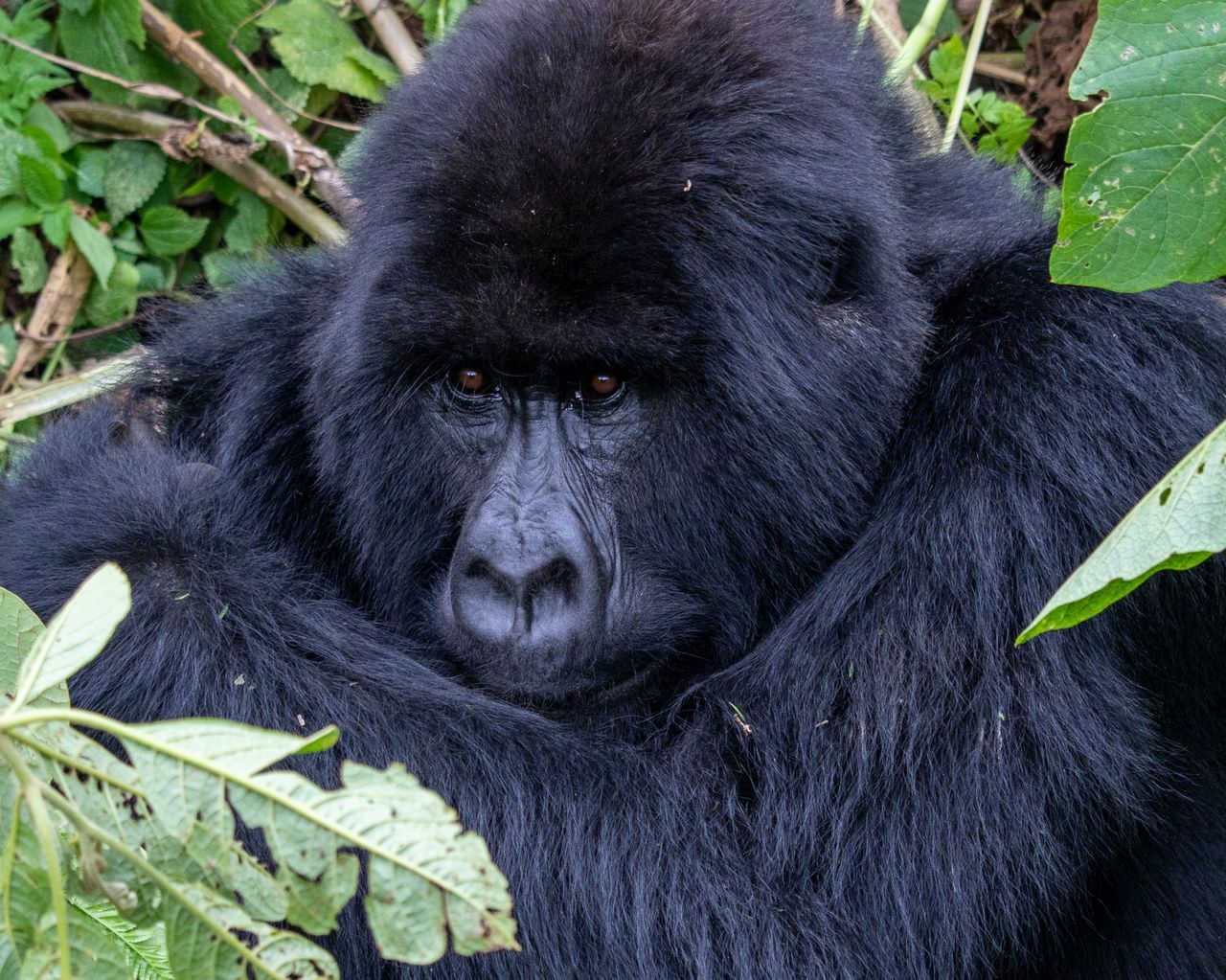
A mountain gorilla. On this route the Rwanda trek comes first and fixes every date that follows.
USD 1,500Rwanda gorilla permit, foreign visitors
2 to 3 hRoad from Kigali to the volcano lodges
1 h 30 to 1 h 50Kigali to Nairobi on published schedules
15 kgSoft-bag limit on the Mara flights
The short answer
A Rwanda and Kenya safari works best starting in Kigali: two nights near the volcanoes with one gorilla trek, a flight of about 1 hour 30 to 1 hour 50 to Nairobi, a Nairobi night, then a bush flight of about an hour to the Mara for three or more nights. Eight days is the tightest sensible length. The East Africa Tourist Visa is not needed for these two countries, and Rwanda's visa plus Kenya's eTA is usually simpler.
The two countries give you two encounters that barely overlap. Rwanda offers the mountain gorilla in the volcano forest above Musanze, in a small country where the airport is a short road from the park (see our Volcanoes National Park guide). Kenya offers the Mara: lions, leopards and cheetahs on open grassland, with private conservancies that limit vehicle numbers. A Rwanda Kenya safari therefore gives you forest and savannah in a trip short enough for one holiday window.
The pairing also solves a logistics problem. From Kigali the gorilla area is a 2 to 3 hour drive, while Entebbe to Bwindi in Uganda is 8 to 10 hours by road, or about 1 hour 15 minutes by light aircraft. A Kigali to Nairobi safari is built around that predictable first leg, which is what lets the days fit together. If you are still choosing between the two gorilla countries, read Uganda vs Rwanda first.
Kigali is the right arrival point because it puts the most fixed, most physical day of the trip first. Everything else on a Kenya and Rwanda safari can be moved by a day if a flight slips; the gorilla permit cannot.
The permit date comes first
A Rwanda permit covers one person, one trek and one date. The Rwanda Development Board portal lists USD 1,500 for foreign visitors, and its rules are strict: no refund for late arrival or for your own cancellation. Peak dates sell out months ahead, so we secure the permit before we book any flight. Our guide to booking gorilla permits explains the process, and the sequencing argument is made in full in gorillas first or last.
Arrival day and the road to the volcanoes
Kigali airport to Musanze is about 105 km, which operators put at 2 to 3 hours by road, and trekkers report at Kinigi at about 7:00. We therefore place you in a lodge near the park the night before, which needs a flight that lands by early afternoon. A late arrival goes to a Kigali hotel instead, and the first lodge night is trimmed. The usual rhythm is two nights near the park: arrival and rest, then trek day. On the third morning you drive back to Kigali for the afternoon flight to Nairobi.
The Rwanda leg is also where plastic bags matter. Rwanda's Law 17/2019 bans the import and use of plastic carry bags, and we found no tourist exemption, so pack with cloth or paper bags and carry none you do not need. Leave drones at home unless permits are in hand: Rwanda needs a permit and a Rwandan sponsor.
The Kigali to Nairobi flight on a Rwanda and Kenya safari
The Kigali to Nairobi flight is the only international hop on this route, and it is nonstop. Kenya Airways and RwandAir both fly it, and one aggregator's sample week also lists a Brussels Airlines service on Sundays, for more than 30 flights a week in total. Sample departures from Kigali that week were Kenya Airways at about 09:00 and in the evening, and RwandAir in the morning and late afternoon. Treat these as the shape of the day, not a timetable.
Leg
What flies or drives
Time
Planning note
Kigali to Nairobi
Kenya Airways and RwandAir, nonstop
About 1 h 30 to 1 h 50
Nairobi is one hour ahead of Kigali
Nairobi airport (JKIA) to Wilson
Road transfer
An hour or more, reported by operators
From the city centre, one guide gives 20 to 45 minutes; allow for traffic
Nairobi Wilson to the Mara
AirKenya, Safarilink, Governors Aviation
About 1 h with stops
Morning and afternoon departures; 15 kg soft bag
Mara back to Wilson
Same airlines
Up to about 1 h 30 with stops
The camp decides which airstrip you use
Kigali to the Mara, direct
No scheduled flight found
Not applicable
Always routed through Nairobi
All times are about, and the aggregator and airline schedules differ in places, so confirm the schedule for your date.
Why guides disagree about the flight time
The disagreement has a simple cause. A scheduled 09:00 departure from Kigali shows an arrival of about 11:30 in Nairobi, which looks like two and a half hours on the clock, but Nairobi is one hour ahead. Subtract the time difference and you are back to roughly an hour and a half in the air. For the wider picture of routes between safari countries, see our safari flight logistics guide.
Why a Nairobi night belongs on this route
A trek morning leaves you in Musanze, 2 to 3 hours from the airport, so no morning flight is reachable from the volcanoes. The morning departures on the samples we saw leave Kigali from about 08:00, which would mean setting out from the park lodge well before dawn. And even if you landed in Nairobi at about 11:30, one operator guide says check-in for the bush flight closes 60 minutes before departure, while the road transfer to Wilson takes an hour or more. That connection has no slack, so we add the night and use it to repack.
Packing tip: the Mara airlines allow 15 kg per person including hand luggage, in a soft bag. AirKenya charges USD 5 per kilogram for excess, and a freight seat that carries an extra 75 kg is sold on some airlines. Leave surplus clothing at your Nairobi hotel. Airline detail is in our guide to safari luggage weight limits.
Confirm before you book. Airline pages and aggregators disagree on several departure times, and the Wilson to Mara timetable has morning and afternoon flights that differ between sources. Do not buy a non-flexible onward ticket until your operator has confirmed the Kigali to Nairobi flight and the Wilson departure for your dates in writing.
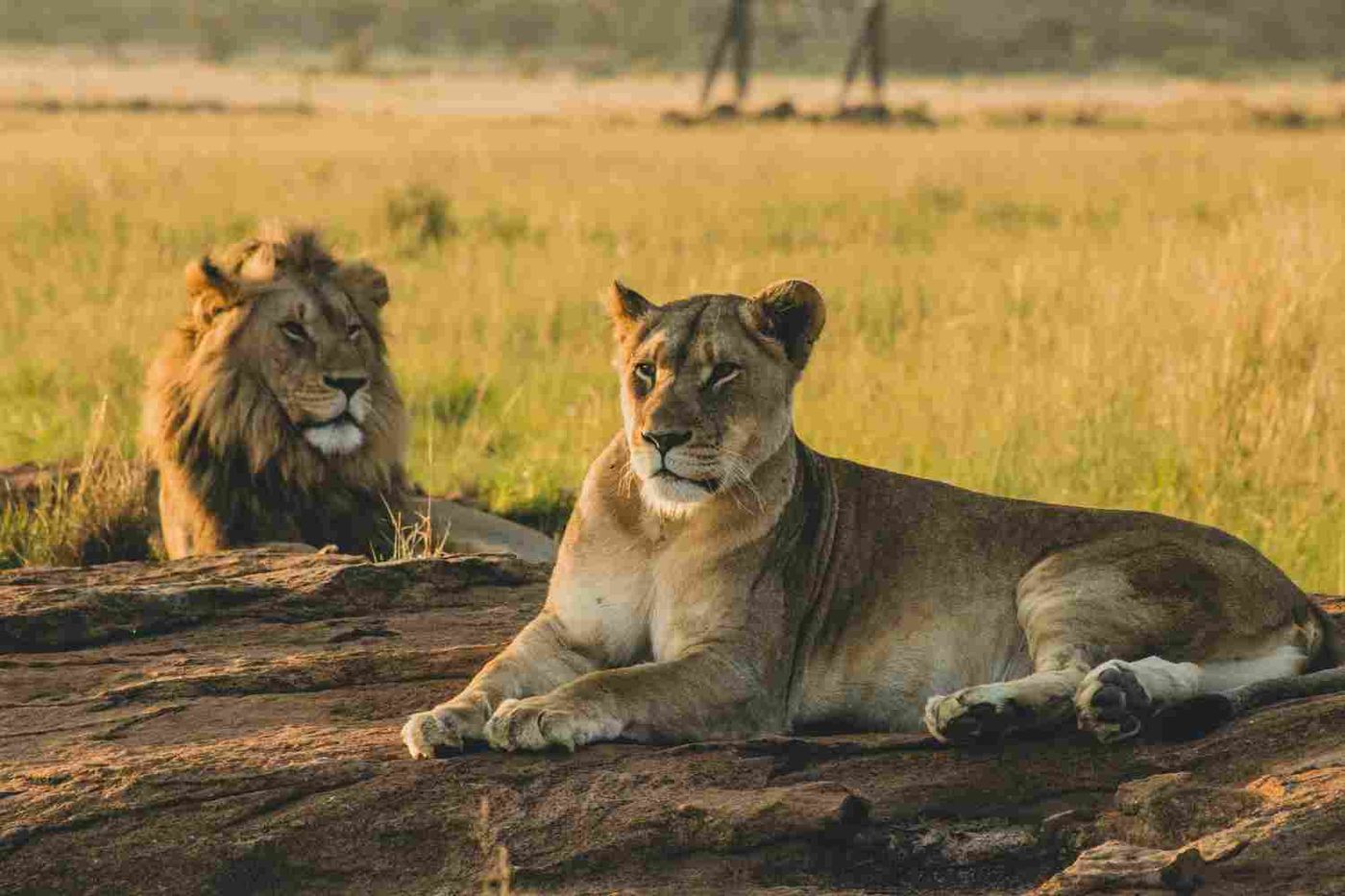
Lions in the Mara. Three nights is the shortest stay we plan here.
Days in the Mara: getting there from Nairobi and how long to stay
The Nairobi to Mara leg is where a Rwanda and Kenya safari becomes a classic safari, so the number of days in the Mara matters more than any other choice after the gorilla permit. There are two ways to get there, and a third question, which part of the Mara.
By air from Wilson
Light aircraft leave Nairobi's Wilson Airport for the Mara strips. AirKenya, Safarilink and Governors Aviation all fly from Wilson, and the flight takes about an hour with stops. Strips named on operator pages include Keekorok, Serena, Musiara, Ol Seki (for the Naboisho area) and Kichwa Tembo; the camp decides the strip, so confirm yours before you book flights. Operators describe a morning and an afternoon departure, with an extra midday flight from July to October. From the city centre, one guide puts the Wilson transfer at 20 minutes without traffic and about 45 in normal traffic.
By road
Nairobi to the Mara is about 6 hours by road (5.5 to 6.5 hours by the gate, per a recent Kenyan travel report). It avoids the flight and its baggage limit, but it takes most of a day each way, which on a short trip is days in the Mara you give up. We offer it for guests who dislike small aircraft, and our guide to fly-in or road safari sets out the trade-off.
Reserve, conservancy and how many nights
The national reserve is open to many vehicles, while private conservancies cap vehicle numbers. The herds may not be in any one conservancy on a given day. Our Mara reserve guide describes the sectors, and luxury conservancy safaris explains how the private areas differ.
We plan three nights as the minimum and four as the comfortable number. Two nights gives you one full game-drive day after the flight, which is too thin if rain, cloud or a quiet morning costs you a drive. From late July the wildebeest usually reach the Mara, and river crossings are the thing guests ask about; they cannot be scheduled, and our crossing timing guide explains why. Three or four days in the Mara is a real chance, not a promise.
How to split your days on a Rwanda and Kenya safari
The question most guests ask is how to split your days between the two countries. On a Kigali to Nairobi safari the answer starts with one fixed block: two nights near the volcanoes, one trek, one Nairobi night. Everything beyond that is extra Mara time or a second Kenya stop. The table sets out the patterns we plan.
Length
Rwanda
Nairobi
Kenya
What it gives you
8 days, 7 nights
2 nights near the volcanoes
1 night between, 1 night before the flight home
3 nights in the Mara
The tightest sensible plan: one trek, three Mara days, no spare day
10 days, 9 nights
1 night in Kigali, 2 near the volcanoes
1 night between, 1 night before the flight home
4 nights in the Mara
A rest night after arrival and a fourth Mara night as a buffer
12 days, 11 nights
1 night in Kigali, 2 near the volcanoes
1 night between, 1 night before the flight home
4 nights in the Mara, 2 at a second Kenya stop
A second Kenya landscape, or a second Rwanda day
Patterns are our planning judgement, built from the sourced transfer and flight times above, not a published standard. One planning guide dated 30 June 2026 says at least 10 days, with 12 to 14 more comfortable, so read the 8 day row as a trimmed version.
Adding days without adding travel
Eight days works because every leg is short and every night has a job, but it has no room for a delayed flight. If you can add two days, we add them as a Kigali night and a fourth Mara night, not as more travel. The second Kenya stop could be Amboseli, Lake Nakuru or Laikipia; we give no transfer times for those here. A morning in Nairobi National Park can fill a buffer day. Day counts for longer, multi-country trips are covered in how many days a multi-country trip needs.
Rwanda first or Kenya first
We start in Kigali, for three reasons. The permit date is fixed and non-refundable, so putting it first means a late flight later in the trip cannot cost you the trek. The trek is also the most tiring day, best taken on fresh legs. And the route ends in Nairobi, where long-haul connections are plentiful. Our tie-breaker is simple: start in Kigali, trek first; start in Nairobi, trek last. This is our reasoning, not a rule, and the debate is two-sided among operators.
Some operators run the reverse, with the Mara first and the gorillas as a finale. That can feel more rewarding, but a weather delay on a bush flight then puts a non-refundable permit at risk, and you finish in Kigali with the flight home from there. One operator document we read also says that if Kenya is your first country the East Africa Tourist Visa cannot cover the trip, which is another reason to settle the order before you buy any visa.
One gorilla trek on a Rwanda and Kenya safari: permit, age and booking
One gorilla trek is the right amount on this route. A single trek gives you the full encounter and keeps the time and money for the Mara. A second trek needs a second permit, a second date and another night, and the Mara days are what you would give up.
The Rwanda rules at a glance
From the Rwanda Development Board portal as of 11 October 2026:
Price. USD 1,500 per person for foreign visitors, for one trek on one date. We found no notice of a 2027 price.
Age. The minimum age is 15, so this trek is not an option for younger children on the route.
Group and time. Groups are limited to 8 people, and you get up to one hour with the family.
Briefing. You report at Kinigi at about 7:00.
Refunds. None for late arrival or your own cancellation. You get 75 percent back if you track all day with no contact, and a retry or full refund if the family moves away and cannot be found.
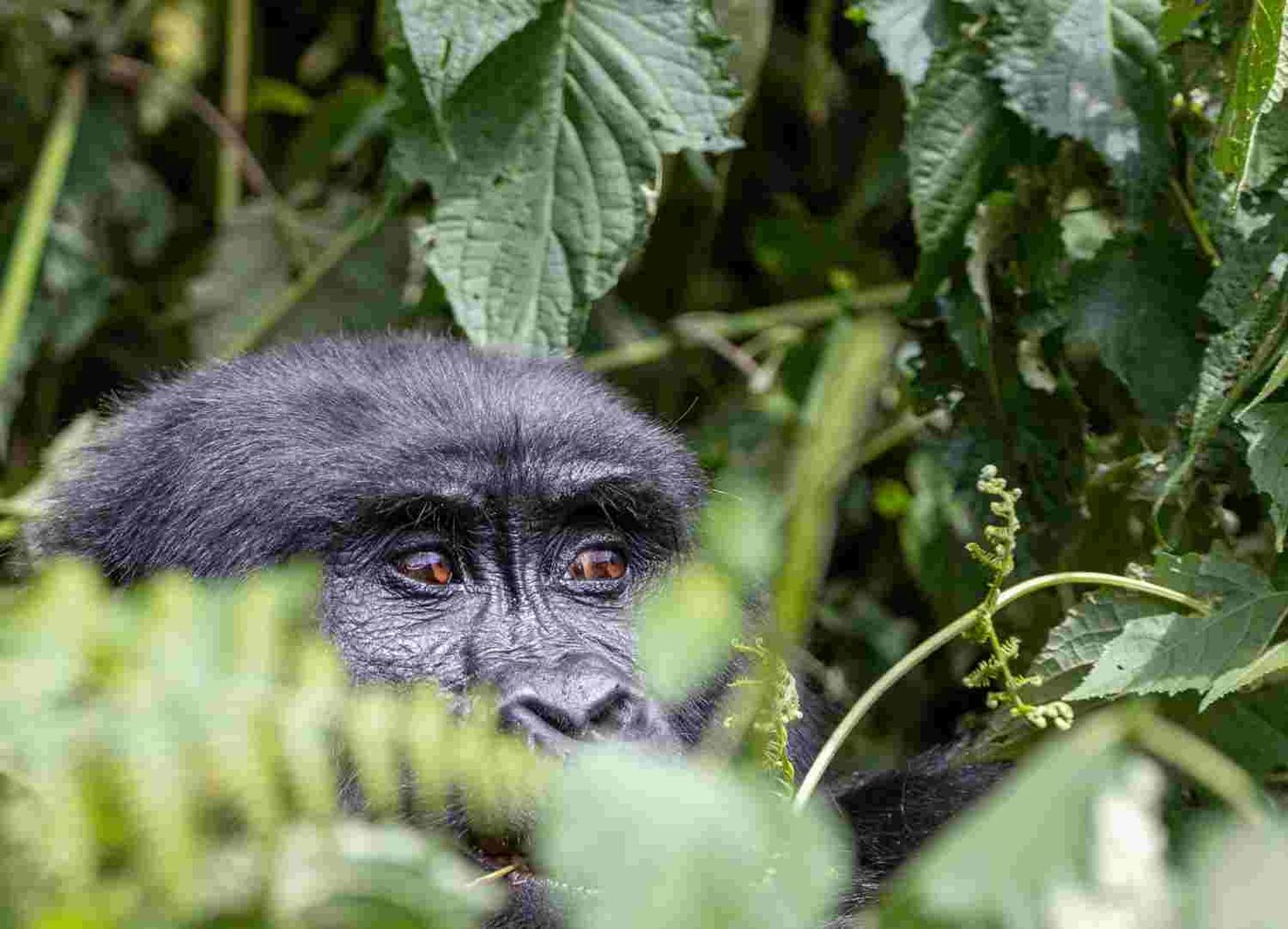
A young mountain gorilla. One permit buys one trek on one date.
If you want more primates
A golden monkey permit is a separate booking in the same park, and the Dian Fossey tomb hike is a half-day extra (about a 30 minute drive and 2 to 3 hours of walking, per one travel guide); we have no verified price for either, so ask us. Treks on consecutive days need two permits, and combining Uganda and Rwanda gorilla trekking covers doing more than one. For what moves the final price, see our East Africa safari cost guide.
Entry rules for both countries on a Rwanda and Kenya safari
Two countries mean two entry systems, and for exactly these two you do not need the East Africa Tourist Visa. The table shows what each country asks. We give the official fee where we found one, and the mechanics sit in the guides linked beneath.
Country
What you need
Fee on published pages
Note
Rwanda
A Rwanda tourist visa, applied for on Irembo, unless you are exempt
About USD 50 single entry
Commonwealth citizens are free for a short stay per the UK FCDO; apply online ahead
Kenya
An eTA from etakenya.go.ke before you fly
USD 30 standard
Apply only on the official portal; plan 2 weeks ahead
Optional: the East Africa Tourist Visa
One visa for Uganda, Kenya and Rwanda, entering through the issuing country
USD 100, non-refundable
Not required for this route; the eTA question below is unresolved
Fees and rules can change.
Visas and the eTA for a Rwanda and Kenya trip
Why we do not use the EATV here. The East Africa Tourist Visa is USD 100, valid 90 days, multiple entry within Uganda, Kenya and Rwanda, and tourism only. On this route that is more than the two separate permissions cost most travellers: about USD 50 for Rwanda plus USD 30 for the Kenya eTA is USD 80 (our arithmetic from published fees), and Commonwealth citizens pay nothing for Rwanda. The decision, including routes that add Uganda, is in our East Africa tourist visa guide.
The Kenya eTA. Some official embassy pages say EATV holders do not need a separate eTA, but Kenya's own eTA portal does not confirm it yet, so confirm with Kenya's immigration helpdesk before you rely on it. The portal's FAQ publishes WhatsApp support on +254 110 922 064. Standard processing takes about 3 working days and can take longer, and airlines may refuse boarding without an approved eTA. Citizens of the East African Community and many African nationals are exempt. The full mechanics are in our Kenya eTA guide.
Passports, yellow fever and health
Passports. Keep at least six months of validity from arrival and at least two blank pages to be safe. The UK FCDO asks for two blank pages for Kenya, while Rwanda asks for one and Kenya's own eTA page says one.
Yellow fever and Ebola notices on this route
Yellow fever. The test is the country you arrive from, not the country you visit. Rwanda's health notice of 22 May 2026 lists Kenya among the countries whose arrivals need a certificate, while Kenya's airports page does not list Rwanda. For this route that matters only if your long-haul flight to Kigali connects through Nairobi: we found no source saying whether a short connection counts, so carry your certificate if you have one and ask. Uganda dropped its own requirement on 2 October 2026, which changes nothing for Rwanda or Kenya. See our yellow fever certificate guide and the vaccination guide.
Health notices are moving. The Ebola outbreak is centred on the DR Congo (WHO, 8 October 2026), and Kenya confirmed its first imported case on 6 October 2026. Press reports of 7 October describe a health declaration and screening at Nairobi airport for flights from several countries, which may include Rwanda; Rwanda's notice also refuses foreign nationals who were in the DR Congo in the previous 30 days, and we could not confirm that it is current. Advisories differ by government and some lag, so read the live pages from WHO, the CDC, UK FCDO for Kenya, UK FCDO for Rwanda and the Rwanda Biomedical Centre. Our hub tracks dated notices under health alerts.
Tanzania's visa and insurance rules do not apply because the route never enters Tanzania. If you add the Serengeti, they do, and the route guide linked earlier covers them. The UK FCDO publishes entry requirements for Rwanda and Kenya.
Which months suit a Rwanda and Kenya safari
A month-by-month calendar belongs to our best time for a multi-country safari guide, so here is the short version for a Kenya and Rwanda safari. Gorillas can be trekked all year. Rwanda's long dry season runs from June to mid-September, with a second short dry spell from December to February. In the Mara, herds usually arrive from late July, August and September are strongest, and some herds leave in October. Timing varies by weeks, and the Mara's crossings cannot be scheduled.
Months
Rwanda trek
Mara
Fit for this route
Late July to September
Long dry season, until mid-September
Herds usually present; river crossings possible
Strongest window, with the highest demand for permits
October to November
Short rains
Herds begin to leave; short rains
Possible, with more weather risk
December to February
Short dry spell
Mostly dry after the short rains; quieter; no river crossings
Good for big cats; plan for 2026/27 rain risk
March to May
Long rains, April wettest
Long rains
Hardest to plan
Timings vary by weeks, and crossings cannot be promised.
The 2026/27 season needs a caveat. Kenya Met's outlook of 26 August 2026 has Narok wetter than normal from October to December, with rains continuing into January in the west, and a press item of 10 September said possibly later. Meteo Rwanda expects a wet season comparable to 1997 and 2023, wetter in the north where the volcanoes are, ending about 6 December. Operators note that in wet years the herds disperse and bush flights suffer delays from cloud and waterlogged strips, so we keep a buffer night in Nairobi. See the migration in Kenya.
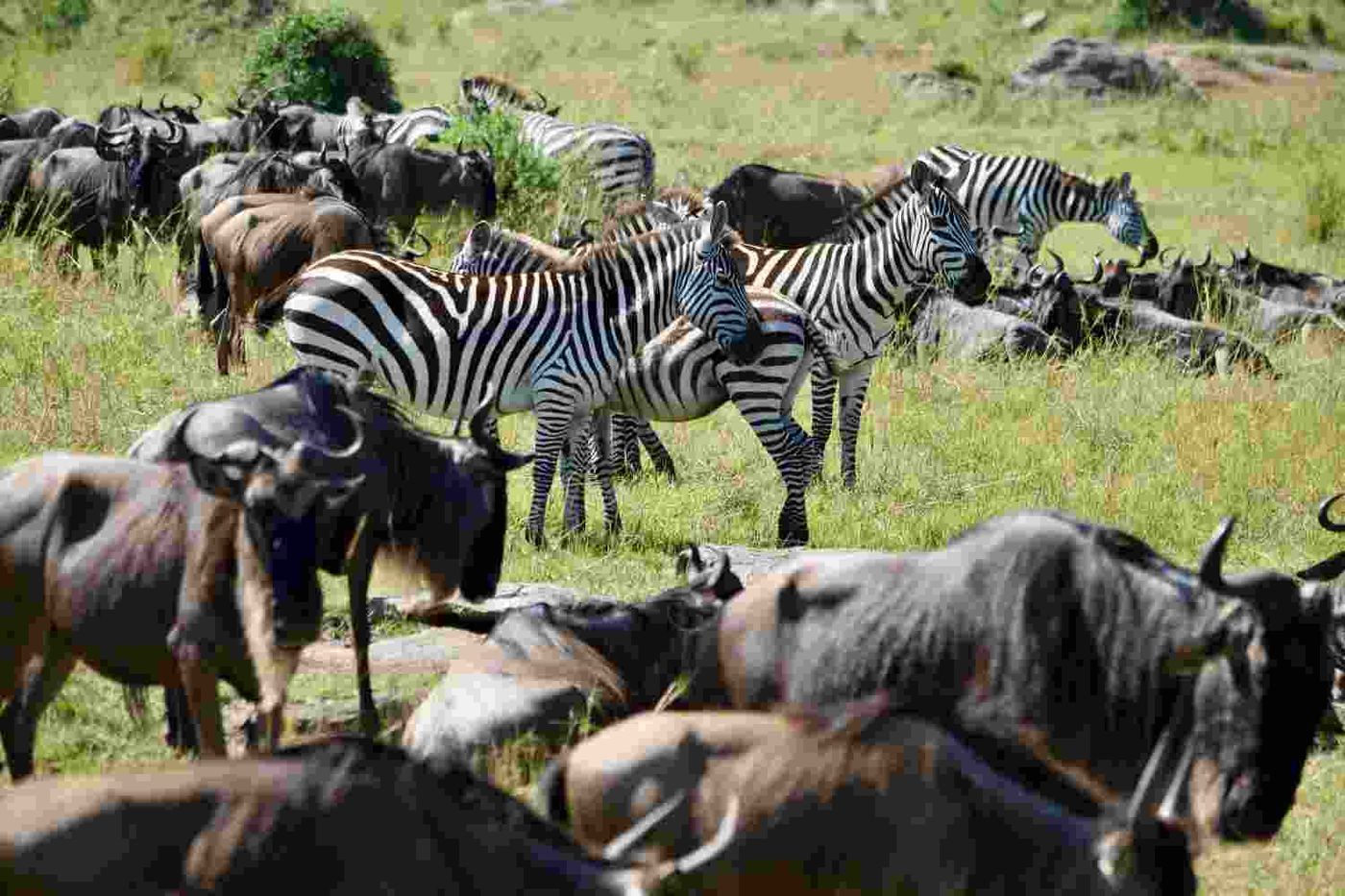
Wildebeest and zebra. Herd timing varies by weeks, which is why we leave a buffer.
Who a Rwanda and Kenya safari suits, and the mistakes to avoid
A Rwanda and Kenya tour suits guests who want a gorilla trek and a classic savannah safari in one short trip: couples, small families with children of 15 and over, and friends travelling for a milestone. It suits anyone who would rather have two well-paced countries than four rushed ones. It suits less well anyone who dislikes small aircraft or cannot pack into a 15 kg soft bag.
The plain trade-offs are these. The permit date is rigid and non-refundable. The bush flights carry a baggage limit and can be delayed. Eight days leaves no spare day. The Mara can show you cats on any date but cannot promise the herds. And a Rwanda and Kenya trip does not include Tanzania's plains.
Same-day Volcanoes to Mara. It cannot be done from a trek morning. Add the Nairobi night.
Buying the East Africa Tourist Visa by habit. It costs more than the separate permissions on published fees, and its eTA benefit is unconfirmed.
Booking flights before the permit. The permit date is the fixed point, so every flight should follow it.
Only two Mara nights. After the flight you get one clear drive day. We plan three.
Packing a hard case. Bush airlines ask for soft bags and weigh them at 15 kg including hand luggage.
Counting on a crossing. It is a possibility, not a booking.
What most Rwanda and Kenya guides get wrong
The same errors recur across the leading pages for this route, and naming them helps you check any plan, ours included.
The flight time. Published guides give anything from 40 minutes to "two to three hours" for Kigali to Nairobi. Schedules show about 1 hour 30 to 1 hour 50 in the air, with the one-hour time difference explaining most of the confusion.
A direct Mara flight. One long guide says a direct flight exists and then says it does not. We found none in AirKenya's 2026 timetable or on the other airline pages; plan through Nairobi.
The visa. The EATV covers Uganda, Kenya and Rwanda, but guides blur it into a two-country saving, and on published fees it is not one. Some say outright that no eTA is needed; no official source we read confirms that.
Booking lead times. Pages differ between 3 to 6 months and 6 to 12 months. We say "months ahead for peak dates", because no official figure exists.
Yellow fever. Some operator pages say Kenya requires a certificate from all travellers. The UK FCDO says it applies to arrivals from risk countries. See the guide linked above.
Next steps for your Rwanda and Kenya safari
Start with the permit date, then the flights, then the lodges. Our planners in Entebbe and Kakindu can confirm the Kigali to Nairobi flight, the Wilson departure for your dates and the entry documents in writing. The closest package for this Rwanda and Kenya tour is the 8 day Rwanda Kenya safari, and we can stretch the same shape to 10 or 12 days. If you would like Tanzania added, the 10 day Rwanda Kenya Tanzania safari continues from the Mara into Tanzania. For the packing basics, see our safari packing list.
For a two-country route like this one, the fixed fees are mostly the Rwanda gorilla permit and the Mara fee. Our four country safari cost guide lists both and adds up the fixed fees of our 8 day route.
Plan my Rwanda and Kenya safari
Tell us your dates, your group and how many gorilla permits you need. We will check the flights and the entry rules and send the route in writing.
Written by Paramount Gorilla Expeditions Team East Africa. Facts last checked 11 October 2026.
#rwanda and kenya safari#rwanda kenya safari#kenya and rwanda safari#kigali to nairobi flight#gorilla trek and mara#days in the mara#rwanda visa and kenya eta#nairobi wilson to mara#how to split your days
Late July to September is the best time for a four country safari across Uganda, Rwanda, Kenya and Tanzania. See the month by month table, the second window and the 2026/27 rain caveat.
Trek gorillas in both countries on one trip: what two permits cost, which Bwindi sector links to Rwanda, which direction to travel and how to protect a rest day between treks.
What an East Africa safari really costs: the four price drivers, official permit and park fees in Uganda, Rwanda, Kenya and Tanzania, our from-prices and how to read a quote.
The East Africa tourist visa covers Uganda, Kenya and Rwanda for USD 100 and 90 days, but not Tanzania. Fees, first-entry rule, Kenya eTA question and the Tanzania eVisa, dated.
The fixed part of a four country safari cost: permits, park fees, visas and Tanzania insurance, added up for six routes, plus the ten lines to compare in any quote.
Should gorilla trekking come at the start or end of a long safari? Both sides, the tie-breakers, buffer nights and what to do if a trek is cancelled, with a five-step method to choose.
Work out how many days a Uganda, Rwanda, Kenya and Tanzania safari needs: a nights-per-stop ledger, the transfer days you cannot skip, and what 10 to 21 days really give you.
The Kenya eTA for safari guests: official USD 30 fee, about three working days to process, 90 days validity, who is exempt, transit rules and the open question for regional visa holders.
A planner's guide to a Rwanda Kenya Tanzania safari that starts in Kigali: route order, flights, the Mara to Serengeti link, entry rules and the gorilla permit.
A planner's guide to a Rwanda and Tanzania safari: one gorilla trek, RwandAir's three-day-a-week flight, the Serengeti by air or road, and Tanzania's eVisa and insurance rules.
How flights really work between safari countries: international routes, bush flights, the 15 kg baggage limit, the Mara to Serengeti link, overland times and a realistic transit day.
Safari luggage weight limits by carrier: the 15 kg soft bag rule, who allows 20 kg, excess and freight seat prices, storing luggage at the gateway and packing for the multi-country trap.
Tanzania now requires foreign visitors to hold government inbound travel insurance. See what is verified, reported and unknown: cost, exemptions, Zanzibar, buying and enforcement.
The route we recommend for a Uganda Kenya Tanzania safari: the best order, how many days it needs, the best months, how you move between countries and what to check before you book.
Two land posts link Rwanda and Uganda for gorilla trips. Learn which suits your sector, what to carry, how long to allow and why hours differ, checked 11 October 2026.
A Uganda Rwanda Kenya safari on one East Africa Tourist Visa: the order of the three countries, the Nairobi flights, the Mara, yellow fever rules and the open Kenya eTA question.
How to plan a Uganda Rwanda Kenya Tanzania safari: the four route directions compared, the flight chain, how the East Africa Tourist Visa interacts with the order, and what to check.
A planner's guide to a Uganda Rwanda Tanzania safari: Entebbe or Kigali start, the border or flight between the forests, Kilimanjaro flights, visas and Tanzania's insurance.
Visa rules for Uganda, Kenya, Tanzania, Zanzibar and the Seychelles change often. Here is how to check them properly and what to prepare before you travel.
Uganda dropped its yellow fever entry certificate on 2 October 2026, but Kenya, Rwanda and Tanzania still ask. Journey table, 12 hour transit rule and border outcomes, dated.
Can you combine Rwanda gorilla trekking with a Mara safari?+
Yes. You trek in Rwanda, fly nonstop from Kigali to Nairobi, then take a light aircraft from Nairobi's Wilson Airport to the Mara. No scheduled flight links Kigali to the Mara directly, so Nairobi is always the connection. The simplest version is eight days, with one trek, a Nairobi night and three nights in the Mara, and it works best when the permit date is fixed first.
How long is the flight from Kigali to Nairobi?+
About 1 hour 30 to 1 hour 50 on published schedules. Kenya Airways and RwandAir fly it nonstop several times a day. Guides disagree because Nairobi is one hour ahead of Kigali, so a flight that departs at 09:00 and lands at about 11:30 looks longer on the clock than it is in the air. Confirm the exact times on your ticket, because airlines retime this route often.
Is there a direct flight from Kigali to the Mara?+
No scheduled direct flight was found in AirKenya's 2026 timetable or on other airline pages we read, and we do not rely on one. You fly Kigali to Nairobi, then Nairobi Wilson to a Mara airstrip, which takes about an hour with stops. Chartering a private aircraft is a separate arrangement, and we would confirm availability and cost with your planner before suggesting it.
Do I need a night in Nairobi between Rwanda and the Mara?+
We plan one, yes. After a trek morning you are 2 to 3 hours from Kigali airport, so no morning flight is realistic, and an afternoon arrival in Nairobi cannot make that day's bush flight. Operators say the road transfer to Wilson takes an hour or more and check-in closes an hour before departure. The night also gives you time to repack into a 15 kg soft bag.
Should I trek the gorillas first or do the Mara first?+
We start with the gorillas. The Rwanda permit is fixed to one date and is non-refundable for lateness, so a delayed bush flight later in the trip cannot then cost you the trek. Starting in Kigali also ends the trip in Nairobi for the flight home. Some operators run it the other way round, so the order is a judgement, not a rule.
Do I need the East Africa Tourist Visa for Rwanda and Kenya?+
No, it is not required. The East Africa Tourist Visa costs USD 100, while a Rwanda visa at about USD 50 plus the Kenya eTA at USD 30 comes to USD 80 on published fees, and Commonwealth citizens pay nothing for Rwanda for a short stay. That is our arithmetic, so confirm the fees for your passport. Our East Africa tourist visa guide covers the full decision.
Do I need a Kenya eTA if I have an East Africa Tourist Visa?+
That is not settled. Some official embassy pages say EATV holders do not need a separate eTA, but Kenya's own eTA portal does not confirm it yet. Confirm with Kenya's immigration helpdesk before you rely on it. If you skip the EATV, as we advise for this route, you apply for the USD 30 standard eTA on etakenya.go.ke before travel.
How many days do I need for a Rwanda and Kenya safari?+
Eight days is the tightest plan we sell, with two nights near the volcanoes, one in Nairobi, three in the Mara and one more in Nairobi. It has no spare day. Ten days adds a Kigali night and a fourth Mara night as a buffer, and twelve adds a second Kenya stop. One planning guide says at least 10 days, so treat eight as a trimmed trip.
Is one gorilla trek enough on this route?+
Yes. One trek gives the full encounter, with up to one hour with a gorilla family, and it leaves time and money for the Mara. A second trek needs a second permit at USD 1,500, a second date and another night. Golden monkey permits are a separate booking in the same park, and we have no verified price for them, so ask your planner.
What is the luggage limit on the Mara flights?+
The Mara airlines allow 15 kg per person including hand luggage, in a soft bag. AirKenya charges USD 5 per kilogram for excess at check-in, and some airlines sell a freight seat for extra bags. Camera gear counts towards the limit. Leave surplus clothing at your Nairobi hotel, and see our luggage guide for airline details.
When is the best time for gorillas and the Mara together?+
Late July to September is the strongest overlap: Rwanda's long dry season runs to mid-September, and herds usually reach the Mara from late July. Permits and rooms sell earliest then. Crossings cannot be scheduled and timing varies by weeks. For October 2026 to early 2027, forecasts point to wetter than normal weather, so build in a buffer.
Do I need a yellow fever certificate for Rwanda and Kenya?+
It depends on where you arrive from, not on the country you visit. Rwanda's May 2026 notice lists Kenya, so a long-haul flight to Kigali that connects through Nairobi is worth asking about, while Kenya's airports page does not list Rwanda. Uganda dropped its own requirement on 2 October 2026. Carry your certificate if you have one, and ask your doctor.
Tick the destinations you're drawn to — each one opens its own list of signature experiences. Tick as many as you like, tell us how to reach you, and a real destination specialist turns your selections into a tailored itinerary within 24 hours.