

Kenya and Tanzania sit side by side across one continuous ecosystem — the Maasai Mara and the Serengeti are, geologically and ecologically, the same grass plains split by a political border — which makes combining the two countries into one safari one of the most natural, popular trip structures in East African travel. It's also one of the most misunderstood: no direct flight links the Mara to the Serengeti, and the realistic routing between them (whether by road through a border post or by air via an international gateway) shapes everything about how a combined trip should actually be planned. This guide explains exactly how a Kenya-Tanzania combination works in practice — the real border crossings, the real flight routings, visa requirements that catch travelers out, migration timing on both sides of the line, and realistic sample itineraries — rather than the oversimplified "just hop over" framing that circulates online.
- Why combine Kenya and Tanzania
- How the border came to split one ecosystem
- The real routing: no direct flights
- Border crossings in detail
- Flying between the two countries
- Visas and entry requirements
- The Mara-Serengeti combination
- The Amboseli-Kilimanjaro-Ngorongoro combination
- Adding Zanzibar
- Comparing the Mara and Serengeti sides
- Practical logistics across the border
- Best time to combine both countries
- Sample combined itineraries
- What a combined trip costs
- Combining with gorilla trekking too
- Choosing your route
- Choosing an operator for a cross-border trip
- Health, safety and travel insurance
- Packing for a cross-border trip
- Common mistakes
- FAQ
Why combining Kenya and Tanzania works
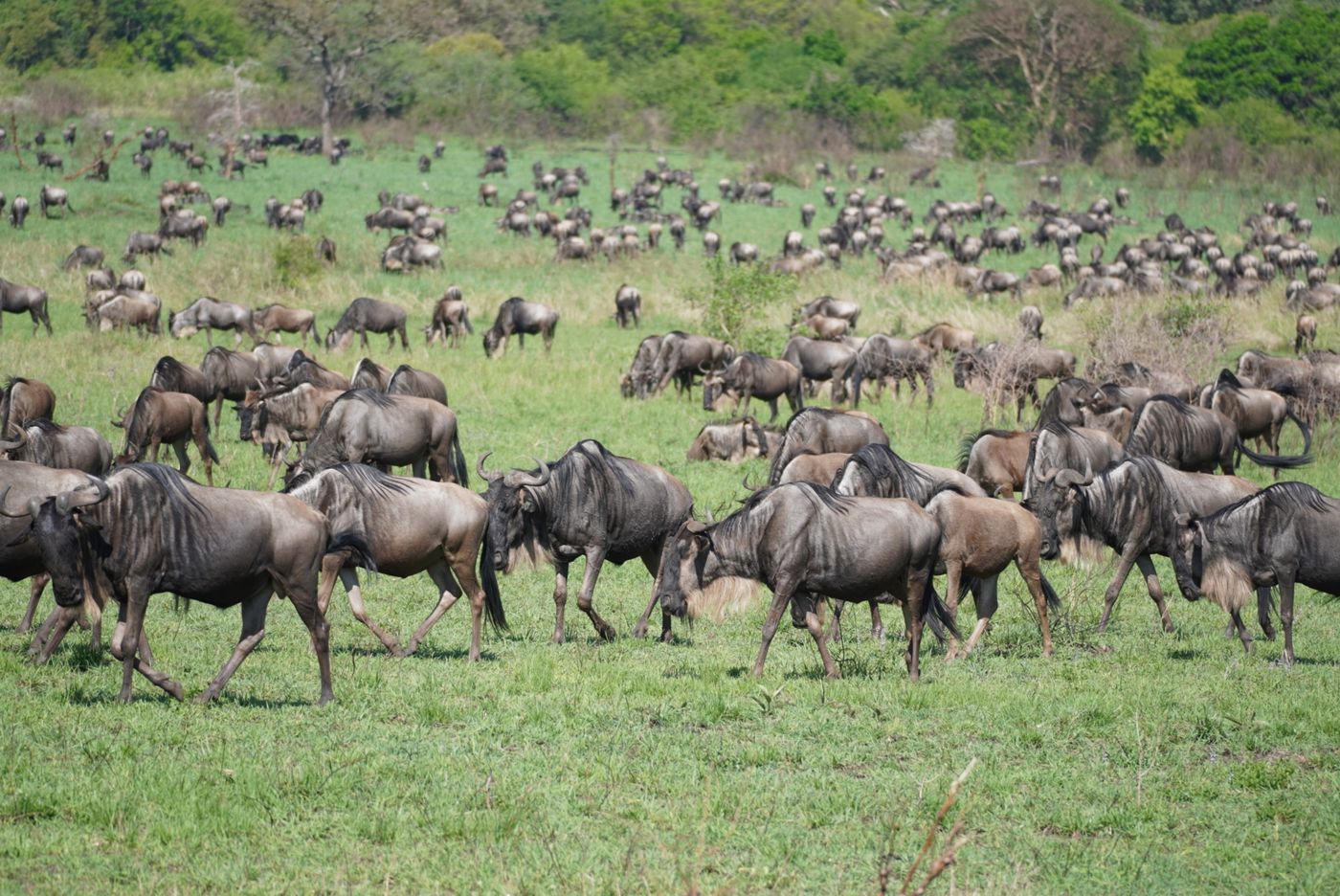
The Maasai Mara and the Serengeti are not two separate ecosystems that happen to be near each other — they're one continuous savanna landscape straddling the Kenya-Tanzania border, home to the single wildlife movement most people mean when they say "the Great Migration." Roughly two million wildebeest, zebra and gazelle move between the two countries across the year, spending the dry season (roughly July through October) concentrated in Kenya's Mara and the wetter months spread across Tanzania's much larger Serengeti plains. For travelers whose primary interest is witnessing the full scope of this ecosystem — rather than just one country's slice of it — combining the two makes genuine ecological sense, not just a box-ticking "visit two countries" exercise.
Beyond the Mara-Serengeti ecosystem specifically, Kenya and Tanzania each bring distinct strengths that complement rather than duplicate each other: Kenya's Amboseli offers the single best classic view of Mount Kilimanjaro anywhere in Africa (the mountain itself sits in Tanzania, but Amboseli's flat plains give it an unobstructed, iconic backdrop), while Tanzania's Ngorongoro Crater offers an extraordinarily dense, self-contained wildlife-viewing experience found nowhere in Kenya. Tanzania's Zanzibar archipelago adds a beach extension with a different character from Kenya's own coast (covered in full in our Kenya Safari & Beach Holidays guide, which does not cover Zanzibar). Put together, a well-planned combination gives travelers access to a noticeably broader range of landscapes and experiences than either country alone, which is exactly why this is one of the most consistently popular multi-country safari structures in East Africa.
How the border came to split one ecosystem
The Kenya-Tanzania border itself is a product of colonial-era boundary-setting rather than any ecological logic — it was fixed during the late nineteenth century as British and German colonial administrations divided their respective East African territories, with the line running straight through what is, ecologically, a single continuous Serengeti-Mara savanna ecosystem that had functioned as one landscape for the migratory herds long before any political boundary existed. Kenya's independence in 1963 and Tanzania's own path to independence (Tanganyika in 1961, later united with Zanzibar to form Tanzania in 1964) inherited this colonial-era border largely as drawn, meaning the wildlife migration that defines this entire region has crossed an international boundary, invisible to the animals themselves, for as long as the modern border has existed.
This history matters practically because it explains why the two countries manage their respective halves of the same ecosystem under entirely separate legal, fee and conservation frameworks despite the underlying landscape and wildlife populations being continuous — Kenya's Maasai Mara National Reserve is managed by Narok and Trans Mara county governments rather than Kenya Wildlife Service (a frequently misunderstood point we also cover in our Kenya safari cost guide), while Tanzania's Serengeti National Park falls under Tanzania National Parks Authority (TANAPA), a structurally different management system with its own separate fee schedule, regulations and conservation priorities. Understanding that you're crossing not just a border but two distinct management systems helps explain why park fees, permit rules and even some wildlife-viewing regulations (such as off-road driving policies) genuinely differ between the Mara and the Serengeti despite the shared ecosystem.
The real routing: no direct flights
This matters enormously for itinerary planning, because it rules out the simplest-sounding option (a quick 45-minute hop straight from a Mara camp to a Serengeti camp) and replaces it with two genuinely different, more involved alternatives, each covered in detail in the next two sections: a road crossing at one of two main border posts, or a flight routed through Nairobi and/or Kilimanjaro International Airport. Neither option is a dealbreaker — both are well-established, regularly used routings that thousands of travelers complete every year — but both take real planning, real time, and (in the case of the road crossing) a vehicle and driver-guide authorized to cross the border, which not every operator's standard vehicle and permit setup supports.
Border crossings in detail
Kenya and Tanzania share two border posts relevant to a standard safari routing, each serving a different combination of parks.
Isebania-Sirari
The border crossing relevant to a Maasai Mara-Serengeti combination, connecting southwestern Kenya to northern Tanzania. A Mara-to-Serengeti road transfer via this crossing typically runs four to six hours of driving (depending on which specific camps you're moving between) plus time for immigration formalities on both sides.
Namanga
The border crossing relevant to an Amboseli-Arusha/Ngorongoro/Serengeti combination, roughly on the direct road route between Nairobi and Arusha. This is the busier, more commonly used crossing of the two, since it sits on the main Nairobi-Arusha highway corridor used by both tourist and commercial traffic.
At either crossing, standard practice is a vehicle transfer with your driver-guide handling the immigration paperwork alongside you — passports are stamped out of one country and into the other at the same physical crossing point, and your safari operator should confirm in advance that your specific vehicle and driver-guide combination is licensed to cross between the two countries, since not every standard single-country vehicle and permit setup is. Border posts can experience queues, particularly at Namanga given its higher traffic volume, so building a buffer into a border-crossing day's schedule — rather than planning tight connections immediately before or after — is standard, sensible practice.
Flying between the two countries
For travelers who'd rather not spend the better part of a day on an overland transfer, the alternative is flying — but, as established above, this means routing through an international gateway airport rather than a direct bush-to-bush hop. The most common pattern connects through Nairobi's Jomo Kenyatta International Airport (JKIA) and Kilimanjaro International Airport (JRO), the gateway for Arusha, Ngorongoro and the Serengeti's northern reaches, with a range of scheduled regional carriers operating this specific route.
From within Kenya, a domestic or regional flight from Wilson Airport (Nairobi's dedicated light-aircraft hub) connects to Mara airstrips in roughly 45 minutes to an hour; from within Tanzania, flights from Arusha or Kilimanjaro connect to Serengeti airstrips on a similar timescale. The combination of a Mara flight, a JKIA-to-JRO connecting flight, and a Serengeti flight adds up to a full travel day, generally comparable in total time to the overland border crossing but trading road time for airport transfer and connection time instead.
Which option makes more sense depends on your priorities: the overland crossing lets you see the landscape and often cross directly through genuinely scenic countryside, while the flight routing is generally more comfortable for travelers prioritizing minimal road time, particularly on a tighter overall schedule where the time saved matters more than the overland experience itself.
Visas and entry requirements
This is one of the most commonly overlooked practical details in planning a Kenya-Tanzania combination: the East Africa Tourist Visa, a single visa covering multiple countries, applies to Kenya, Uganda and Rwanda — it does not include Tanzania. Tanzania maintains its own separate visa regime (an eVisa or visa-on-arrival depending on nationality), entirely independent of whatever visa arrangement covers the Kenya portion of your trip. Travelers combining Kenya and Tanzania need to apply for and hold both countries' entry documentation separately — this is a genuinely easy detail to miss if you've seen "East Africa Tourist Visa" marketed as a multi-country pass and assumed it covers every East African country rather than the specific three it actually does.
Practically, this means budgeting for two separate visa costs and two separate application or on-arrival processes, and confirming your specific nationality's requirements for both countries well before travel, since requirements and costs vary by passport and change periodically. See our Kenya travel guide for the fuller picture on Kenya's own entry requirements specifically.
The Mara-Serengeti combination
This is the single most popular Kenya-Tanzania combination, built around the fact that the Mara and Serengeti are one continuous ecosystem split by the Isebania-Sirari border post described above. The appeal is straightforward: rather than seeing only the portion of the Great Migration present in whichever single country you visit, a Mara-Serengeti combination lets you follow the migration's broader seasonal pattern — generally the Mara's dry-season concentration (July-October) paired with time in the Serengeti's own territory, whether that's the northern Serengeti during the same window or the central and southern plains during calving season (roughly January-March), depending on which specific Serengeti chapter of the migration story interests you most.
A typical Mara-Serengeti combination runs the Mara leg first (easier initial logistics from Nairobi) followed by the overland or flight transfer to the Serengeti, though the reverse order works equally well depending on your overall trip routing and international flight arrival point.
The Amboseli-Kilimanjaro-Ngorongoro combination
The second major combination pattern pairs Kenya's Amboseli National Park — famous for its unobstructed views of Mount Kilimanjaro's snow-capped peak, despite the mountain itself sitting across the border in Tanzania — with Tanzania's Ngorongoro Crater and the broader Arusha region, connected via the Namanga border crossing. This routing suits travelers prioritizing the Kilimanjaro photography opportunity (genuinely best from Amboseli's Kenyan side, not from within Tanzania itself, where the mountain's own foothills obscure the same classic wide-plains view) alongside Ngorongoro's exceptionally dense, self-contained crater wildlife-viewing experience, a genuinely different style of safari from either Amboseli's or the Mara/Serengeti's open-plains format.
This combination also integrates naturally with a Zanzibar beach extension afterward, since Kilimanjaro International Airport and the broader Arusha area sit on a direct routing toward Tanzania's coast, discussed next.
Adding Zanzibar
Tanzania's Zanzibar archipelago is a natural closing leg for a Kenya-Tanzania combined safari, reached via a short flight from Kilimanjaro, Arusha or the Serengeti's own airstrips rather than requiring a return to Nairobi first. Zanzibar's character — Stone Town's UNESCO World Heritage old quarter, spice plantation tours, and a genuinely different beach and reef environment from Kenya's own Diani-Watamu-Malindi coast — makes it a distinct, complementary addition rather than a duplicate of the Kenya coast extension covered in our Kenya Safari & Beach Holidays guide.
We treat "which coast to add, Kenya's or Zanzibar's" as a genuine, trip-specific choice rather than a default — Kenya's coast suits travelers wanting to stay within a single country's logistics after a Kenya-heavy safari, while Zanzibar suits travelers already routing through Tanzania for the Serengeti or Ngorongoro who want their beach extension to continue in the same country rather than flying back across the border.
Comparing the Mara and Serengeti sides
Travelers weighing how to split their time between the two sides of this single ecosystem benefit from understanding what each side does differently, beyond just "which country." The Mara's smaller size (roughly 1,510 km² of reserve and surrounding conservancies) concentrates wildlife into a more compact area, which during the dry-season migration peak produces an extraordinarily dense, easy-to-access wildlife-viewing experience — river-crossing drama at the Mara River is the single most iconic image associated with this entire ecosystem, and it happens on both the Kenyan and Tanzanian sides depending on exactly where the herds are at a given moment.
The Serengeti, at roughly 14,750 km², is vastly larger and supports a correspondingly broader range of experiences across the year — not just the dry-season concentration shared with the Mara, but also the calving season further south, and a genuinely different, less crowded feel in its central and western regions simply because of the greater total area available to spread visitors across.
Maasai Mara (Kenya)
Smaller, more concentrated, strongest July-October; includes private conservancies bordering the reserve with their own access privileges (night drives, off-road driving, walking safaris) not available inside the reserve itself.
Serengeti (Tanzania)
Much larger, supports year-round wildlife viewing across different regions; central and southern plains host calving season (Jan-Mar), while the north overlaps with the Mara's own peak season.
Neither side is objectively "better" — they're genuinely complementary halves of one ecosystem, which is precisely the argument for combining both rather than treating the choice as either/or.
Practical logistics across the border
A few practical details are worth planning around specifically for a cross-border trip, beyond the visa and vehicle-authorization points already covered above. Luggage on light-aircraft flights connecting to bush airstrips on either side of the border is typically restricted to soft-sided bags under a specific weight limit (commonly around 15kg per person, though this varies by carrier) — pack accordingly if your itinerary includes any flight segment, since a hard-sided suitcase or an overweight bag can genuinely cause problems at check-in for these smaller aircraft. Mobile connectivity also changes at the border: Kenyan SIM cards don't work in Tanzania and vice versa, so travelers wanting continuous connectivity across both legs typically either carry two local SIM cards, use an international roaming plan, or rely on camp and lodge WiFi where available (which is itself inconsistent at remote bush camps on both sides of the border).
Electrical outlets and plug types are consistent between Kenya and Tanzania (both use the same UK-style three-pin standard), so no adapter change is needed crossing the border specifically — only for travelers coming from outside East Africa in the first place. Time zones are also identical (both countries sit in East Africa Time, UTC+3), so a cross-border transfer introduces no jet lag or schedule-adjustment considerations of its own.
Best time to combine both countries
Timing a combined trip means reconciling two countries' own seasonal patterns rather than following a single calendar. Kenya's dry season (roughly June through October, detailed in full in our Kenya best time to visit guide) overlaps with the Mara's peak migration concentration and generally the most comfortable overland travel conditions for a border crossing. Tanzania's own dry season runs on a broadly similar June-to-October pattern for the northern Serengeti and Ngorongoro, which is exactly why this window is also the most popular (and most heavily booked) time for a combined Mara-Serengeti trip — book well ahead if targeting these months specifically.
Travelers prioritizing the Serengeti's calving season instead (roughly January-March, concentrated in the southern and central Serengeti rather than the area closest to the Kenya border) face a genuine timing trade-off: this window doesn't overlap with the Mara's own peak season, so a combined trip timed around Serengeti calving generally means a quieter, less migration-dense Mara leg, or restructuring the trip to prioritize Amboseli and Ngorongoro instead of the Mara specifically. There's no single "best" answer here — it depends entirely on which half of the migration story, or which combination of parks, matters most to your specific trip.
Sample itineraries for combining Kenya and Tanzania
Two realistic structures illustrate how these combinations typically come together in practice.
10-day Mara-Serengeti migration itinerary
Days 1-4: Maasai Mara, timed to the July-October dry season window. Day 5: overland transfer via Isebania-Sirari to the northern Serengeti (or a flight routing via Nairobi/Kilimanjaro, depending on preference). Days 6-9: Serengeti, with a possible side trip to Ngorongoro Crater. Day 10: fly out via Kilimanjaro International Airport, with an optional Zanzibar extension appended before the international flight home.
12-day Amboseli-Ngorongoro-Zanzibar itinerary
Days 1-3: Amboseli, for the classic Kilimanjaro backdrop and elephant herds. Day 4: overland transfer via Namanga to Arusha. Days 5-6: Ngorongoro Crater. Days 7-8: central Serengeti. Day 9: fly to Zanzibar via Kilimanjaro or Arusha. Days 10-12: Zanzibar beach time before departure.
14-day comprehensive Kenya-Tanzania itinerary
Days 1-3: Nairobi arrival and Amboseli, for the Kilimanjaro backdrop. Days 4-6: Maasai Mara, timed to peak migration season. Day 7: overland transfer via Isebania-Sirari to the northern Serengeti. Days 8-10: Serengeti, following the migration's current position. Days 11-12: Ngorongoro Crater. Day 13: fly to Zanzibar via Kilimanjaro. Day 14: Zanzibar beach day before departure.
Both shorter structures above are starting points, not fixed templates, and this longer 14-day version shows how the full combination scales when time allows — see our Kenya safari packages guide for how we typically scope and price a single-country Kenya itinerary, which a Tanzania leg or Zanzibar extension then builds onto.
What a combined trip costs
A Kenya-Tanzania combination generally costs more than either country alone, for reasons specific to crossing an international border mid-trip rather than simply "two countries costs double": you're budgeting for two separate visas, often two separate park-fee and conservation-fee structures, a cross-border transfer (whether a longer vehicle day or an additional flight segment), and in many cases two different operators' logistics coordinating a handover at the border or a connecting flight. See our Kenya safari cost guide for the detailed Kenya-side fee structure that forms the base of a combined trip's Kenya leg; the Tanzania leg adds its own comparable set of park and conservation fees on top, plus the cross-border transfer cost itself.
| Cost component | Typical added cost vs. single-country trip | Notes |
|---|---|---|
| Tanzania visa | Separate fee, varies by nationality | In addition to whatever covers your Kenya entry — not included in the East Africa Tourist Visa |
| Overland border transfer | One extra full vehicle day | Isebania-Sirari or Namanga, roughly 4-6 hours of driving plus formalities |
| Connecting flight routing | 1-2 extra flight segments | Alternative to the overland transfer — routed via Nairobi and/or Kilimanjaro |
| Tanzania park and conservation fees | Separate fee structure | Distinct from Kenya's KWS and county reserve fees — see our Kenya safari cost guide for the Kenya-side baseline |
Combining with gorilla trekking too
Some travelers go further and build a three-country trip — Kenya and Tanzania's savanna safari paired with gorilla trekking in Uganda or Rwanda. This is a genuinely different, more involved routing than the two-country Kenya-Tanzania combinations covered above, since it adds a further international border and a flight or road routing to the Virunga/Bwindi gorilla-trekking region. If a Kenya-plus-gorilla-trekking combination specifically (without the Tanzania leg) is what you're planning, our dedicated Uganda and Kenya Together guide covers that routing, visa and timing picture in full rather than duplicating it here. A genuine three-country Kenya-Tanzania-Uganda/Rwanda trip is possible but needs careful sequencing — we're glad to help map out a realistic version of this specific combination directly, since it's involved enough that a generic template doesn't serve it well.
Choosing your route
The right combination depends on what you most want from the trip. Travelers whose top priority is the Great Migration specifically should lead with the Mara-Serengeti combination, timed to whichever phase of the migration matters most. Travelers prioritizing the Kilimanjaro photography opportunity and a genuinely dense, compact wildlife-viewing experience should lead with Amboseli-Ngorongoro instead. Travelers wanting to close the trip with a beach extension should weigh Zanzibar (if routing naturally continues through Tanzania) against Kenya's own coast (if the trip is more Kenya-weighted overall) — see the Zanzibar section above and our Kenya coast guide for the comparison. We build each combined itinerary around these specific priorities rather than defaulting to one standard route for every traveler.
Choosing an operator for a cross-border trip
Not every safari operator is set up to handle a genuine cross-border itinerary well, and this is worth confirming directly before booking rather than assuming any operator capable of running a single-country Kenya or Tanzania safari can handle the combination equally smoothly. The specific things worth asking: whether the operator has its own licensed presence (or an established partner relationship) in both countries rather than just one, whether their vehicles and driver-guides are specifically authorized for the Isebania-Sirari or Namanga crossing if your itinerary includes an overland transfer, and how they handle the practical handover if two different country-based teams are managing your trip's two halves — ideally with a clear point of contact on each side and a confirmed plan for exactly where and how your luggage, documents and vehicle transfer happen at the border itself.
A genuinely experienced cross-border operator should be able to answer these questions specifically and confidently, with real detail about which border post they use for your particular route and why, rather than a vague assurance that "it's all taken care of." We build every Kenya-Tanzania combination with this level of specific routing detail mapped out from the start, precisely because the gaps in a poorly planned cross-border itinerary tend to show up at the worst possible moment — mid-transfer, at the border itself, rather than catchable in advance.
Health, safety and travel insurance for a combined trip
A cross-border itinerary adds a few specific considerations to the standard health and safety planning that applies to any East African safari. Travel insurance should explicitly cover activities and locations in both countries — most comprehensive policies do this automatically for a single trip regardless of how many countries it touches, but it's worth confirming directly with your insurer rather than assuming, particularly for coverage of medical evacuation, which matters more on a longer, more remote itinerary spanning two countries' bush areas. Medical evacuation coverage specifically should be confirmed to include both the Mara/Amboseli area and the Serengeti/Ngorongoro area, since evacuation logistics and the specific providers involved can differ by country even within the same comprehensive policy.
As noted earlier, malaria risk applies on both sides of the border, and current antimalarial guidance should be confirmed with a doctor or travel clinic covering both countries rather than assuming identical requirements. Altitude is a minor consideration for the Ngorongoro Crater rim specifically (sitting at roughly 2,200 meters), generally not significant enough to cause altitude sickness for most travelers but worth noting if you have a pre-existing condition sensitive to moderate elevation changes.
Packing for a cross-border trip
Beyond the soft-sided luggage requirement already noted for light-aircraft flight segments, a cross-border Kenya-Tanzania trip benefits from a few specific packing considerations. Neutral-colored safari clothing (khaki, olive, tan) works identically on both sides of the border — there's no meaningful difference in appropriate safari dress between Kenya and Tanzania, so a single packing list serves the whole trip rather than needing country-specific adjustments. Carry printed or easily accessible digital copies of both countries' visa confirmations, your yellow fever certificate if applicable, and your passport's photo page, since border crossings (whether by road or connecting flight) involve presenting documentation at each country's immigration point rather than a single check at your international arrival airport.
A small daypack for carrying passports, visa documents, cash in both currencies, and camera equipment during the border-crossing day itself is worth packing separately from your main luggage, particularly for an overland crossing where you'll be handling documents repeatedly at immigration windows on both sides of Isebania-Sirari or Namanga. Binoculars, a good camera with a capable zoom lens, and a basic first-aid kit are standard recommendations for either country's leg and don't need duplicating — one set serves the entire combined trip.
Common mistakes
- Expecting a direct flight between the Mara and the Serengeti. As established above, this doesn't exist — budget real time (and, for a road crossing, a full travel day) for the transfer, whichever routing you choose.
- Assuming the East Africa Tourist Visa covers Tanzania. It covers Kenya, Uganda and Rwanda only — Tanzania requires its own completely separate visa, applied for independently.
- Not confirming your vehicle is cross-border licensed. Not every standard safari vehicle and driver-guide setup is authorized to cross between Kenya and Tanzania — confirm this specifically if your itinerary includes an overland border crossing.
- Underestimating border-crossing time. Four to six hours of driving plus immigration formalities is a real chunk of a trip day — don't schedule tight activities immediately before or after a crossing.
- Timing the trip around only one country's migration calendar. The Mara's peak season and the Serengeti's calving season don't overlap — decide which half of the migration story matters most before locking in dates.
- Treating Zanzibar and Kenya's coast as interchangeable. They're genuinely different destinations in different countries with their own distinct character — choose based on which fits your overall routing and interests, not by default.
Ready to plan a Kenya-Tanzania combination?
We'll build a realistic cross-border itinerary around your priorities — the Great Migration, Kilimanjaro views, Ngorongoro's crater, or a Zanzibar close — with the actual routing, visas and border logistics mapped out from the start.
Start planningPlan combining Kenya and Tanzania
Keep planning with our Kenya safari destination guide and Kenya & Tanzania Honeymoon Safari. National park fees are set by the Kenya Wildlife Service, and Magical Kenya, the Kenya Tourism Board, publishes official visitor information. Park fees are set by Tanzania National Parks (TANAPA) and, for the crater, the Ngorongoro Conservation Area Authority. We confirm the current fees for your dates in every quote.
Frequently asked questions
Is there a direct flight between the Maasai Mara and the Serengeti?
No — this is a common misconception. No scheduled direct flight connects any Kenya bush airstrip to any Tanzania bush airstrip. Realistic routings go either overland through the Isebania-Sirari border post, or by air via an international gateway airport such as Nairobi and Kilimanjaro.
How do you get from the Maasai Mara to the Serengeti?
Either an overland transfer via the Isebania-Sirari border crossing (typically four to six hours of driving plus immigration formalities), or by flying via an international gateway — most commonly a Mara-to-Nairobi flight, a Nairobi-to-Kilimanjaro connection, and a Kilimanjaro-to-Serengeti flight.
Does the East Africa Tourist Visa cover Tanzania?
No — the East Africa Tourist Visa covers Kenya, Uganda and Rwanda only. Tanzania requires its own completely separate visa (an eVisa or visa-on-arrival depending on nationality), applied for independently of whatever covers the Kenya portion of your trip.
How long does the Namanga border crossing take?
Crossing time varies with border traffic, but budget meaningful time for immigration formalities on both sides in addition to the drive itself — Namanga is the busier of Kenya's two main tourist border crossings with Tanzania, given its position on the main Nairobi-Arusha highway.
Which border crossing do you use for Amboseli to Ngorongoro?
Namanga, the border post on the direct road route between Nairobi/Amboseli and Arusha, which is itself the gateway town for Ngorongoro Crater and the Serengeti's northern approach.
Can you combine the Maasai Mara and Serengeti in one trip?
Yes, and it's one of the most popular combinations in East African travel, since the two parks are ecologically one continuous ecosystem split by the political border — see our Mara-Serengeti section above for routing and timing detail.
How many days do you need for a Kenya-Tanzania combined safari?
Most well-paced combinations run seven to fourteen days total, depending on how many parks on each side of the border you want to include and whether a Zanzibar or Kenya coast extension is appended at the end.
Is it better to start in Kenya or Tanzania?
Either order works — the more relevant factor is usually your international flight's arrival point (Nairobi vs. Kilimanjaro International Airport) and whichever park's peak season aligns best with your travel dates.
What's the best time to see the Great Migration across both countries?
Roughly July through October for the Mara's dry-season concentration, which also generally overlaps well with the northern Serengeti; the Serengeti's own calving season (January-March) happens separately in the central and southern plains and doesn't align with the Mara's peak window.
Can you see Mount Kilimanjaro from Kenya?
Yes — Amboseli National Park in Kenya offers the single best classic, unobstructed view of Kilimanjaro's snow-capped peak anywhere in Africa, despite the mountain itself sitting across the border in Tanzania.
Is Ngorongoro Crater in Kenya or Tanzania?
Tanzania — it sits in the Ngorongoro Conservation Area near Arusha, reached from Kenya via the Namanga border crossing as part of an Amboseli-Ngorongoro combination.
Should I add Zanzibar or Kenya's coast to a combined safari?
It depends on your overall routing: Zanzibar suits a trip that's already routing through Tanzania (Serengeti, Ngorongoro, Kilimanjaro) since it's reached directly from there without a return to Nairobi, while Kenya's own coast suits a more Kenya-weighted trip — see our Zanzibar section above and our Kenya coast guide for the fuller comparison.
Is a Kenya-Tanzania combined safari more expensive than a single-country trip?
Generally yes, since it adds a second country's visa and park-fee structure plus a cross-border transfer cost — see our cost section above and our Kenya safari cost guide for the Kenya-side baseline that a Tanzania leg builds onto.
Can any safari vehicle cross the Kenya-Tanzania border?
No — not every standard single-country safari vehicle and driver-guide setup is licensed for cross-border transfers. Confirm this specifically with your operator if your itinerary includes an overland border crossing.
Do you need separate travel insurance for Kenya and Tanzania?
Most travel insurance policies cover multi-country trips under one policy rather than requiring separate coverage per country, but confirm your specific policy explicitly lists both countries and any activities (game drives, flights, border crossings) you'll be doing in each.
What currency do you need for a Kenya-Tanzania combined trip?
Kenyan shillings for the Kenya leg and Tanzanian shillings for the Tanzania leg — many tourism-facing businesses in both countries also accept US dollars, but carrying or accessing both local currencies (via ATM or exchange) is the more reliable approach for smaller, everyday purchases.
Is it safe to cross the Kenya-Tanzania border by road?
Yes — both Namanga and Isebania-Sirari are well-established, heavily used tourist and commercial border crossings with routine immigration processing; standard travel precautions apply as they would at any international border crossing.
Can you fly directly from Nairobi to the Serengeti?
Not directly in the sense of a single nonstop flight to a Serengeti airstrip — the realistic routing connects through Kilimanjaro International Airport or Arusha first, then a shorter regional flight on to a specific Serengeti airstrip.
What's the difference between the northern and southern Serengeti for a combined trip?
The northern Serengeti sits closest to the Kenya border and the Mara, and overlaps best with the Mara's own July-October peak season; the southern and central Serengeti are better aligned with the January-March calving season and sit further from a Kenya-side routing.
Does combining Kenya and Tanzania mean two separate safari operators?
Not necessarily — some operators coordinate both legs directly, including the cross-border transfer; others hand off between a Kenya-based and Tanzania-based operator at the border or airport. Either approach can work well, but confirm explicitly how your specific trip is structured before booking.
How far in advance should you book a combined Mara-Serengeti safari during peak season?
Well in advance — the July-October window is the most heavily booked time for both the Mara and the Serengeti simultaneously, and camps on both sides of the border fill up accordingly for this overlapping peak period.
Can you visit Amboseli and the Maasai Mara and the Serengeti all in one trip?
Yes, though it's a longer, more involved itinerary combining the Namanga crossing (or a Nairobi-area routing) for Amboseli with an additional Mara-Serengeti leg — realistic for a two-week-plus trip rather than a shorter one-week visit.
Is the Serengeti bigger than the Maasai Mara?
Yes, substantially — the Serengeti covers roughly 14,750 km², many times the Maasai Mara's approximately 1,510 km², though the Mara's smaller size concentrates wildlife viewing more densely during the migration's dry-season peak.
What language is spoken on both sides of the Kenya-Tanzania border?
Swahili and English are both official languages in Kenya and Tanzania, so language is not a meaningful barrier when crossing between the two countries, though regional dialects and usage patterns vary somewhat.
Do Kenya and Tanzania use the same mobile money system?
No — Kenya's dominant mobile money platform is M-Pesa, while Tanzania has its own separate mobile money providers; a Kenyan M-Pesa account doesn't automatically work for payments inside Tanzania, so plan on separate cash, card or local mobile money arrangements for each country's leg.
Is malaria a risk on both sides of the border?
Yes — both the Kenya and Tanzania legs of a combined safari sit within malaria risk areas, so confirm antimalarial guidance with a doctor or travel clinic that covers both countries before departure.
Can first-time safari travelers do a Kenya-Tanzania combination?
Yes — it's a well-established, heavily traveled route and not meaningfully more complicated for a first-timer than a single-country trip, provided the visa, border-crossing and timing details covered in this guide are planned for in advance rather than assumed.
What's the single best Kenya-Tanzania combination for a first trip?
For most first-time travelers, the Mara-Serengeti combination timed to the July-October dry season offers the clearest, most straightforward introduction to both countries' flagship migration experience in one well-paced trip.
Does this guide cover combining Kenya with Uganda or Rwanda instead?
No — this guide covers Kenya and Tanzania specifically. For combining a Kenya safari with gorilla trekking in Uganda or Rwanda, see our dedicated Uganda and Kenya Together guide.
What's the difference between the Isebania-Sirari and Namanga border crossings?
Isebania-Sirari connects southwestern Kenya to northern Tanzania and serves a Mara-to-Serengeti routing; Namanga sits on the main Nairobi-Arusha highway and serves an Amboseli-to-Arusha/Ngorongoro/Serengeti routing. They serve different combinations of parks and aren't interchangeable for route planning.
How much luggage can you bring on a light-aircraft flight between parks?
Typically around 15kg per person in a soft-sided bag, though exact limits vary by carrier — confirm your specific flight's weight and bag-type restrictions in advance if your itinerary includes any light-aircraft segment on either side of the border.
Do Kenya and Tanzania use the same electrical outlets?
Yes — both countries use the same UK-style three-pin plug standard, so no adapter change is needed specifically for crossing the border, only for travelers arriving from outside East Africa in the first place.
Are Kenya and Tanzania in the same time zone?
Yes — both countries sit in East Africa Time (UTC+3), so a cross-border transfer introduces no time-zone adjustment or jet lag of its own.
Can you use Kenyan shillings in Tanzania or vice versa?
Generally no for everyday transactions — each country uses its own currency (Kenyan shillings and Tanzanian shillings respectively), though many tourism-facing businesses in both countries also accept US dollars as an alternative.
Is the Mara River crossing visible from both the Kenya and Tanzania sides?
The Mara River itself flows through both the Maasai Mara and into the Serengeti's northern reaches, and dramatic crossings can occur on either side depending on exactly where the herds are at a given time — neither side guarantees a crossing on any specific day, since herd movement and river-crossing behavior aren't fully predictable.
How big is the Serengeti compared to the Maasai Mara?
The Serengeti covers roughly 14,750 km², close to ten times the Maasai Mara's approximately 1,510 km² — a significant size difference that shapes how wildlife is distributed and how crowded each park feels at any given time.
Do you need a yellow fever vaccination for Tanzania if arriving from Kenya?
Requirements vary by individual circumstances and current health guidance, and can depend on your routing and layovers — confirm current yellow fever and other vaccination requirements for both countries with a doctor or travel clinic well before departure, consistent with the health guidance in our Kenya travel guide.
Is the Tanzania side of this combination the Serengeti specifically, or can it include other parks?
The Serengeti and Ngorongoro Crater are the two most commonly combined Tanzania parks on a Kenya-Tanzania itinerary, since both sit on the Arusha-area routing reachable via Namanga or Kilimanjaro International Airport — Tanzania's other major parks (Tarangire, Lake Manyara, the southern circuit) can be added too, but that moves toward a longer, more Tanzania-weighted trip than the standard combination covered in this guide.
Does combining Kenya and Tanzania require more vaccinations than visiting just one country?
Not inherently — the core recommended vaccinations for East African travel (routine vaccines, hepatitis A, typhoid, and yellow fever where applicable) broadly overlap between Kenya and Tanzania, but confirm your specific requirements with a doctor or travel clinic covering both countries' current guidance rather than assuming identical requirements.
Can you do a Kenya-Tanzania combination on a budget safari?
Yes, though budget considerations apply on both sides of the border independently — camp and lodge pricing, vehicle types and park fee structures all vary by country and by property tier, so a combined trip's overall cost reflects both countries' own pricing rather than a single blended rate.
What's the closest international airport to the Serengeti?
Kilimanjaro International Airport (JRO), near Arusha, is the standard international gateway for the Serengeti, Ngorongoro and the broader northern Tanzania safari circuit, reached by a further short regional flight or road transfer to the specific park.
Is Nairobi or Kilimanjaro International Airport the better arrival point for a combined trip?
It depends on which country's leg you're starting with — Nairobi (JKIA) suits a Kenya-first routing beginning with the Mara or Amboseli, while Kilimanjaro International Airport suits a Tanzania-first routing beginning with the Serengeti or Ngorongoro. Either works well; the choice follows your overall itinerary sequencing rather than one being objectively better.
Do lodges and camps on both sides of the border accept credit cards?
Most established lodges and camps in both countries accept major credit cards, though remote bush camps can have inconsistent connectivity for card processing — carrying some cash (in the relevant local currency or US dollars) as a backup is standard practice on both sides of the border.
Is drinking water safe on both the Kenya and Tanzania legs of a trip?
As with most of East Africa, bottled or filtered water is the standard recommendation rather than tap water on both sides of the border — most lodges and camps in both countries provide bottled or filtered water as a matter of course.
Who manages the Maasai Mara, and who manages the Serengeti?
The Maasai Mara National Reserve is managed by Narok and Trans Mara county governments, not Kenya Wildlife Service, while the Serengeti National Park falls under Tanzania National Parks Authority (TANAPA) — two structurally different management systems with their own separate fee schedules and regulations, despite the shared underlying ecosystem.
Why do Kenya and Tanzania have different safari regulations if it's one ecosystem?
Because the Kenya-Tanzania border was fixed during colonial-era boundary-setting rather than along any ecological line, splitting one continuous Serengeti-Mara ecosystem between two countries that each inherited and developed their own separate park management, fee and conservation systems after independence.
Do you need different safari clothing for Kenya versus Tanzania?
No — neutral-colored safari clothing (khaki, olive, tan) works identically on both sides of the border, so a single packing list serves the entire combined trip without needing country-specific adjustments.
What documents do you need at the border crossing itself?
Your passport, both countries' visa confirmations (printed or easily accessible digitally), and your yellow fever certificate if applicable — a small daypack kept separate from your main luggage makes these easy to access repeatedly at immigration windows on both sides of the crossing.
Can you combine Kenya and Tanzania with just a one-week trip?
It's possible but tight — a one-week trip generally works better focused on a single country, or a very streamlined two-park combination (such as the Mara plus a short Serengeti add-on) rather than trying to cover both countries' full range of highlights in such a short window.
Is off-road driving allowed in both the Maasai Mara and the Serengeti?
Regulations differ by specific area — Mara conservancies bordering the main reserve generally permit off-road driving and night drives (privileges the reserve itself doesn't allow), while Serengeti regulations vary by zone under TANAPA's own rules; confirm current specifics for your exact camps and planned activities with your operator.
Does a Kenya-Tanzania combination work well for a honeymoon?
Yes — many honeymooning couples choose exactly this combination specifically to pair the Mara-Serengeti migration experience with a closing Zanzibar beach extension, giving the trip both an adventure component and a relaxed, romantic finish in one well-sequenced itinerary.
How far is Nairobi from the Tanzania border?
Roughly 165 km (about 100 miles) from Nairobi to the Namanga border crossing by road, generally a two-to-three-hour drive before any further time crossing the border itself and continuing on toward Arusha.
Can you see the Great Migration from both the Kenya and Tanzania sides in the same trip?
Yes — this is exactly what the Mara-Serengeti combination is built around, following the migration's broader seasonal pattern across both countries rather than viewing only the portion visible from a single-country itinerary.
Does one safari operator typically handle the whole Kenya-Tanzania trip, or two?
Both models exist — some operators maintain their own licensed presence or established partnerships in both countries and manage the full trip directly, while others hand off between a Kenya-based and Tanzania-based team at the border or airport. Confirm which model your operator uses and how the handover is coordinated before booking.
Does travel insurance automatically cover a multi-country East African trip?
Most comprehensive policies cover a single trip regardless of how many countries it touches, but confirm this explicitly with your insurer, particularly for medical evacuation coverage spanning both the Kenya and Tanzania legs of your specific itinerary.
Is altitude a concern anywhere on a Kenya-Tanzania combined trip?
Only mildly, at the Ngorongoro Crater rim (roughly 2,200 meters) — generally not significant for most travelers, but worth noting if you have a pre-existing condition sensitive to moderate elevation changes.
What should you ask a safari operator before booking a cross-border trip?
Whether they have a genuine licensed presence or established partner in both countries, whether their vehicles and driver-guides are specifically authorized for your planned border crossing, and exactly how the handover between the two countries' legs of your trip is coordinated — a confident, specific answer to all three is a good sign of real cross-border experience.
Can you bring a drone on a Kenya-Tanzania combined safari?
Drone regulations are strict and vary by country and by specific park — both Kenya and Tanzania generally require special permits for drone use in national parks and reserves, and unauthorized drone flights are commonly prohibited outright, so confirm current rules for both countries' specific parks on your itinerary well before travel if this matters to you.
Is there a cell signal at the border crossings themselves?
Coverage varies and isn't guaranteed at either border post — Kenyan SIM coverage typically fades as you approach the Tanzania side and vice versa, so don't rely on continuous connectivity during the crossing itself, even if coverage is generally good at camps and lodges on both sides.
What's the best way to carry cash for a combined Kenya-Tanzania trip?
A mix of both countries' local currency (obtained via ATM or exchange after arrival in each country) plus a reserve of US dollars in good condition accepted widely by tourism-facing businesses in both countries — avoid relying on a single currency or exclusively on cards, given inconsistent connectivity for card processing at remote bush camps.
Do children need separate documentation for a Kenya-Tanzania combined trip?
Yes — children need their own passports and, depending on nationality and age, may need additional documentation (such as consent letters for travel without both parents) for crossing international borders; confirm specific requirements for both countries well in advance if traveling with children.
Is a Kenya-Tanzania combination a good fit for a family safari?
It can be, though the added border-crossing logistics and longer overall trip length are worth weighing against a single-country family itinerary — see our Kenya Family Safaris guide for family-specific planning considerations that apply to the Kenya leg of a combined trip.
Can you fly a light aircraft with a pet or service animal between Kenya and Tanzania?
This is a highly specialized logistical question involving both countries' import and transit regulations for animals, well outside a standard safari booking — if this applies to your trip, raise it directly with us and with both countries' relevant authorities well in advance, since standard safari logistics don't cover this scenario.
Does the order you visit Kenya and Tanzania in affect the cost?
Not meaningfully by itself — cost is driven primarily by which specific parks, camps and property tiers you choose on each side, the season you travel in, and the border-crossing method, rather than by which country you visit first.
Can you extend a Kenya-Tanzania combination with a Rwanda or Uganda gorilla-trekking leg?
Yes, though as noted in our gorilla-trekking section above, this becomes a genuine three-country trip requiring careful sequencing — we're glad to help map out a realistic version of this specific combination directly rather than following a generic two-country template.
What's the single most important thing to get right when planning a Kenya-Tanzania combination?
Getting the border-crossing routing and timing right — confirming whether you're crossing overland or flying via an international gateway, building adequate time around it, and securing both countries' visas separately well in advance — since these logistics, more than any single park choice, determine how smoothly the rest of the trip comes together.
Planning more than one country?
Planning a trip across more than one country? These guides answer the questions that come up next.
- every route, visa rule and package in one place: every route, visa rule and package in one place.
- the full four country route: the full four country route.
- how long a multi-country trip needs: how long a multi-country trip needs.
- how to move between the countries: how to move between the countries.
- one visa for three countries: one visa for three countries.
See also: Kenya & Tanzania Luxury Private-Guide Safari.